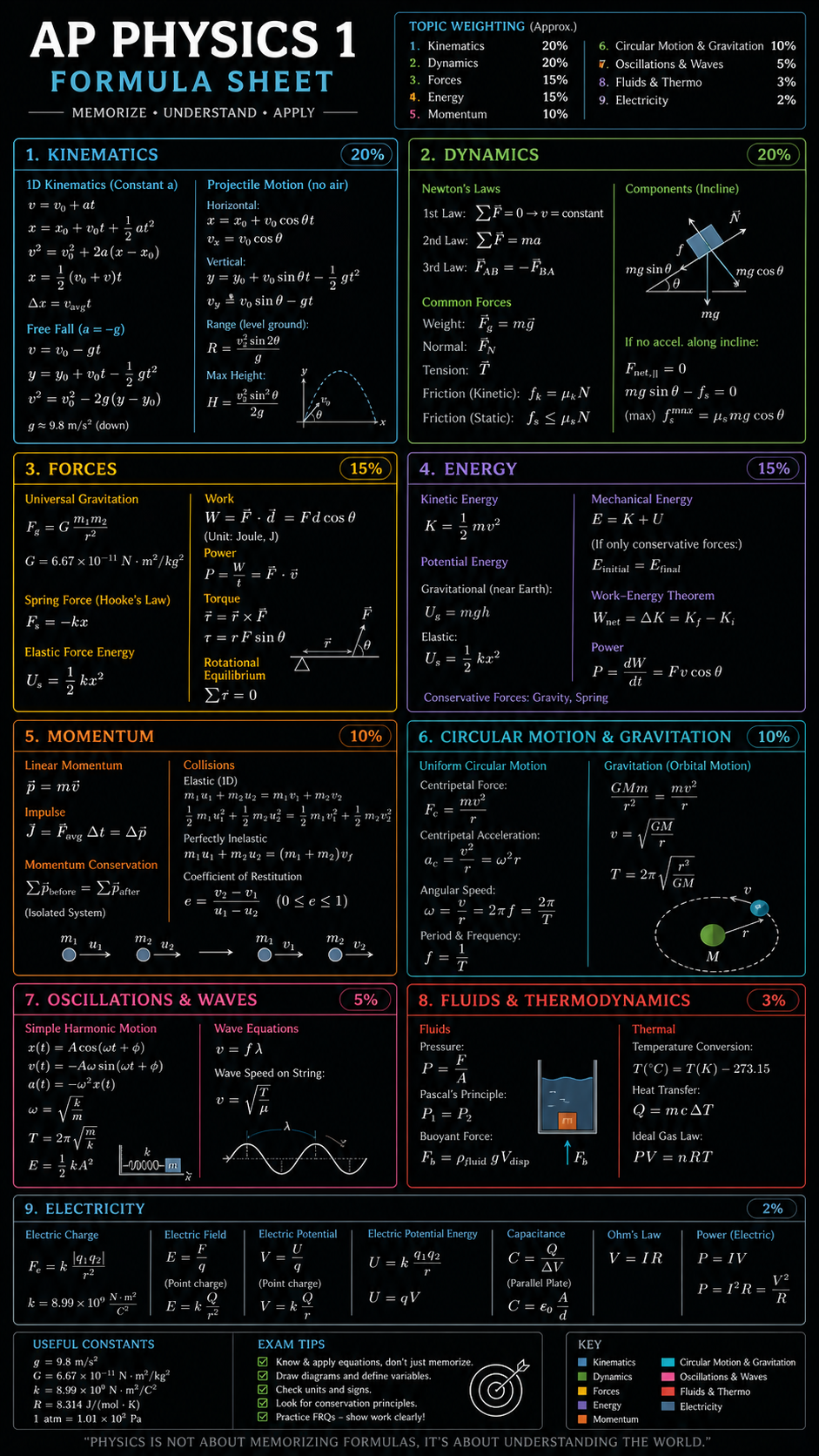
1. Kinematics (Motion Basics)
$$v = \frac{\Delta x}{\Delta t}, \quad a = \frac{\Delta v}{\Delta t}$$
$$v = v_0 + at$$
$$x = x_0 + v_0 t + \frac{1}{2}at^2$$
When it appears:
- Motion problems (constant acceleration)
- Graph interpretation (position, velocity, acceleration)
👉 Focus on relationships between graphs
2. Newton’s Second Law
$$\sum F = ma$$
When it appears:
- Free-body diagram problems
- Almost every unit in the course
👉 Always draw a free-body diagram first
3. Friction
$$f_s \leq \mu_s N$$
$$f_k = \mu_k N$$
When it appears:
- Inclined plane problems
- Objects at rest vs moving
4. Work and Energy
$$W = Fd \cos \theta$$
$$K = \frac{1}{2}mv^2$$
$$U_g = mgh$$
When it appears:
- Energy conservation
- Situations with multiple forces
5. Work-Energy Theorem
$$W_{net} = \Delta K$$
When it appears:
- When force analysis is complicated
- Alternative to Newton’s Laws
6. Momentum
$$\sum p_{initial} = \sum p_{final}$$
When it appears:
- Collisions
- Explosions
7. Impulse
$$J = F \Delta t = \Delta p$$
When it appears:
- Force vs time graphs
- Conceptual questions
8. Circular Motion
$$a_c = \frac{v^2}{r}$$
$$F_c = \frac{mv^2}{r}$$
When it appears:
- Objects moving in circles
- Often combined with Newton’s Laws
9. Torque and Rotation
$$\tau = rF \sin \theta$$
$$\sum \tau = 0 \quad (\text{equilibrium})$$
When it appears:
- Rotational equilibrium
- Balancing forces
10. Rotational Energy
$$K_{rot} = \frac{1}{2} I \omega^2$$
When it appears:
- Rolling motion
- Energy problems involving rotation
11. Simple Harmonic Motion (SHM)
$$T = 2\pi \sqrt{\frac{m}{k}}$$
$$T = 2\pi \sqrt{\frac{L}{g}}$$
When it appears:
- Springs and pendulums
- Period calculations
12. Waves
$$v = f \lambda$$
When it appears:
- Wave motion
- Frequency and wavelength relationships
Final Strategy for the Exam
- Focus on:
- Newton’s Laws
- Energy methods
- Momentum
- Always:
- Draw diagrams
- Explain reasoning clearly
- Interpret graphs
Pro Tip
Top scorers:
✔ Focus on conceptual understanding (not just formulas)
✔ Explain answers clearly in FRQs
✔ Connect equations to real physical meaning
This guide helps you quickly identify which formula to apply under exam pressure.