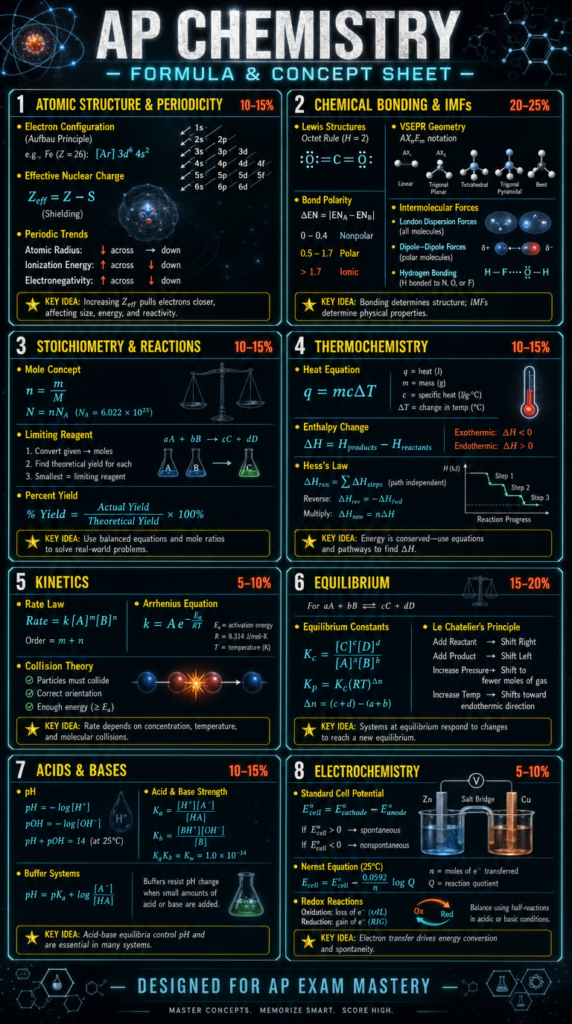
1. Atomic Structure & Properties
Key Concepts
- Electron configuration
- Periodic trends (atomic radius, ionization energy, electronegativity)
- Effective nuclear charge
When it appears:
- Multiple-choice conceptual questions
- Explaining trends across a period or group
👉 You must explain WHY trends occur, not just memorize them.
2. Molecular & Ionic Compound Structure
Key Concepts
- Lewis structures
- Formal charge
- Resonance
- VSEPR geometry
When it appears:
- Drawing structures
- Predicting molecular shape and polarity
👉 Geometry + polarity questions are very common
3. Intermolecular Forces & Properties
Key Concepts
- Hydrogen bonding
- Dipole-dipole interactions
- London dispersion forces
When it appears:
- Comparing boiling points
- Explaining physical properties
👉 Strong conceptual reasoning required
4. Chemical Reactions & Stoichiometry
Key Concepts
- Balancing equations
- Limiting reagent
- Percent yield
When it appears:
- Calculation-heavy MCQs
- FRQs involving reaction setup
👉 Always track units and mole relationships
5. Thermodynamics (Very High Frequency)
Key Concepts
- Enthalpy (ΔH)
- Calorimetry
- Hess’s Law
When it appears:
- Energy changes in reactions
- FRQs involving heat transfer
👉 One of the most heavily tested units
6. Kinetics
Key Concepts
- Rate laws
- Reaction order
- Activation energy
When it appears:
- Graph interpretation
- Experimental data analysis
👉 Be comfortable extracting information from tables and graphs
7. Chemical Equilibrium (Core Unit)
Key Concepts
- Equilibrium constant (K)
- Reaction quotient (Q)
- Le Chatelier’s Principle
When it appears:
- Predicting system shifts
- Writing equilibrium expressions
👉 Frequently tested in both MCQ and FRQ
8. Acids and Bases (Very High Frequency)
Key Concepts
- pH and pOH
- Strong vs weak acids
- Buffers and titration
When it appears:
- Calculations (pH, Ka, Kb)
- Titration curves
👉 Expect at least one major FRQ
9. Electrochemistry
Key Concepts
- Redox reactions
- Galvanic vs electrolytic cells
- Cell potential
When it appears:
- Identifying oxidation/reduction
- Calculating voltage
10. Experimental Design & Data Analysis
Key Skills
- Interpreting lab results
- Identifying sources of error
- Designing experiments
When it appears:
- FRQs with tables, graphs, or procedures
👉 This is where many students lose points
Final Strategy for the Exam
Focus on these high-weight areas:
- Thermodynamics
- Equilibrium
- Acids & Bases
Always:
- Show units
- Justify answers clearly
- Interpret data, not just calculate
Pro Tip
Top scorers:
✔ Understand concepts deeply (not just formulas)
✔ Connect multiple units in one problem
✔ Explain reasoning clearly in FRQs
Final Takeaway
AP Chemistry is not about memorizing facts—it’s about:
👉 explaining chemical behavior using models, data, and reasoning
This guide is designed to help you quickly identify what matters most under exam pressure.