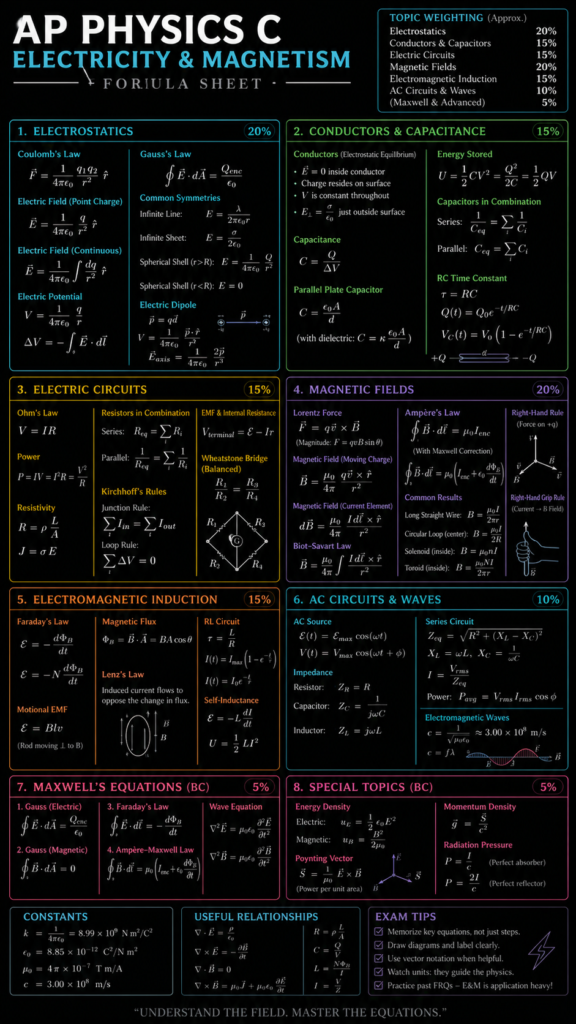
🔹 1. Coulomb’s Law (Electric Force)
When it appears:
- Force between point charges
- Superposition problems
👉 Always consider direction and sign
🔹 2. Electric Field
$$E = \frac{F}{q}$$
$$E = k \frac{q}{r^2}$$
When it appears:
- Field due to point charges
- Conceptual questions (field vs force)
🔹 3. Electric Potential
$$V = k \frac{q}{r}$$
$$\Delta V = – \int \vec{E} \cdot d\vec{r}$$
When it appears:
- Potential energy problems
- Relation between field and potential
🔹 4. Gauss’s Law (High-Level Concept)
$$\oint \vec{E} \cdot d\vec{A} = \frac{Q_{\text{enc}}}{\varepsilon_0}$$
When it appears:
- Symmetry-based problems
- Spheres, cylinders, planes
👉 Focus on choosing the correct Gaussian surface
🔹 5. Capacitance
$$C = \frac{Q}{V}$$
$$C = \varepsilon_0 \frac{A}{d}$$
When it appears:
- Parallel plate capacitors
- Energy storage
🔹 6. Energy in a Capacitor
$$U = \frac{1}{2}CV^2$$
When it appears:
- Stored energy problems
- Charging/discharging situations
🔹 7. Ohm’s Law
When it appears:
- Circuit analysis
- Almost every circuits question
🔹 8. Kirchhoff’s Rules
- Junction Rule
- Loop Rule
When it appears:
- Multi-loop circuits
- FRQs with complex diagrams
🔹 9. Magnetic Force
$$F = qvB \sin \theta$$
$$F = ILB \sin \theta$$
When it appears:
- Charges in magnetic fields
- Current-carrying wires
🔹 10. Magnetic Field (Current Source)
$$B = \frac{\mu_0 I}{2\pi r}$$
When it appears:
- Long straight wire problems
- Field direction (right-hand rule)
🔹 11. Magnetic Flux
$$\Phi_B = BA \cos \theta$$
When it appears:
- Induction problems
- Changing magnetic fields
🔹 12. Faraday’s Law (Induction)
$$\mathcal{E} = -\frac{d\Phi_B}{dt}$$
When it appears:
- Induced current
- Changing flux situations
👉 Don’t forget Lenz’s Law (direction!)
🎯 Final Strategy for the Exam
- Focus on:
- Electric fields & Gauss’s Law
- Circuits (Ohm + Kirchhoff)
- Induction
- Always:
- Draw diagrams
- Track direction/signs
- Use symmetry when possible
🚀 Pro Tip
Top scorers:
✔ Think in fields, not just forces
✔ Use symmetry to simplify problems
✔ Clearly explain reasoning in FRQs
This guide helps you quickly decide which equation to apply under exam pressure.