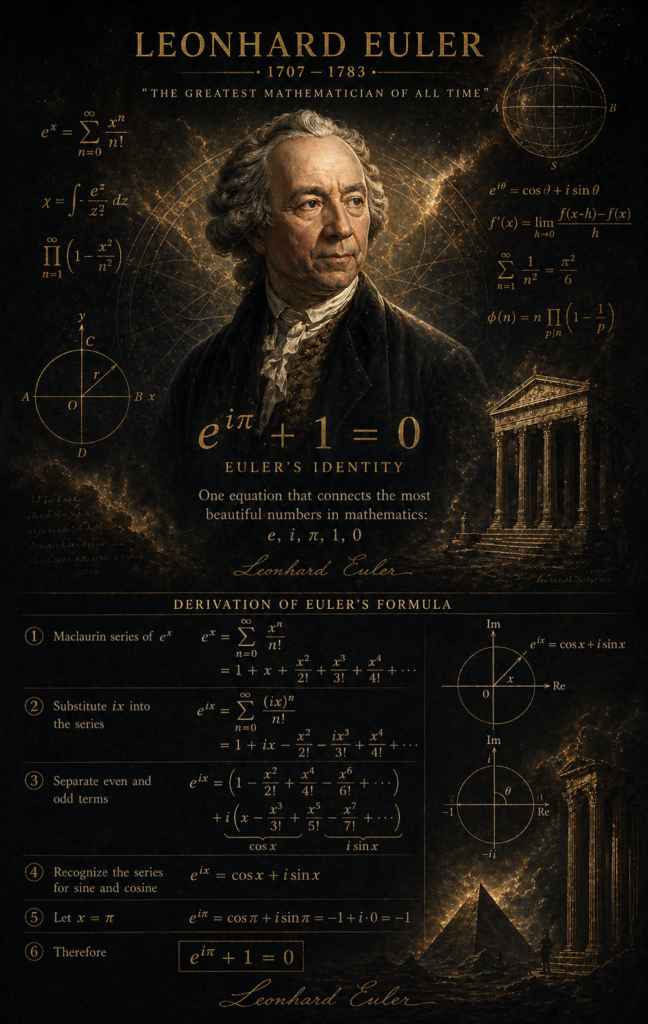
“Mathematics reveals its deepest beauty when seemingly unrelated ideas become one.”
Among all mathematical formulas, Euler’s Formula is often regarded as the most beautiful. It elegantly connects exponential functions, imaginary numbers, trigonometry, geometry, and some of the most fundamental mathematical constants into a single equation.
The Formula
When we substitute θ = π, Euler’s Formula becomes
\(e^{i\pi}+1=0\)
This equation is known as Euler’s Identity, and it is frequently called “the most beautiful equation in mathematics.”
Why Is Euler’s Formula So Beautiful?
Euler’s Formula combines five of the most important mathematical constants:
| Constant | Meaning |
|---|---|
| (e) | Euler’s number, the base of natural logarithms |
| (i) | The imaginary unit, where (i^2=-1) |
| (\pi) | The ratio of a circle’s circumference to its diameter |
| (1) | The multiplicative identity |
| (0) | The additive identity |
These constants arise from completely different areas of mathematics, yet Euler’s Identity connects them with only three basic operations:
- addition
- multiplication
- exponentiation
Very few equations in mathematics are this concise and this profound.
Understanding the Idea Behind Euler’s Formula
Imagine a point moving around the unit circle.
Every point on the unit circle has coordinates
\((\cos\theta,;\sin\theta)\)
In the complex plane, we write the same point as
\(\cos\theta+i\sin\theta\)
Euler’s Formula tells us that multiplying by
\(e^{i\theta}\)
is exactly the same as rotating a point by an angle (\theta).
This remarkable connection transforms complex exponentials into simple geometric rotations.
A Derivation Using Taylor Series
One elegant derivation begins with the Taylor series expansions.
Step 1. Expand the exponential function
\(e^x=1+x+\frac{x^2}{2!}+\frac{x^3}{3!}+\frac{x^4}{4!}+\cdots\)
Replace (x) with (i\theta):
\(e^{i\theta}=1+i\theta+\frac{(i\theta)^2}{2!}+\frac{(i\theta)^3}{3!}+\frac{(i\theta)^4}{4!}+\cdots\)
Step 2. Simplify the powers of (i)
Since
\(i^2=-1,\qquadi^3=-i,\qquadi^4=1\)
the expansion becomes
\(e^{i\theta}=1-\frac{\theta^2}{2!}+\frac{\theta^4}{4!}-\cdots+i\left(\theta-\frac{\theta^3}{3!}+\frac{\theta^5}{5!}-\cdots\right)\)
Step 3. Recognize familiar series
The cosine function has the Taylor series
\(\cos\theta=1-\frac{\theta^2}{2!}+\frac{\theta^4}{4!}-\cdots\)
The sine function has the Taylor series
\(\sin\theta=\theta-\frac{\theta^3}{3!}+\frac{\theta^5}{5!}-\cdots\)
Therefore,
\(e^{i\theta}=\cos\theta+i\sin\theta\)
Euler’s Formula is proved.
From Euler’s Formula to Euler’s Identity
Now let
\(\theta=\pi\)
Since
\(\cos\pi=-1,\qquad\sin\pi=0,\)
we obtain
\(e^{i\pi}-1\)
Finally,
\(e^{i\pi}+1=0\)
Five fundamental constants become united in a single elegant equation.
Why Is Euler’s Formula So Important?
Euler’s Formula is far more than a mathematical curiosity. It is one of the foundations of modern science and engineering.
1. Electrical Engineering
Alternating current (AC) circuits are naturally described using complex exponentials.
Instead of repeatedly writing sine and cosine functions, engineers write
\(e^{i\omega t}\)
which greatly simplifies circuit analysis.
2. Signal Processing
Every sound recording, image, and digital communication system relies on the Fourier Transform, whose mathematical foundation is Euler’s Formula.
Applications include:
- MP3 audio compression
- JPEG image compression
- Wi-Fi
- 5G communication
- Radar
- Medical imaging
3. Quantum Mechanics
The wave function of a quantum particle is commonly written as
\(\psi(x,t)=Ae^{i(kx-\omega t)}\)
Without Euler’s Formula, quantum mechanics would be far more difficult to express mathematically.
4. Differential Equations
Many differential equations become much easier to solve using complex exponentials instead of trigonometric functions.
This technique appears throughout:
- Physics
- Mechanical engineering
- Control systems
- Vibrations
- Electromagnetism
5. Computer Graphics
Rotating objects in two dimensions can be represented simply by multiplying complex numbers by
\(e^{i\theta}.\)
This idea appears in computer graphics, robotics, and animation.
Why Students Should Learn Euler’s Formula
Although it may first appear in advanced mathematics, Euler’s Formula connects ideas students already know:
- exponential functions
- trigonometry
- the unit circle
- complex numbers
- geometry
Learning Euler’s Formula helps students see mathematics as a connected system rather than a collection of isolated topics.
Fun Facts
- Leonhard Euler discovered the formula in the 18th century.
- Richard Feynman famously called Euler’s Identity “our jewel” and “the most remarkable formula in mathematics.”
- Euler’s Formula appears in mathematics, physics, electrical engineering, computer science, quantum mechanics, signal processing, and many other scientific disciplines.
Final Thoughts
Euler’s Formula is more than an equation—it is a bridge connecting multiple branches of mathematics into a single elegant idea.
Its simplicity hides extraordinary depth, and its applications power much of the modern world, from wireless communication and quantum physics to computer graphics and digital signal processing.
Few formulas demonstrate the unity of mathematics as beautifully as
\(e^{i\theta}=\cos\theta+i\sin\theta.\)
It is not only one of the most useful equations ever discovered—it is also one of the most beautiful.