AP Physics 1 · Unit 8 · Topic 8.2
Pressure
Pressure measures how perpendicular force is distributed over area. In a fluid, countless particle interactions create pressure on every contacting surface, while the fluid's weight makes pressure change predictably with vertical position.
Learning Goals
After this lesson, you should be able to:
- calculate pressure from the perpendicular component of force and contact area;
- distinguish the scalar pressure at a point from the vector force exerted on a surface;
- explain fluid pressure using collective particle interactions;
- derive and apply the hydrostatic pressure relationship for a constant-density fluid;
- distinguish absolute, atmospheric, reference, and gauge pressure;
- compare pressure at different depths, in different fluids, and in differently shaped containers;
- interpret pressure-versus-depth and pressure-versus-height graphs;
- analyze multiple fluid layers and simple manometer measurements; and
- design an experiment that tests the hydrostatic model.
1. Pressure Is Perpendicular Force per Area
For a force distributed uniformly over a flat surface, pressure is
\(F_\perp\) is the magnitude of the force component perpendicular to the surface, not necessarily the magnitude of the entire applied force. Rearranging gives
This definition describes the average pressure over the stated area. Local pressure can vary from one part of a surface to another.
2. Units and Dimensional Check
The SI unit of pressure is the pascal:
Because a pascal is small, pressure is often reported in kilopascals:
The dimensions follow from force divided by area:
Area must be converted using a squared conversion: \(1\,\mathrm{cm^2}=10^{-4}\,\mathrm{m^2}\).
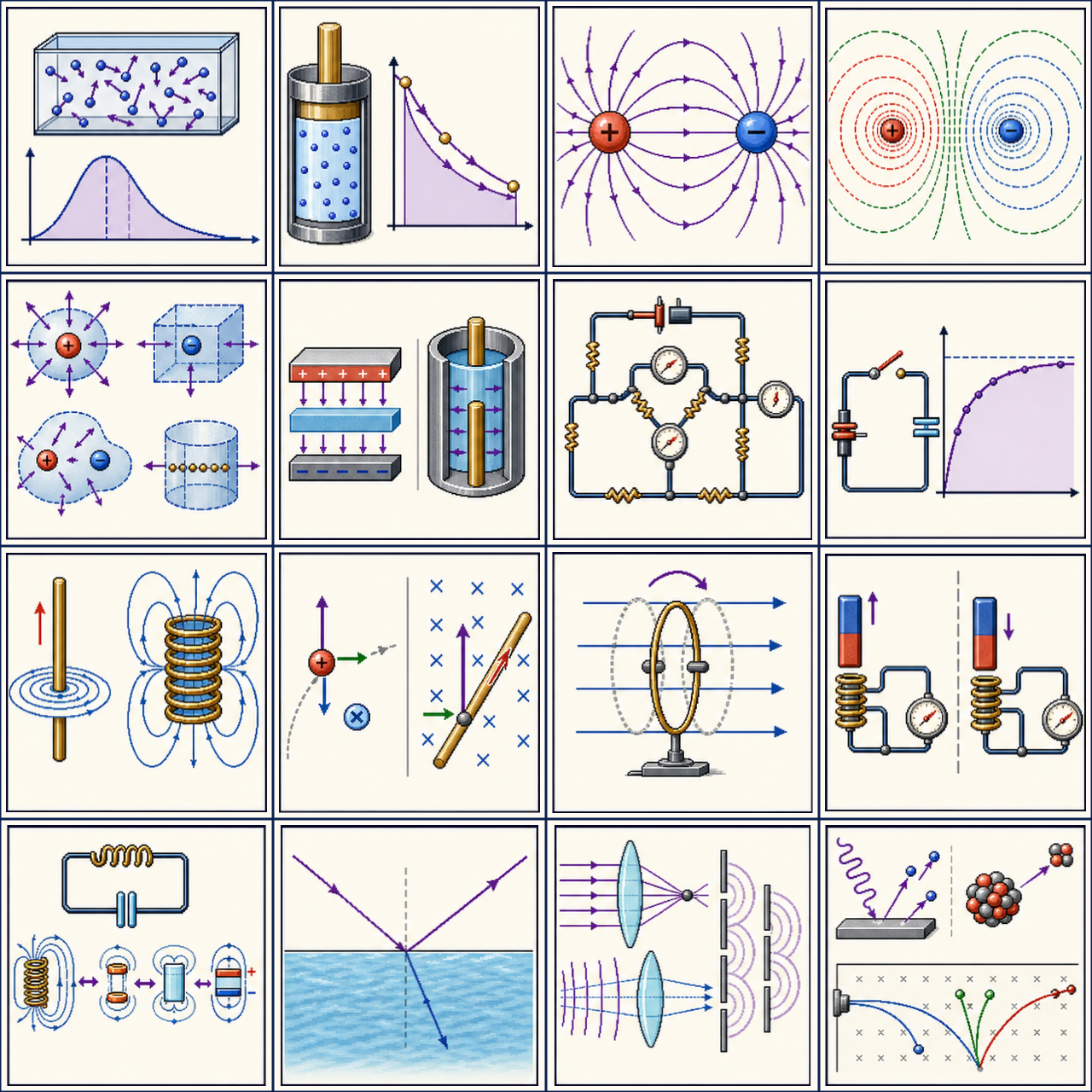
3. Detailed Visual Model
4. Pressure Is a Scalar; Pressure Force Is a Vector
Pressure at a point has magnitude but no spatial direction, so pressure is a scalar. A surface experiencing that pressure feels a force perpendicular to the surface:
The bottom of a container feels a downward fluid force, a vertical wall feels a horizontal fluid force, and a submerged surface at an angle feels a normal force. These different force directions do not make pressure itself a vector.
5. Only the Normal Force Component Produces Pressure
A \(500\,\mathrm N\) force is applied \(30^\circ\) above a flat surface over \(0.020\,\mathrm{m^2}\). The component perpendicular to the surface is
Answer: The average pressure is \(1.25\times10^4\,\mathrm{Pa}\). The parallel component does not enter \(P=F_\perp/A\).
6. Microscopic Origin of Fluid Pressure
A fluid contains enormous numbers of moving, interacting particles. Each particle–surface interaction transfers a tiny amount of momentum. The combined perpendicular forces from all those interactions over an area produce the macroscopic pressure.
Even when a fluid is at rest macroscopically, its particles are not motionless. Pressure is a collective effect, so it cannot be explained by following only one molecule.
7. Why Pressure Acts on Every Orientation
In a static fluid, a small imagined fluid element cannot have an unbalanced sideways force or it would accelerate and the fluid would rearrange. The pressure at one point therefore does not depend on the orientation of the tiny test surface used to measure it.
The resulting force is always normal to the chosen surface. A static ideal fluid cannot sustain a tangential shear stress; it changes shape instead.
8. Deriving the Hydrostatic Pressure Difference
Consider a stationary vertical column of constant-density fluid with cross-sectional area \(A\) and height difference \(h\). The lower pressure is \(P_{\mathrm{lower}}\) and the upper pressure is \(P_{\mathrm{upper}}\).
Static equilibrium requires the vertical forces to balance:
The area cancels, showing that the pressure difference does not depend on the width of the imagined column.
9. Gauge Pressure at Depth
If a liquid's upper surface is exposed to reference pressure \(P_0\), then at depth \(h\)
Depth is measured vertically downward from the reference level. It is not the diagonal distance traveled through the fluid or the distance along a container wall.
10. Absolute, Reference, Atmospheric, and Gauge Pressure
| Quantity | Meaning | Relationship |
|---|---|---|
| \(P_{\mathrm{absolute}}\) | Pressure measured relative to a perfect vacuum. | Cannot be negative. |
| \(P_0\) | Chosen reference pressure at the top level. | Often \(P_{\mathrm{atm}}\) for an open container. |
| \(P_{\mathrm{gauge}}\) | Difference between the pressure of interest and the reference. | \(P_{\mathrm{absolute}}-P_0\) |
| \(P_{\mathrm{atm}}\) | Local atmospheric pressure. | Approximately \(1.01\times10^5\,\mathrm{Pa}\) near sea level. |
A tire gauge normally reports pressure above the surrounding atmosphere, not absolute pressure.
11. Worked Example: Water Pressure
Find the gauge and absolute pressure \(3.5\,\mathrm m\) below the surface of fresh water. Use \(\rho=1000\,\mathrm{kg/m^3}\), \(g=9.8\,\mathrm{m/s^2}\), and \(P_{\mathrm{atm}}=1.01\times10^5\,\mathrm{Pa}\).
Answer: The gauge pressure is \(34.3\,\mathrm{kPa}\), and the absolute pressure is approximately \(135\,\mathrm{kPa}\).
12. What Determines Hydrostatic Pressure?
For a constant-density fluid under uniform gravity, the gauge pressure at depth depends on exactly three quantities:
- Doubling depth doubles gauge pressure.
- Replacing the fluid with twice the density doubles gauge pressure at the same depth.
- Changing the container's width or shape does not change pressure at the same depth.
- Adding the same reference pressure everywhere shifts absolute pressure but does not change the hydrostatic difference.
13. Same Depth, Same Connected Static Fluid
Two points in the same connected, stationary, constant-density fluid have the same pressure when they are at the same vertical level and share the same reference conditions. Otherwise a horizontal pressure difference would accelerate the fluid.
This remains true in a narrow tube, a wide reservoir, or an irregularly shaped vessel. The amount of liquid directly above a point is not the deciding factor; vertical depth is.
14. Pressure–Depth and Pressure–Height Graphs
With depth \(h\) positive downward,
The \(P\)-versus-\(h\) graph is linear with vertical intercept \(P_0\) and slope \(\rho g\). A denser fluid produces a steeper line.
If vertical coordinate \(y\) is positive upward instead,
The \(P\)-versus-\(y\) slope is negative. State the coordinate convention before interpreting a slope.
15. Use Graph Slope to Determine Density
A pressure sensor is lowered through a liquid. A best-fit graph of gauge pressure versus depth has slope \(7.84\times10^3\,\mathrm{Pa/m}\). With \(g=9.8\,\mathrm{m/s^2}\),
Answer: The liquid density is \(800\,\mathrm{kg/m^3}\). A nonzero gauge-pressure intercept would suggest a sensor-zero offset or an incorrectly chosen depth origin.
16. Multiple Fluid Layers
For stationary layers of different constant densities, add each layer's pressure increase:
A point lies below \(0.50\,\mathrm m\) of oil with \(\rho_o=800\,\mathrm{kg/m^3}\) and \(1.20\,\mathrm m\) of water with \(\rho_w=1000\,\mathrm{kg/m^3}\):
The pressure remains continuous across a quiet fluid boundary, but the graph's slope changes because \(\rho g\) changes.
17. Incompressibility and Pressure
For a given amount of incompressible fluid, increasing pressure does not change its volume or density in the model:
This does not mean pressure is constant throughout the fluid. Pressure may vary with depth while the density remains constant. Real gases are usually compressible; many liquids can be approximated as incompressible over ordinary pressure ranges.
18. Measuring a Pressure Difference with a Manometer
In a U-tube containing one constant-density manometer liquid, compare points at equal height within the connected liquid. If the two free levels differ vertically by \(h\), the magnitude of the pressure difference is
The side with the greater applied pressure pushes its liquid level lower. Determine the sign from the observed level positions rather than attaching a sign to \(h\) automatically.
19. Force on a Surface When Pressure Varies
If pressure is uniform over a small horizontal surface, \(F=PA\). On a tall vertical surface, however, pressure increases with depth, so using the bottom pressure over the entire area overestimates the force.
For a rectangular surface extending from the liquid surface to depth \(H\), pressure varies linearly from \(P_0\) to \(P_0+\rho gH\). The average gauge pressure is
Therefore the net gauge-pressure force magnitude is \(F_{\mathrm{gauge}}=P_{\mathrm{gauge,avg}}A\). This average method works because the graph is linear.
20. Investigation: Test Pressure versus Depth
- Fill a tall transparent container with a liquid of independently measured density.
- Zero a pressure sensor at the liquid surface or record the surface reading as \(P_0\).
- Measure pressure at at least six vertical depths without touching the container wall.
- Repeat measurements while moving downward and upward to identify drift or hysteresis.
- Graph gauge pressure vertically against depth horizontally with units and uncertainty bars.
- Fit a line and compare its slope with \(\rho g\).
- Use the intercept to evaluate the sensor-zero and depth-origin choices.
- Repeat with a second liquid or container shape to test which variables affect slope.
A strong conclusion compares the measured slope and uncertainty with the predicted \(\rho g\), rather than merely stating that pressure “went up.”
21. Model Limits and Experimental Errors
- Depth measured along a slanted path gives the wrong \(h\); use vertical separation.
- Sensor motion can create flow, so wait for a stable reading before treating the fluid as static.
- Depth-origin error changes the graph intercept.
- Density variation makes a pressure–depth graph curve instead of maintaining slope \(\rho g\).
- Gas compression can invalidate the constant-density assumption.
- Using bottom pressure over a vertical wall ignores the pressure gradient.
- Changing atmospheric pressure affects absolute readings but cancels from gauge-pressure differences measured relative to the same atmosphere.
22. A Reliable Pressure Workflow
- Identify the surface and its area in square meters.
- Resolve the force perpendicular to that surface before using \(P=F_\perp/A\).
- Decide whether the requested pressure is absolute, gauge, or a difference.
- Choose a reference level and use vertical depth.
- Check that density can be treated as constant and the fluid as static.
- For one layer, use \(\Delta P=\rho gh\); for several layers, sum \(\rho_i gh_i\).
- Add reference pressure only when absolute pressure is requested.
- For a graph, inspect both slope and intercept with units.
- Translate pressure into a force only after deciding whether pressure is uniform over the area.
- Check that the result increases with density and depth and has units of pascals.
23. Common Traps and Key Takeaways
- Use the perpendicular force component, not the total force automatically.
- Pressure is scalar; the pressure force on a surface is normal to that surface.
- Smaller area means larger pressure only when perpendicular force is held fixed.
- At depth \(h\), gauge pressure is \(\rho gh\).
- Absolute pressure is \(P_0+P_{\mathrm{gauge}}\), not just \(\rho gh\).
- Pressure depends on vertical depth, not container shape or diagonal distance.
- Equal-depth points in one connected static fluid have equal pressure.
- The slope of \(P\) versus depth is \(\rho g\).
- Incompressible means constant density and volume, not constant pressure.
- Use average pressure when pressure varies across a surface.
A sealed tank contains water of density \(1000\,\mathrm{kg/m^3}\). The gas above the water has absolute pressure \(1.20\times10^5\,\mathrm{Pa}\). Calculate the absolute and gauge pressure \(2.5\,\mathrm m\) below the surface relative to an outside atmospheric pressure of \(1.01\times10^5\,\mathrm{Pa}\). Determine the perpendicular force exerted by the tank fluid on one \(35\,\mathrm{cm^2}\) horizontal face of a pressure diaphragm at that depth. Sketch absolute pressure versus depth with its intercept and slope labeled. Then replace the upper \(0.60\,\mathrm m\) of water with oil of density \(750\,\mathrm{kg/m^3}\) while keeping the sensor at the same elevation; calculate the new sensor pressure and justify the change. Finally, explain why a vertical side panel cannot use the bottom pressure as a uniform pressure, and design a pressure-sensor experiment that could determine an unknown liquid's density and reveal a zero-offset error.
Concept scope cross-checked with the College Board AP Physics 1 Course and Exam Description and the open educational references OpenStax University Physics: Fluids, Density, and Pressure, OpenStax University Physics: Measuring Pressure, and OpenStax College Physics: Variation of Pressure with Depth. Explanations, diagram, derivation, values, examples, tables, checkpoint, and investigation are independently written for Insomnia Studyroom.
Official curriculum reference: College Board AP Physics 1 course page. The explanation and worked example are independently written for this study site.