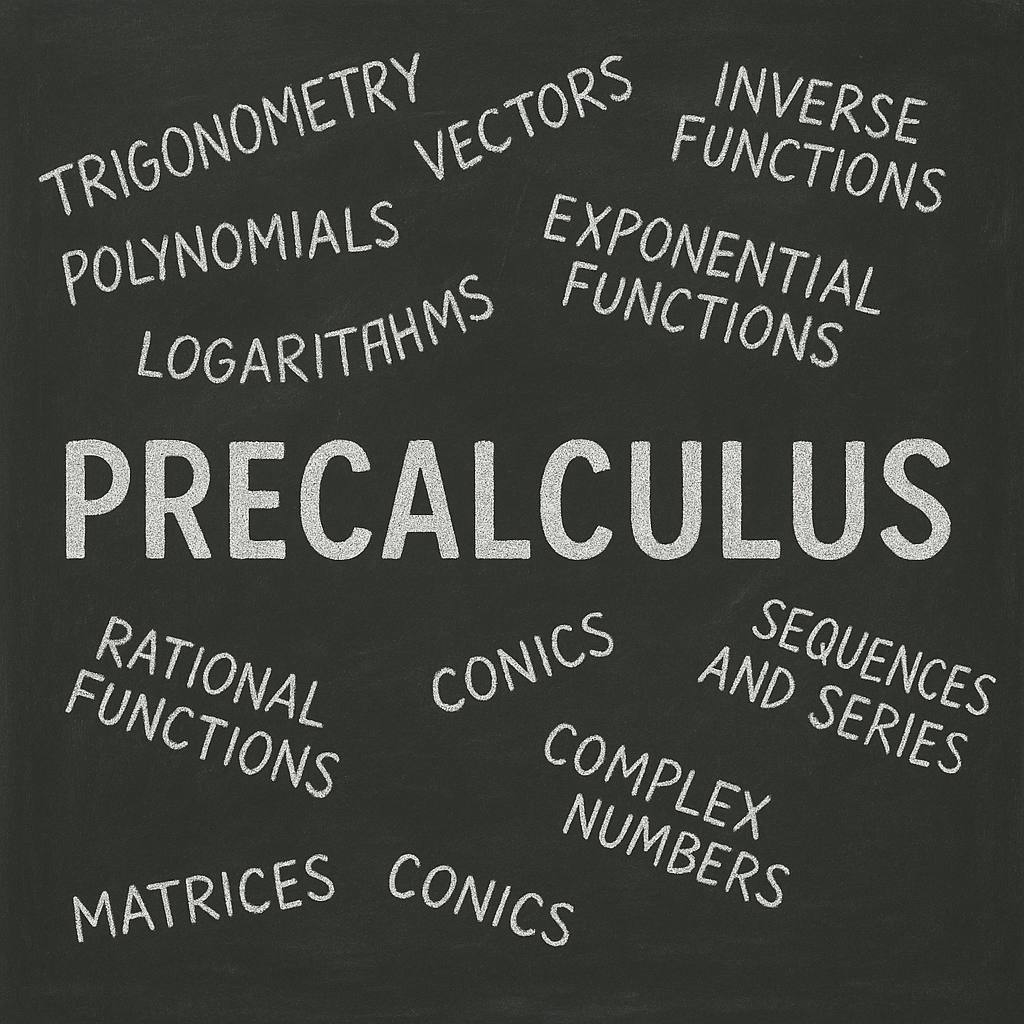
About Course
AP Precalculus is a new Advanced Placement course created by the College Board (first exam in 2024).
It is designed to prepare students for college-level calculus by focusing on modeling, functions, and rates of change—the essential foundations of Calculus.
Rather than memorizing formulas, AP Precalculus emphasizes understanding patterns of change and applying math to real-world situations.
1. Purpose of AP Precalculus
AP Precalculus aims to:
-
Build strong understanding of functions and their behaviors
-
Prepare students for AP Calculus AB/BC
-
Strengthen algebra skills needed for college STEM courses
-
Develop modeling skills for physics, chemistry, engineering, economics, and data science
It is more conceptual and application-based than a traditional precalculus course.
2. The Four Units of AP Precalculus
The course is organized into four major units, each focusing on modeling real-world behavior with different types of functions.
Unit 1: Polynomial Functions
Topics include:
-
Polynomial structure
-
End behavior
-
Roots and multiplicity
-
Polynomial division
-
Transformations
-
Rate of change for polynomials
-
Modeling with polynomial functions
This unit builds a foundation for understanding limits and derivatives in calculus.
Unit 2: Rational Functions
Students learn:
-
Rational expressions and domains
-
Asymptotes (vertical, horizontal, slant)
-
Discontinuities (holes)
-
Behavior near asymptotes
-
Rate of change in rational functions
-
Modeling real-life situations such as ratios, rates, and intensities
Rational functions introduce students to constraints, infinite behavior, and nonlinear changes, which are essential ideas in calculus.
Unit 3: Exponential and Logarithmic Functions
Covers:
-
Exponential growth & decay
-
Logarithm properties
-
e and continuous growth
-
Inverses
-
Rate of change in exponential models
-
Modeling interest, population, radioactive decay, bacteria growth
This unit prepares students for calculus topics like differential equations and exponential derivatives.
Unit 4: Trigonometric and Polar Functions
Students explore:
-
Unit circle
-
Sine, cosine, tangent
-
Trigonometric identities
-
Graphs and transformations
-
Simple harmonic motion
-
Polar coordinates and polar graphs
-
Modeling cycles (waves, seasons, periodic motion)
Trigonometry is essential for Calculus BC and physics.
3. What Makes AP Precalculus Different?
A. Strong focus on modeling
Almost every unit includes:
-
Real-world data
-
Graph interpretation
-
Choosing the correct function to model a situation
-
Explaining reasoning (not just computing)
B. Deep understanding of functions
Students compare:
-
How functions grow
-
How they change
-
How they behave near key features (roots, asymptotes, maximums, etc.)
C. Preparation for Calculus
The course builds conceptual tools like:
-
Average rate of change
-
Instantaneous rate intuition
-
Behavior as inputs approach certain values
-
Functional relationships
D. Less memorizing, more interpreting
The exam asks you to explain:
-
Why a model fits
-
What parameters mean
-
How adjusting a value changes the graph
4. Skills Students Gain
By the end of AP Precalculus, students can:
-
Understand and analyze any type of function
-
Interpret graphs, tables, and equations
-
Model real-world problems with appropriate functions
-
Explain how quantities change together
-
Prepare for AP Calculus confidently
5. Who Should Take AP Precalculus?
This course is ideal for students who:
-
Plan to take AP Calculus AB or BC
-
Want a strong math foundation for science or engineering
-
Prefer understanding concepts instead of just memorizing formulas
-
Want a college-level challenge in high school