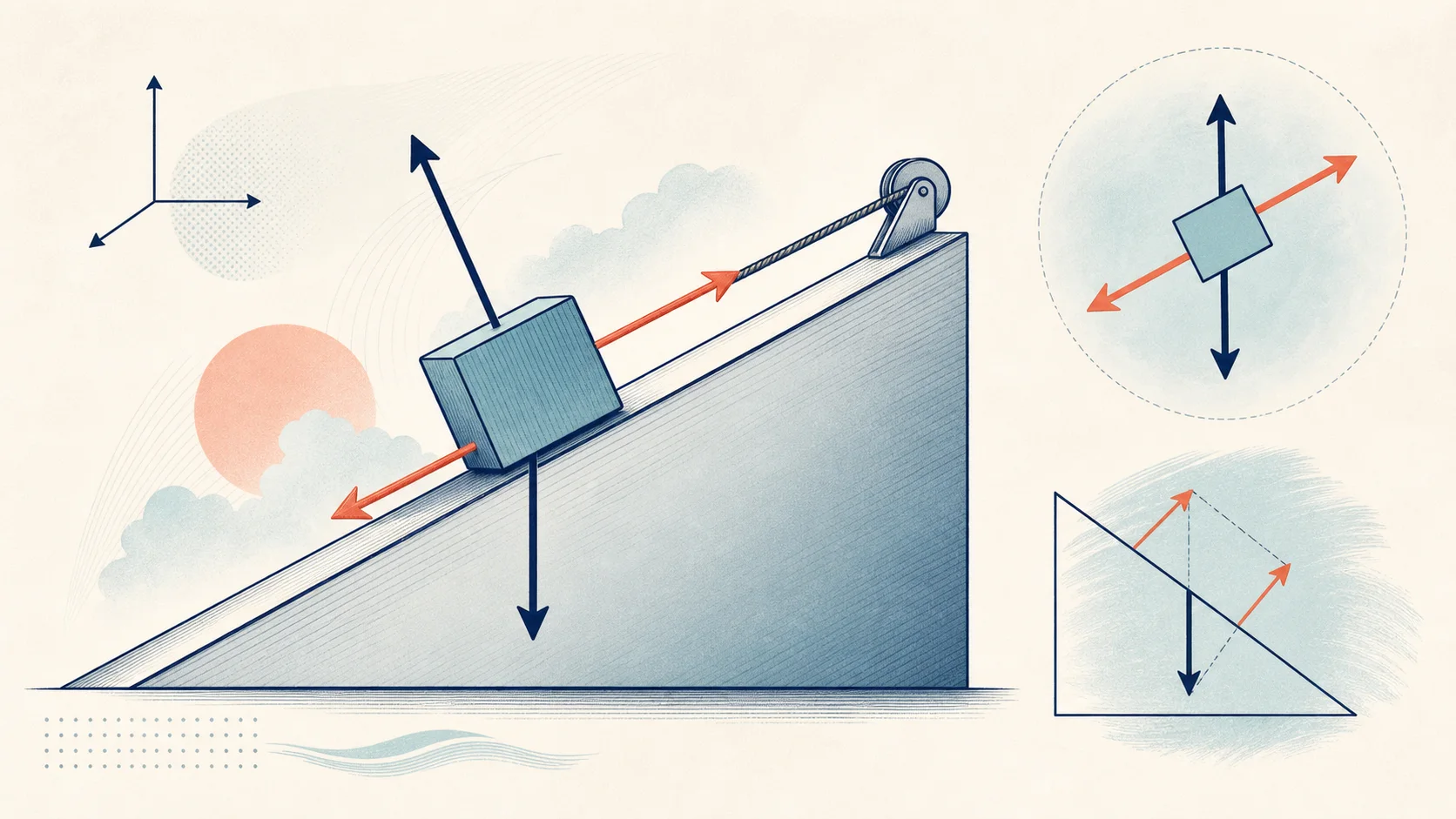
Definition: what a free-body diagram represents
A free-body diagram is a model of one chosen system that shows every external force acting on that system. It excludes forces exerted by the system on other objects, and it does not treat velocity or acceleration as forces.
Many mechanics problems feel difficult because the words describe several objects, directions, and interactions at once. A free-body diagram reduces that information to a force model of one system. Once the forces are correct, Newton's second law turns the picture into equations:
The diagram should contain only the selected object and the external forces acting on it. It should not show forces that the object exerts on something else, and it should not include velocity or acceleration arrows as though they were forces.
A six-step method
- Choose the system. State exactly which object, or group of objects, you are analyzing.
- Identify interactions. Look for gravity, contact with surfaces, strings, springs, fluids, and applied pushes or pulls.
- Draw one force per interaction. Begin each arrow on the object and point it in the force's actual direction.
- Choose useful axes. Align an axis with the expected motion or with a surface whenever that simplifies components.
- Resolve angled forces. Replace an angled vector with perpendicular components along the chosen axes.
- Write a separate equation for each axis. Keep signs consistent with the positive directions on the diagram.
The force library
- Weight: near Earth's surface, \(\vec W=m\vec g\) points vertically downward.
- Normal force: \(\vec N\) is perpendicular to the contact surface. It is not automatically equal to \(mg\).
- Friction: friction lies parallel to the surface and opposes slipping or the tendency to slip. Kinetic friction has magnitude \(f_k=\mu_kN\), while static friction adjusts up to \(f_s\leq\mu_sN\).
- Tension: an ideal string pulls along its own length and away from the object.
- Spring force: for an ideal spring, \(\vec F_s=-k\vec x\); the negative sign indicates a restoring direction.
Worked model: a block on a frictionless incline
Suppose a block of mass \(m\) rests on a ramp inclined at angle \(\theta\). Choose the \(x\)-axis parallel to the ramp and the \(y\)-axis perpendicular to it. The weight remains vertical, so resolve it into two components:
There is no acceleration perpendicular to the ramp, so the normal force balances the perpendicular component of weight:
Along the ramp, gravity is the only force. If downhill is positive,
Notice that the mass cancels. In this ideal model, blocks of different masses have the same acceleration on the same frictionless incline.
Adding friction or tension
If the block slides down a rough ramp, kinetic friction points uphill. The parallel equation becomes
If a rope pulls the block, include tension with a positive or negative sign according to its direction. Do not decide the sign from a memorized formula; decide it from the axis drawn on the diagram.
Common errors to catch
- Drawing both \(mg\) and its components on the same final diagram, which counts gravity twice.
- Assuming \(N=mg\) even when the surface is tilted or another vertical force acts.
- Drawing friction opposite the velocity without first checking the direction of relative slipping.
- Pairing Newton's third-law forces on one diagram. Action-reaction forces act on different objects.
- Using \(\sum F=0\) simply because the object is moving at constant speed in one direction while overlooking acceleration in another.
A fast study routine
Before doing algebra, cover the equations and explain every force arrow aloud: who exerts the force, on what object, and in which direction. Then predict the acceleration direction from the net force. This short habit makes the later signs and components much easier to verify.
Key takeaways
- Choose and name the system before drawing any force.
- Draw one arrow for each external interaction and label the agent when useful.
- Choose axes before resolving vectors, then write one Newton's-law equation per axis.
- Check that the net-force direction agrees with the acceleration, not necessarily with the velocity.
Practice the same modeling sequence in forces and free-body diagrams, then connect your force components to acceleration in Newton’s second law.