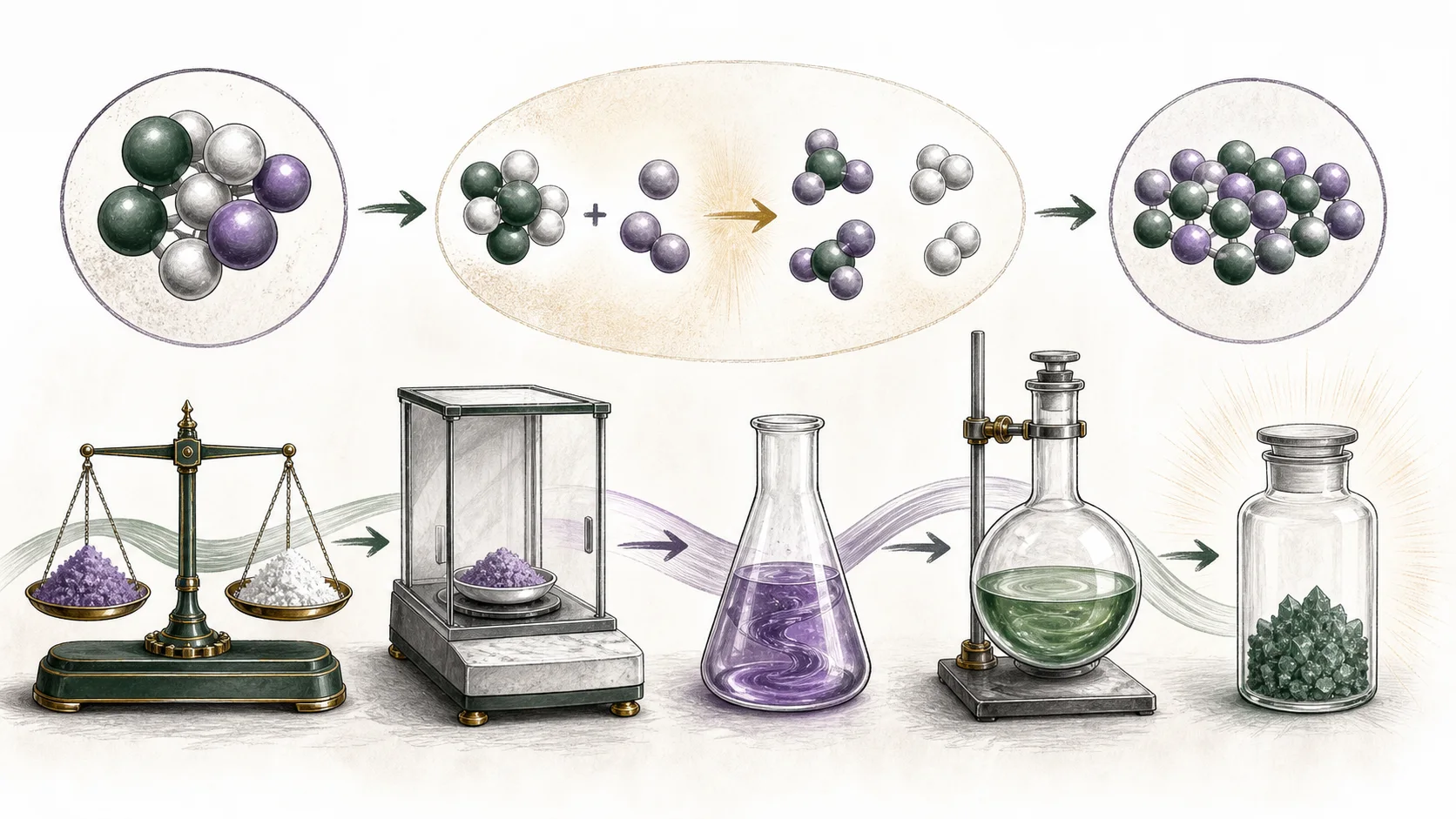
The central idea: coefficients are mole ratios
A balanced chemical equation conserves every type of atom. Its coefficients describe relative numbers of particles and, because one mole represents a fixed number of particles, relative numbers of moles. For methane combustion,
This equation says that 1 mole of methane reacts with 2 moles of oxygen to form 1 mole of carbon dioxide and 2 moles of water. It does not say that the same masses react, because each substance has a different molar mass.
The conversion pathway
Most stoichiometry problems can be organized as one chain:
- Write and balance the equation.
- Convert the given amount to moles.
- Use the coefficient ratio to change substances.
- Convert target moles to grams, particles, gas volume, or concentration as requested.
- Check units, significant figures, and whether the answer is physically reasonable.
Worked example: methane to carbon dioxide
How many grams of carbon dioxide can form when 8.00 g of methane burns in excess oxygen? Use molar masses \(M_{\mathrm{CH_4}}=16.04\,\mathrm{g\,mol^{-1}}\) and \(M_{\mathrm{CO_2}}=44.01\,\mathrm{g\,mol^{-1}}\).
The units cancel in sequence, leaving grams of carbon dioxide. Writing units at every stage acts like an error-detection system: if the unwanted units do not cancel, the conversion factor is probably upside down or missing.
When there are two reactants: the limiting reactant
The limiting reactant is consumed first and therefore sets the maximum amount of product. A reliable method is to calculate how much of the same product each reactant could make. The reactant that predicts less product is limiting. Do not simply choose the reactant with fewer grams or fewer moles; the balanced coefficient ratio matters.
After identifying the limiting reactant, use only that reactant to calculate the theoretical yield. Any other reactant is in excess, and some of it remains after the reaction.
Theoretical yield and percent yield
Theoretical yield is the maximum predicted by stoichiometry. Actual yield is what the experiment produces and measures. Their comparison is
A yield below 100% may result from incomplete reaction, side reactions, product loss during transfer, or purification. A value above 100% usually signals wet or contaminated product, measurement error, or an incorrect calculation rather than the creation of extra matter.
Three ideas that should stay separate
- Subscripts belong to chemical formulas and describe composition. Changing them changes the substance.
- Coefficients balance the equation and provide mole ratios. Changing them changes quantity, not identity.
- Molar mass converts between grams and moles. It comes from the formula, not from the equation coefficient.
A final answer check
Ask four questions: Is the equation balanced? Did the calculation pass through moles? Was the coefficient ratio oriented so the given substance canceled? If multiple reactants were supplied, did the limiting reactant determine the yield? A solution that answers all four is usually on solid ground.
Review moles and molar mass for the mass-to-amount conversion, then continue to stoichiometry to connect those amounts through a balanced reaction.