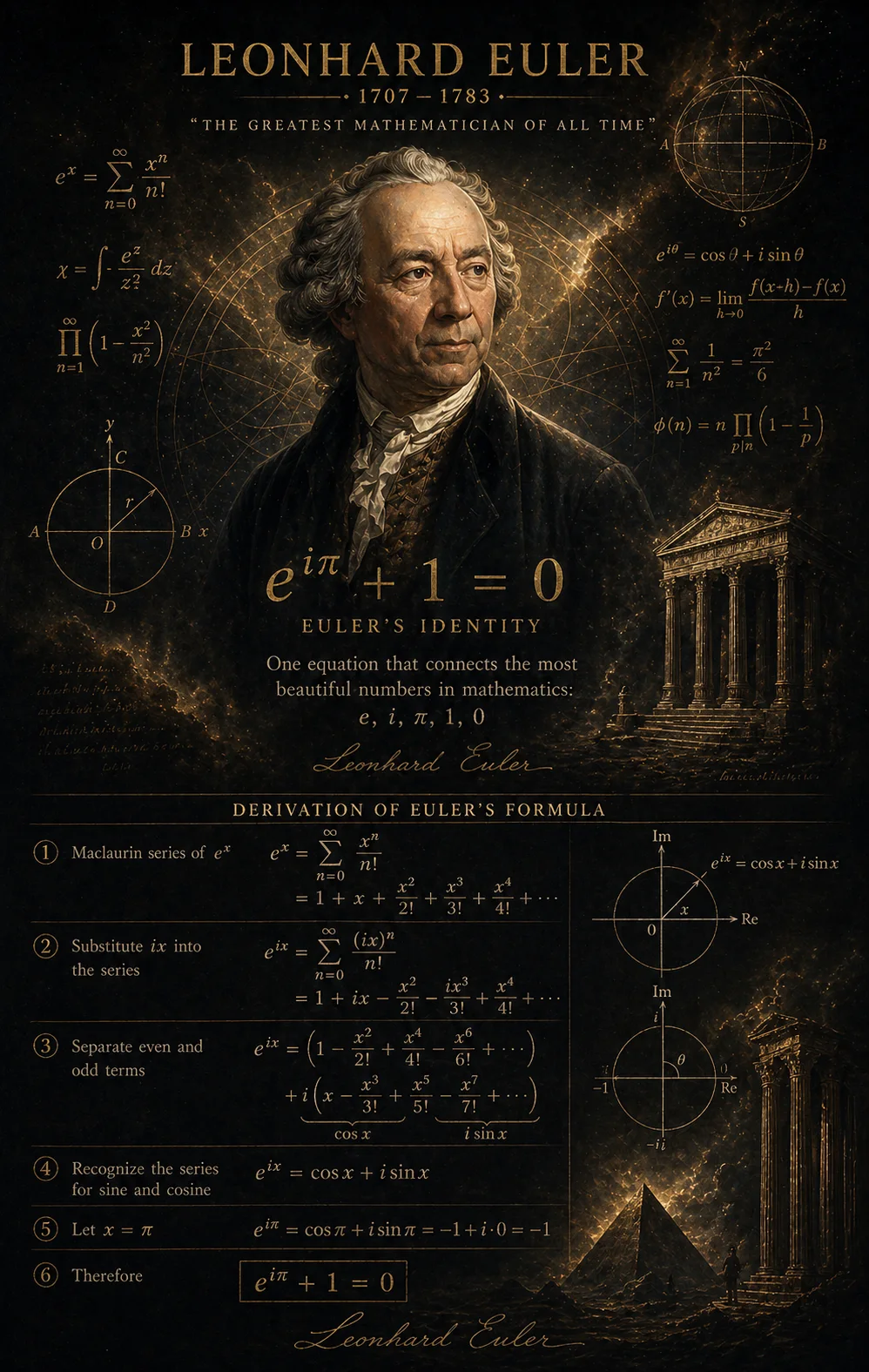
One formula, two remarkable statements
Euler's formula describes every real angle \(\theta\) through a complex exponential:
The formula says that raising \(e\) to an imaginary power does not produce ordinary exponential growth. Instead, it produces rotation on the complex plane. The real coordinate is \(\cos\theta\), the imaginary coordinate is \(\sin\theta\), and the resulting point always lies on the unit circle.
Setting \(\theta=\pi\) gives the celebrated special case known as Euler's identity:
Why mathematicians call it beautiful
Beauty is subjective, but Euler's identity has several qualities that mathematicians consistently admire.
- It unites five fundamental constants. The number \(e\) belongs to calculus and continuous growth, \(i\) extends arithmetic into the complex plane, \(\pi\) comes from the geometry of circles, 1 is the multiplicative identity, and 0 is the additive identity.
- It connects distant ideas. Exponential functions, trigonometry, complex numbers, and Euclidean geometry appear to be separate subjects until Euler's formula shows that they are different descriptions of the same structure.
- It is unexpectedly concise. Exponentiation, multiplication, addition, and equality are enough to link those constants in one short line.
- It explains rather than merely calculates. The equation reveals that periodic motion can be understood as exponential motion in a complex direction.
Derivation from the Maclaurin series
The cleanest algebraic derivation begins with the Maclaurin series for the exponential, cosine, and sine functions. These series converge for every real or complex input:
Now substitute \(z=i\theta\) into the exponential series:
The powers of \(i\) repeat in a four-step cycle:
Using that cycle and separating the real terms from the imaginary terms gives
The first parenthesis is exactly the Maclaurin series for \(\cos\theta\), and the second is the series for \(\sin\theta\). Therefore,
Because the exponential series converges absolutely, separating its even and odd powers is mathematically valid. Finally, let \(\theta=\pi\):
The geometric meaning: exponentiation becomes rotation
A complex number \(a+bi\) can be viewed as the point \((a,b)\). Euler's formula places \(e^{i\theta}\) at \((\cos\theta,\sin\theta)\), so its distance from the origin is always
Increasing \(\theta\) moves the point around the unit circle. Multiplication by \(e^{i\theta}\) therefore rotates any complex number through an angle \(\theta\) without changing its magnitude. More generally,
so the real part of the exponent controls scaling while the imaginary part controls rotation. Growth and oscillation become two parts of one exponential law.
Where Euler's formula is used
- Waves and oscillations: a sinusoid such as \(A\cos(\omega t+\phi)\) can be handled as the real part of \(Ae^{i(\omega t+\phi)}\), which makes differentiation and integration much easier.
- Electrical engineering: alternating-current voltages and currents are represented by phasors. Resistors, inductors, and capacitors can then be analyzed with complex impedances such as \(Z_L=i\omega L\) and \(Z_C=1/(i\omega C)\).
- Fourier analysis and signal processing: complicated signals are decomposed into complex waves \(e^{i\omega t}\). This is central to audio processing, image compression, communications, and spectral analysis.
- Differential equations: equations describing vibration, rotation, and wave motion often have solutions of the form \(e^{(a+i\omega)t}\). Euler's formula converts those solutions into growing, decaying, sine, and cosine components.
- Quantum mechanics: wavefunctions carry phase through complex exponentials such as \(e^{-iEt/\hbar}\). Interference depends on how these phases combine.
- Geometry, robotics, and control: in two dimensions, multiplying by a unit complex number performs a rotation. The same principle supports rotation calculations, feedback analysis, and stability methods.
Two useful consequences
Adding and subtracting Euler's formula for opposite angles produces exponential forms for cosine and sine:
It also reveals the \(n\)-th roots of unity, the evenly spaced solutions of \(z^n=1\):
These points form a regular polygon on the unit circle and play an important role in algebra, discrete Fourier transforms, and numerical computation.
Why the formula matters
Euler's formula is beautiful not simply because it contains famous symbols. It is beautiful because it compresses a deep structural fact into one line: circular motion and exponential change are the same phenomenon viewed in different number systems. It turns trigonometry into algebra, makes oscillation easier to calculate, and provides a common language for ideas that appear across pure mathematics and modern technology.
Build the geometric and algebraic background with trigonometry and polar coordinates and polynomial functions and complex zeros. Use these foundations to revisit the complex-plane interpretation above.