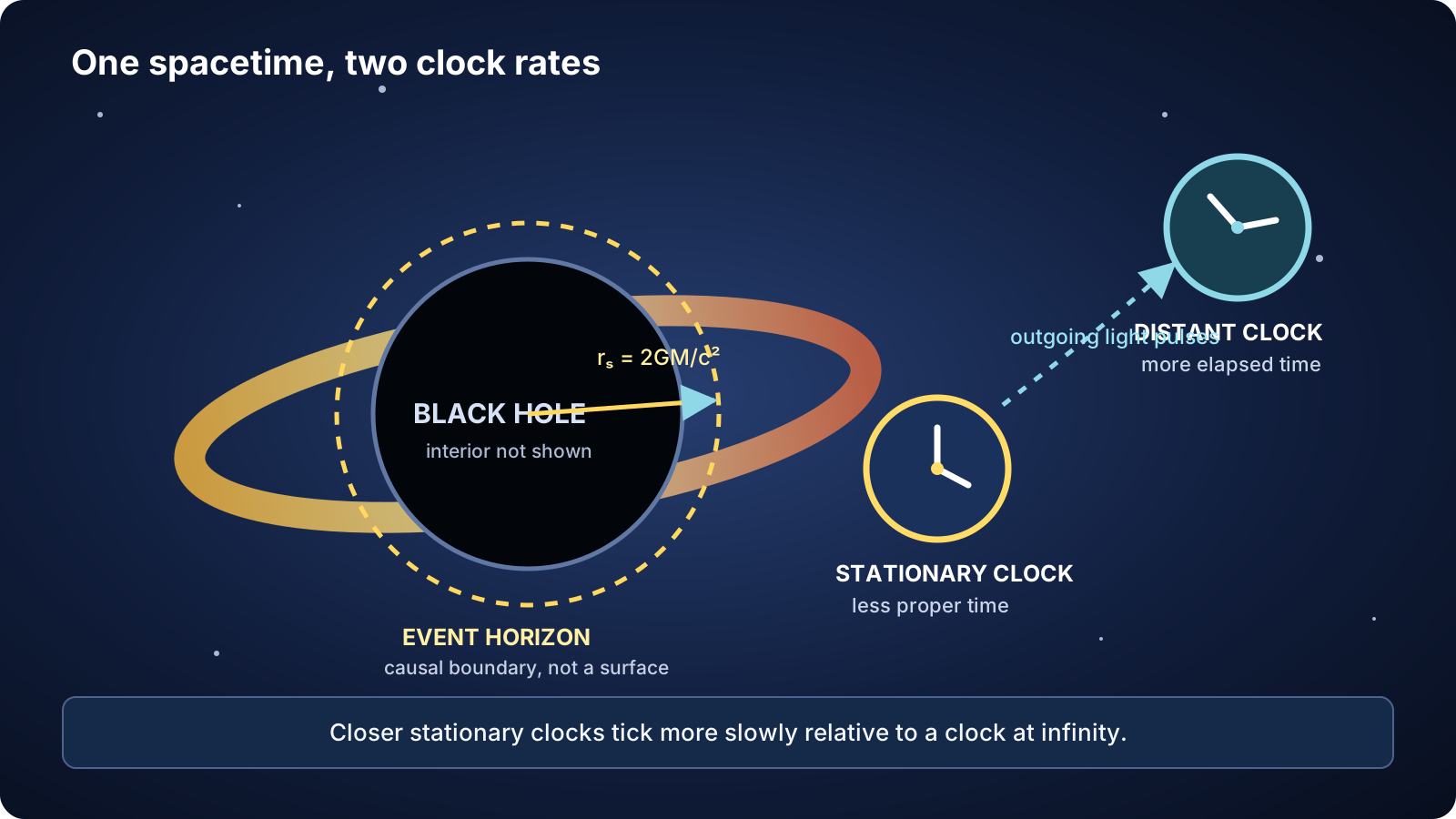
If you spent one hour near a black hole, could much more time pass far away? Yes—in a carefully defined comparison between clocks—but the answer depends on where the clocks move and which spacetime describes the black hole. Gravitational time dilation near a black hole is not a broken clock or an illusion. It is the prediction that different paths through curved spacetime can contain different amounts of elapsed time.
1. What is gravitational time dilation?
Gravitational time dilation is the difference in elapsed time measured by clocks at different gravitational potentials. Relative to a clock farther from a gravitating mass, a clock deeper in the gravitational field accumulates less time between appropriately compared events. Every local observer still sees a nearby, well-functioning clock tick normally.
The effect does not require a black hole. Earth produces it too, but a black hole makes the contrast large because spacetime is strongly curved close to the horizon. The important statement is therefore not “gravity damages time,” but “different observers can measure different proper times.” Proper time is the time recorded by a clock traveling along a particular path through spacetime.
2. From Newton's force to Einstein's spacetime
In Newtonian physics, gravity is modeled as a force acting across space. Einstein's general relativity changes the description: mass and energy curve spacetime, and freely moving objects follow the straightest possible paths—called geodesics—within that curved geometry. Time is part of the geometry, so gravity changes not only trajectories but also comparisons between clock rates.
A useful analogy is a map with different distance scales in different regions. No ruler is malfunctioning; the geometry determines how distances compare. In relativity, an ideal clock measures its own proper time locally, while the spacetime geometry determines how that reading compares with another clock following a different path.
3. The key equation for a stationary clock
For a spherical, non-rotating, uncharged black hole, the exterior spacetime is described by the Schwarzschild metric. A clock held stationary at radius (r) satisfies
Equivalently, the interval assigned by a clock at rest very far away is
- (G) is the gravitational constant.
- (M) is the black hole's mass.
- (r) is the Schwarzschild radial coordinate measured from the center.
- (c) is the speed of light.
- (Delta au) is the proper time recorded by the stationary clock at radius (r).
- (Delta t) is Schwarzschild coordinate time, matching the proper time of a stationary observer infinitely far away in this idealized spacetime.
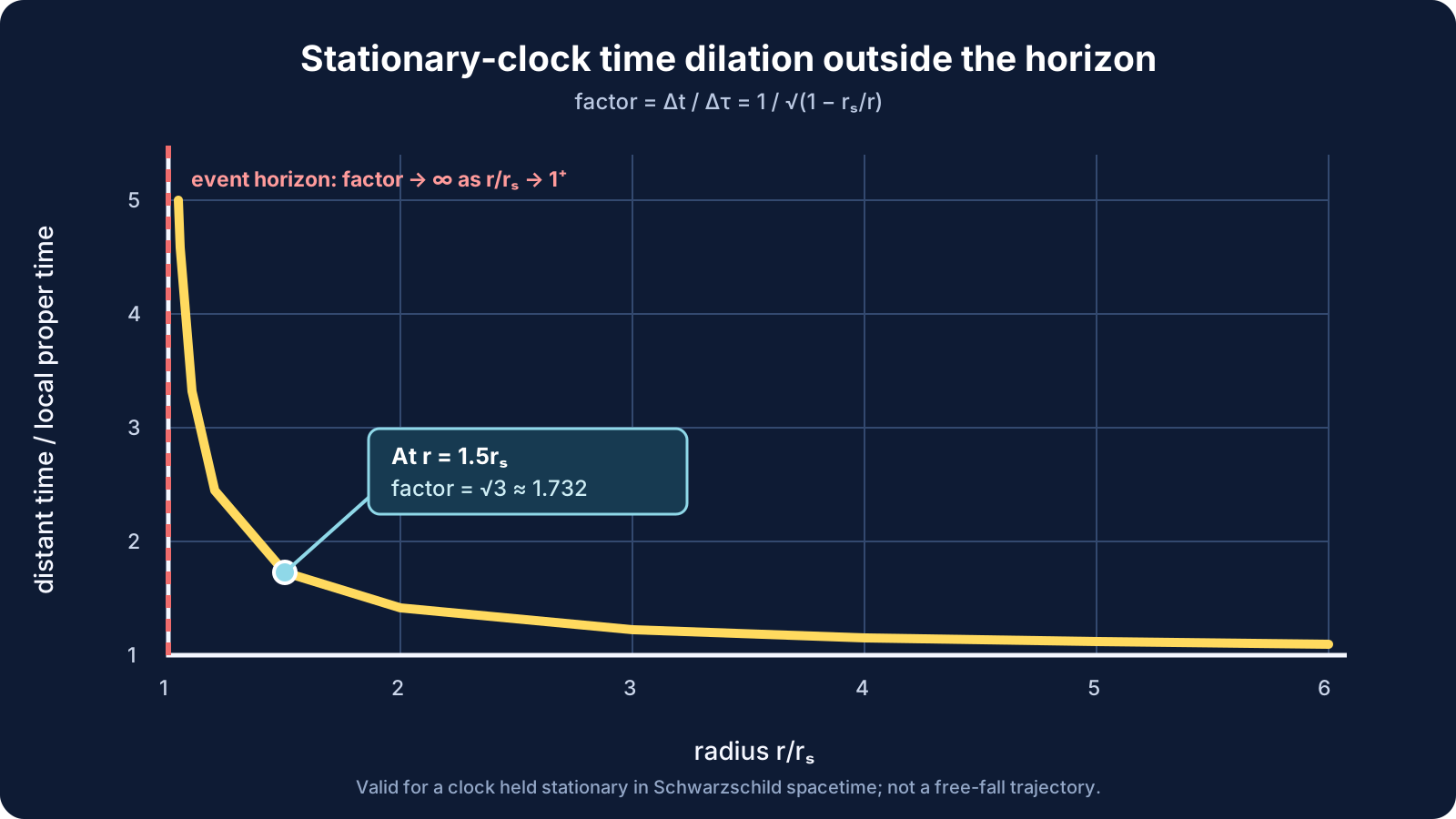
The factor (1/sqrt{1-r_s/r}) grows as (r) approaches (r_s) from outside. This is why time dilation near a black hole can become extreme. The formula has strict limits: it describes a stationary, hovering observer outside the horizon, not the local clock carried by a freely falling observer. Holding position arbitrarily close to the horizon would require acceleration that grows without bound. A Princeton physics explanation of the Schwarzschild metric derives the same clock-rate factor.
4. What is the Schwarzschild radius?
For this idealized black hole, the Schwarzschild radius is
The sphere at (r=r_s) is the event horizon. It is a causal boundary: once a future-directed path crosses inward, no signal following that path can later reach the exterior universe. It is not a material shell. The familiar statement that the Newtonian escape speed reaches (c) at (r_s) is a useful numerical analogy, but the horizon's full definition comes from the causal structure of general relativity.
5. What happens near the event horizon?
For a distant observer
Light pulses sent outward by an infalling object arrive progressively later and with lower frequency. In Schwarzschild coordinates, the object appears to slow as it approaches the horizon. The received image also becomes increasingly redshifted and faint; a distant observer does not watch a bright object simply freeze forever. NASA's overview of objects approaching black holes describes this combination of time delay, redshift, and strong tidal effects.
For the falling observer
The falling observer's own clock continues normally and reaches the horizon after a finite amount of proper time. For a sufficiently massive black hole, the tidal forces at the horizon can be small enough that crossing need not produce an immediate local signal. The observer cannot hover at the horizon and cannot send information back out after crossing it.
6. Does time actually stop at a black hole?
No. “Time stops at the event horizon” is an observer-dependent oversimplification. General relativity has no single universal clock shared by every observer. A falling clock records ordinary local seconds and crosses the horizon in finite proper time. A distant observer instead receives an ever more delayed and redshifted sequence of signals.
The apparent freezing arises from the coordinates used by the distant description and from the increasing travel time and redshift of outgoing light. It does not mean that the falling observer's local time becomes zero or that physical processes halt from that observer's perspective.
7. Worked example at 1.5 Schwarzschild radii
Suppose a powered observer hovers outside a Schwarzschild black hole at (r=1.5r_s). The local-to-distant clock-rate factor is
Therefore,
If the hovering clock records one hour, the idealized clock at infinity records about 1.73 hours. This is not the time ratio for a freely falling clock or for an orbiting planet. In fact, (r=1.5r_s) is the Schwarzschild photon-sphere radius, and maintaining a fixed position there requires continuous thrust.
8. What about Interstellar?
Miller's planet in Interstellar orbits Gargantua, which was modeled as a rapidly rotating Kerr black hole. Rotation changes the spacetime geometry, the horizon, and the allowed orbits. Producing the movie's extreme clock ratio requires highly specific assumptions about spin and orbit, so the stationary Schwarzschild equation above cannot model that scene. A peer-reviewed paper by James, von Tunzelmann, Franklin, and Thorne explains the Kerr-black-hole calculations used for the film's visual modeling. The film is a useful motivation, not a substitute for stating those assumptions.
9. Gravitational time dilation is measurable on Earth
GPS satellites
GPS satellites carry atomic clocks, and navigation depends on comparing extremely precise signal times. Their altitude places them at a higher gravitational potential than clocks on Earth's surface, which makes the satellite clocks run faster by the general-relativistic effect. Their orbital speed also makes them run slower by special relativity. The system must account for both effects; NIST's relativity and atomic-clock overview explains why GPS timing is a practical test and application of Einstein's theories.
Atomic clocks at different heights
The same physics appears across tiny height differences. In 2022, JILA and NIST researchers compared regions of an optical atomic clock separated by about one millimeter and resolved the gravitational difference in ticking rate. The NIST experiment report shows that gravitational time dilation is not confined to astronomy; it can be measured in a laboratory.
10. Why this matters
- Black hole physics: clock rates and redshift help describe signals produced near horizons.
- General relativity: time dilation is direct evidence that gravity is spacetime geometry, not merely a Newtonian force.
- GPS and satellite technology: precise navigation requires relativistic timekeeping.
- Astrophysics and cosmology: observations must connect emitted and received light across curved spacetime.
- Precision timing: optical clocks can test relativity and measure gravitational-potential differences.
The Newtonian mechanics developed in AP Physics C Mechanics remains an excellent approximation for many motions. Black-hole environments show where a spacetime description becomes essential.
11. Common misconceptions
| Misconception | Reality |
|---|---|
| Time completely stops at the event horizon. | A falling observer crosses in finite proper time; distant signals become delayed and redshifted. |
| Gravity physically slows a clock mechanism. | Ideal clocks follow spacetime geometry and accumulate different proper times. |
| Only black holes cause gravitational time dilation. | Every gravitational field does; Earth-based atomic clocks measure it. |
| A falling observer sees their own time slow. | Their local clock and nearby physics proceed normally. |
| The Schwarzschild formula describes every black hole observer. | The displayed factor assumes a stationary clock outside a non-rotating black hole. |
12. Final takeaway
Gravity does not merely pull objects—it changes the geometry of spacetime, and that includes the rate at which time passes. Gravitational time dilation means that clocks following different paths through that geometry can record different elapsed times, even though each clock behaves normally in its own local frame.
Near a Schwarzschild black hole, the difference between a stationary clock and a clock at infinity grows sharply as the stationary clock approaches the event horizon. That mathematical statement must not be confused with the experience of a freely falling observer, who crosses the horizon in finite proper time. Keeping the observer, motion, and spacetime model explicit is the key to explaining black hole time dilation accurately.
To distinguish the Newtonian starting point from the relativistic model in this article, review gravitational force. That lesson covers a prerequisite, not curved spacetime or a derivation of gravitational time dilation.