AP Physics 2 · Unit 10 · Topic 10.4
Energy of Configurations of Charges
Describe a charge arrangement with one scalar energy instead of tracking every force along a path. Interpret the sign of electric potential energy, calculate changes as separations vary, assemble many-charge systems pair by pair, and connect lost potential energy to kinetic energy.
Learning Goals
- Explain why electric potential energy belongs to a system of interacting charges.
- Use the zero-energy reference at infinite separation and interpret positive or negative \(U\).
- Calculate \(U\), \(\Delta U\), electric-force work, and slow external work for two point charges.
- Find the energy of a many-charge configuration by summing every distinct pair once.
- Apply conservation of energy to release, closest-approach, and assembly situations.
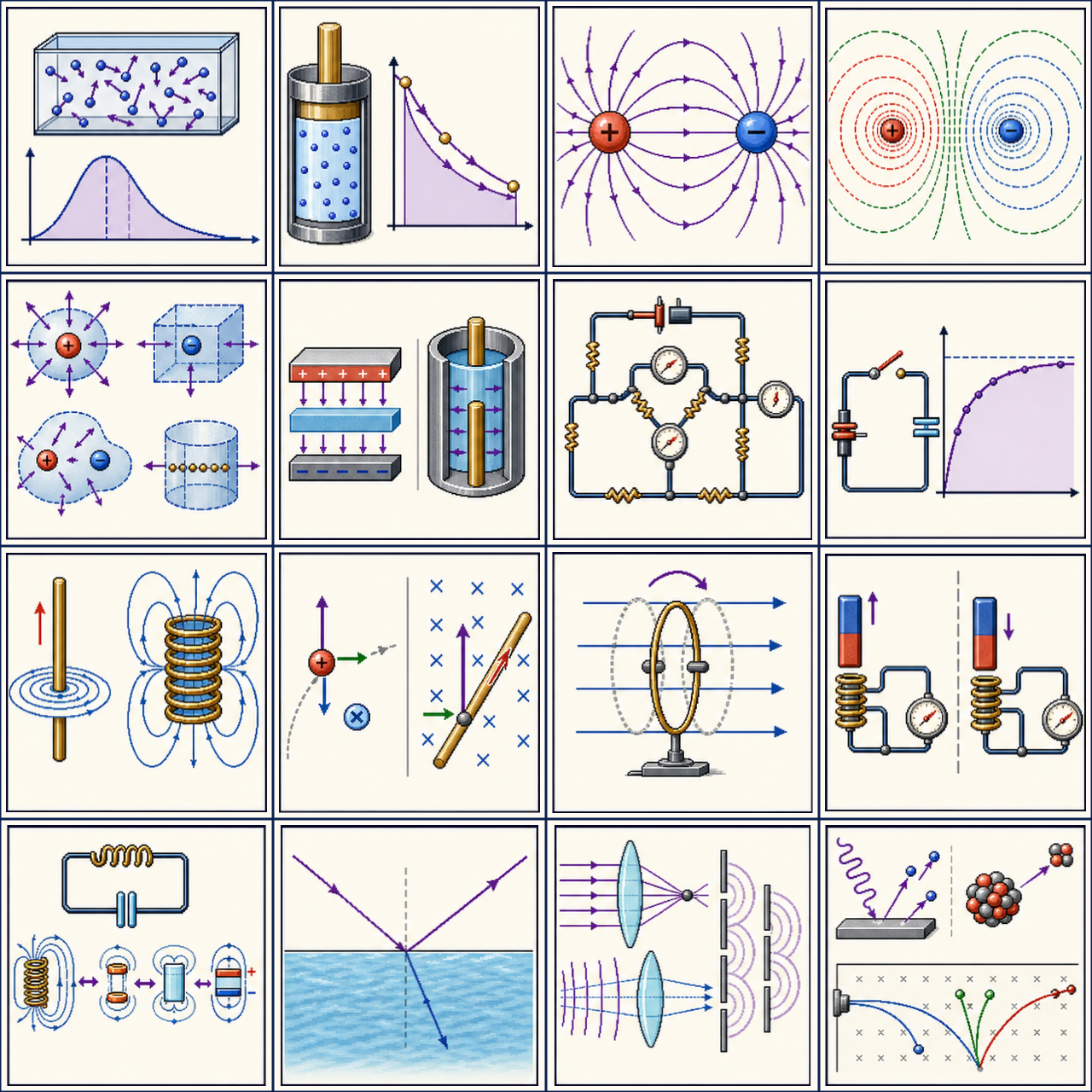
1. Energy Belongs to the Configuration
Electric potential energy is not stored in one isolated charge. It describes the interaction of at least two charges and depends on their relative positions. Moving either charge changes the same system energy.
Always identify the system: two charges, all charges in an arrangement, or charges plus an external device. The energy equation must match that boundary.
2. Electrostatic Force Is Conservative
For fixed source charges, the work done by the electrostatic force depends only on initial and final configurations, not on the route between them:
A closed trip returns to the same configuration, so \(\Delta U=0\) and the net electrostatic work is zero.
3. Choosing the Zero and Building the Two-Charge Formula
For point charges, infinite separation is the convenient reference because their interaction vanishes there: \(U(\infty)=0\). Bringing \(q_2\) slowly from infinity to distance \(r\) from fixed \(q_1\) changes the system energy by the work of the balancing external force.
The charge product keeps its algebraic sign. Unlike the force-magnitude formula, the energy formula must not replace \(q_1q_2\) with \(|q_1q_2|\).
4. Positive Energy: Like Charges
If \(q_1q_2>0\), then \(U>0\). An external agent must do positive work to push like charges closer slowly. If released, the charges repel, separation grows, and \(U\) falls toward zero while kinetic energy can increase.
5. Negative Energy: Opposite Charges
If \(q_1q_2<0\), then \(U<0\). The configuration has less energy than the separated reference state. Positive external work is required to pull the pair apart to infinity; the pair is energetically bound in this ideal model.
Energy Above the Separated Reference
Charges \(+2.0\,\mu\mathrm C\) and \(+3.0\,\mu\mathrm C\) are \(0.50\,\mathrm m\) apart.
The positive sign means this configuration lies \(0.108\,\mathrm J\) above the infinite-separation reference.
Negative Configuration Energy
Charges \(+5.0\,\mathrm{nC}\) and \(-2.0\,\mathrm{nC}\) are separated by \(0.10\,\mathrm m\).
The negative sign does not mean energy was calculated incorrectly. It indicates an attractive, bound configuration relative to infinity.
6. A Change in Separation Requires \(\Delta U\)
When a pair moves from \(r_i\) to \(r_f\), subtract the initial energy from the final energy:
Do not report \(U_f\) when the question asks for a change. The initial configuration may already contain substantial positive or negative energy.
Push Like Charges Closer Slowly
Charges \(+4.0\,\mathrm{nC}\) and \(+6.0\,\mathrm{nC}\) move slowly from \(0.40\,\mathrm m\) apart to \(0.10\,\mathrm m\) apart.
For a slow move with negligible kinetic-energy change, \(W_{\mathrm{ext}}=+1.62\,\mu\mathrm J\). The electric force does \(W_{\mathrm e}=-1.62\,\mu\mathrm J\).
7. Three Work Statements That Must Stay Separate
- Electric-force work: \(W_{\mathrm e}=-\Delta U\).
- Slow external work: \(W_{\mathrm{ext}}=\Delta U\) when \(\Delta K\approx0\).
- Net work: \(W_{\mathrm{net}}=\Delta K\).
If the charge accelerates during the move, do not automatically set external work equal to \(\Delta U\).
8. Energy Conservation for an Isolated Charge System
When no energy crosses the chosen boundary and only conservative electric forces do work,
A decrease in electric potential energy becomes an equal increase in total kinetic energy. If several charges move, \(K\) means the sum of their kinetic energies.
Convert Interaction Energy into Kinetic Energy
Two \(+1.0\,\mu\mathrm C\) charges begin at rest \(0.50\,\mathrm m\) apart. One is fixed; the other has mass \(0.010\,\mathrm{kg}\). Find the moving charge's speed when it is very far away.
At infinite separation \(U_f=0\). The support holding the first charge fixed has zero displacement, so it does no mechanical work in this ideal setup.
9. Many Charges: Add Pair Energies as Scalars
For \(N\) point charges, calculate the energy of every distinct pair and add:
The condition \(i Because electrostatic force is conservative, the final total is independent of assembly order. The number of distinct pairs among \(N\) charges is Three charges give three pairs, four charges give six, and five give ten. This quick count catches omitted or double-counted interactions. Charges \(q_1=+2.0\,\mathrm{nC}\), \(q_2=+3.0\,\mathrm{nC}\), and \(q_3=-4.0\,\mathrm{nC}\) form a triangle with \(r_{12}=0.30\,\mathrm m\), \(r_{13}=0.40\,\mathrm m\), and \(r_{23}=0.50\,\mathrm m\). The negative total means the complete configuration lies below the separated reference even though one pair contributes positive energy. Four equal positive charges \(+q\) occupy the corners of a square of side \(a\). There are four edge pairs at distance \(a\) and two diagonal pairs at distance \(\sqrt2a\): Counting the six pairs first makes the geometry transparent and prevents treating the square as only four neighbor interactions. In a many-charge system, positive and negative pair energies can cancel so that \(U_{\text{system}}=0\). Individual forces and fields can still be nonzero. Energy is a scalar global property; force and field are local vectors. If every separation is multiplied by the same positive scale factor \(s\) while charges stay fixed, every pair energy is divided by \(s\): This works because every term contains \(1/r_{ij}\). It does not apply when only some distances change. A \(+2.0\,\mu\mathrm C\) charge approaches an identical fixed charge from very far away with kinetic energy \(0.180\,\mathrm J\). At closest approach it momentarily stops, so \(K_f=0\). The turning point is not an equilibrium point; the repulsive force is nonzero and reverses the motion. Microscopic electric energies are often measured in electron-volts: An electron-volt is energy, not electric potential and not charge. Convert only when the requested unit or physical scale makes it useful. For two point charges, \(|F|\propto1/r^2\), but \(|U|\propto1/r\). Force describes the local rate at which energy changes with position; it is incorrect to reuse the inverse-square dependence in the energy formula. 1. Two equal positive charges move from separation \(r\) to \(2r\). How does their potential energy change? Because \(U=k_eq^2/r\), doubling separation halves the positive energy: \(U_f=U_i/2\). Thus \(\Delta U=-U_i/2\). 2. What does \(U<0\) mean when the zero reference is infinite separation? The configuration has less energy than the infinitely separated state. Positive external work is required to separate the system to infinity; opposite-sign interactions commonly produce this result. 3. The electric force does \(+4.0\,\mathrm{mJ}\) of work. What is \(\Delta U\)? For a conservative electric force, \(W_{\mathrm e}=-\Delta U\). Therefore \(\Delta U=-4.0\,\mathrm{mJ}\). 4. How many pair-energy terms are required for five point charges? \(N(N-1)/2=5(4)/2=10\) distinct pairs. Each must appear exactly once. 5. Can a three-charge configuration have \(U=0\) while the charges experience forces? Yes. Positive and negative scalar pair-energy terms can cancel, while the vector forces at individual charge locations remain nonzero. 6. A pair is moved slowly and \(\Delta U=-2.0\,\mu\mathrm J\). What work is done by the external agent and by the electric force? For negligible kinetic-energy change, \(W_{\mathrm{ext}}=\Delta U=-2.0\,\mu\mathrm J\). The electric force does the opposite work: \(W_{\mathrm e}=+2.0\,\mu\mathrm J\). Choose three point charges and place them at measured coordinates on graph paper or in a spreadsheet. Calculate the three pair distances, then create a signed ledger containing \(U_{12}\), \(U_{13}\), and \(U_{23}\). Move only one charge through at least five positions. At each position, compare total \(U\), the predicted attractive or repulsive tendency, and the work an external agent would do during a slow move from the previous position. As a check, repeat the assembly in a different order. The intermediate ledger entries will differ, but the final configuration energy must agree within rounding uncertainty. Official curriculum reference: College Board AP Physics 2 course page. The explanation and worked example are independently written for this study site.10. Assembly Method
11. Count Pairs Before Calculating
Sum Positive and Negative Pair Contributions
Group Equal Pair Distances
12. Zero Total Energy Does Not Mean No Interaction
13. Scaling the Entire Configuration
Use a Turning Point
14. Electron-Volt as an Energy Unit
15. Force and Energy Have Different Distance Laws
16. Reliable Configuration Workflow
17. Common Traps
Show reasoning and answer
Show reasoning and answer
Show reasoning and answer
Show reasoning and answer
Show reasoning and answer
Show reasoning and answer
Investigation: Build an Energy Ledger