AP Physics 2 · Unit 15 · Topic 15.6
Photon-Electron Scattering and Momentum
Quantization, probability, nuclear processes, and relativity extend classical models at atomic scales.
1. Topic Lens
Photon-Electron Scattering and Momentum is studied through modern physics. Connect the system boundary, interacting parts, and measurable evidence before applying a formula.
2. Why the Formula Works
The relationship is built from definitions and conservation reasoning:
- A photon carries discrete energy hf.
- The material requires work function φ to release an electron.
- Energy conservation leaves the remainder as the maximum electron kinetic energy.
3. Detailed Visual Model
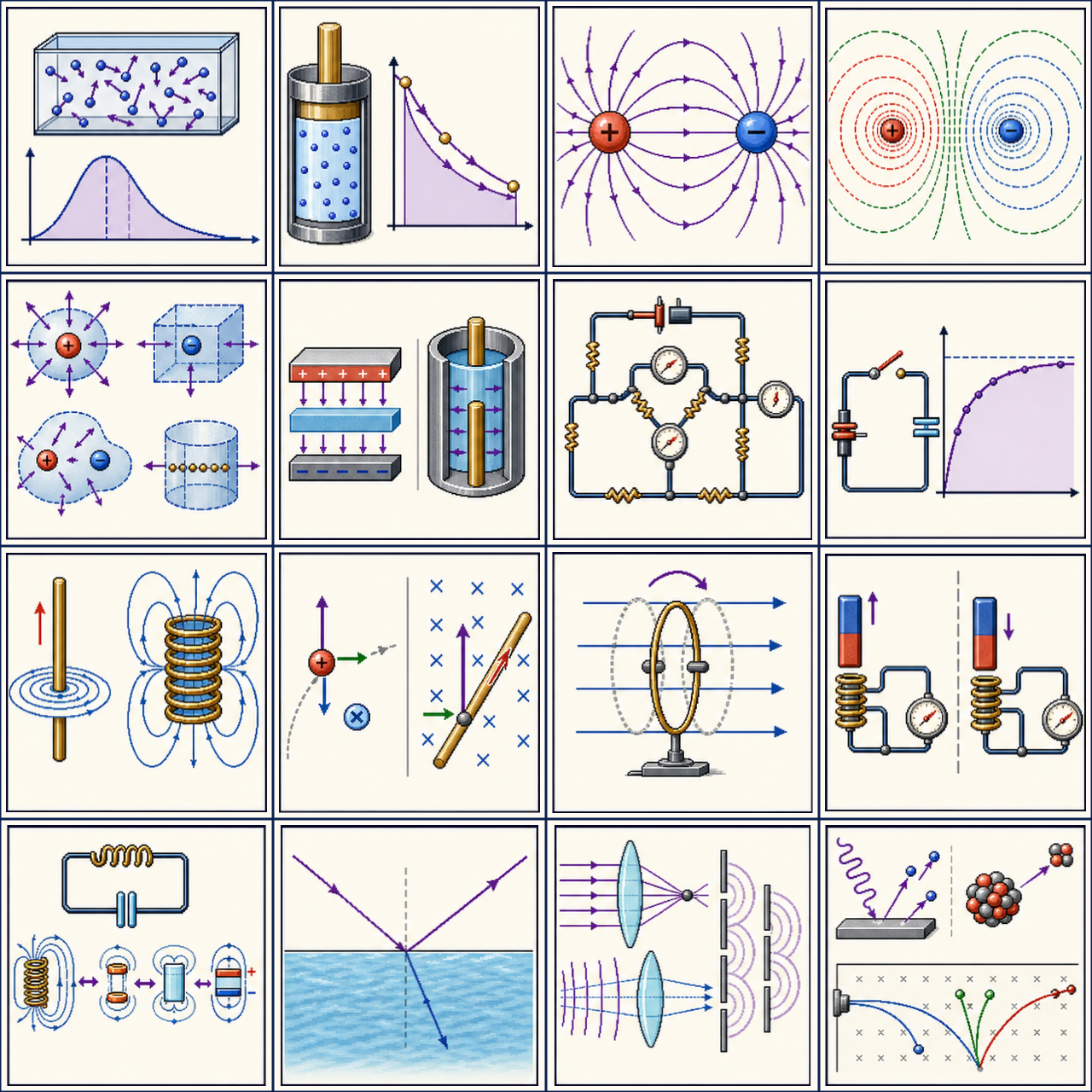
4. Worked Example and Lab Link
A 5 eV photon strikes a surface with work function 2 eV. Find maximum electron kinetic energy.
Answer: Kmax=5-2=3 eV.
Investigation idea: Analyze original stopping-potential data versus frequency and infer threshold frequency and Planck-slope meaning.
Common trap: Light intensity changes photon count; below threshold frequency it does not release electrons in the ideal model.
Expanded Topic 15.6 Lesson
5. Learning Targets
- Relate photon energy, wavelength, and momentum using \(E=pc=hf=hc/\lambda\).
- Apply vector momentum and relativistic energy conservation to photon–electron scattering.
- Use the Compton-shift equation to predict scattered wavelength from angle.
- Calculate the scattered photon energy and the recoil electron's kinetic energy and direction.
- Explain why the observed angle-dependent shift supports a particle-momentum model of light.
6. A Massless Photon Still Carries Momentum
The relativistic energy–momentum relation is
For a photon, \(m_0=0\), so \(E=pc\). Combining this with \(E=hf=hc/\lambda\) gives
The formula gives magnitude. The momentum vector points in the photon's direction of travel.
7. The Experimental Puzzle
When monochromatic X-rays scatter from targets such as graphite, detectors record a component with a wavelength longer than the incident wavelength. The shift changes systematically with scattering angle.
8. Original Photon–Electron Collision Map
9. State the Collision Model First
If binding or whole-atom recoil matters, the free-electron formula requires modification.
10. The Two Conservation Equations
For an electron initially at rest, total energy conservation gives
Momentum conservation gives
The final electron must obey \(E_e^2=p_e^2c^2+m_e^2c^4\). A nonrelativistic collision equation alone is not sufficient for an X-ray photon.
11. Derivation Roadmap
Rearrange the momentum equation and square its magnitude:
Use the energy equation to express \(E_e\), then substitute \(E_e^2=p_e^2c^2+m_e^2c^4\) and \(p_\gamma=h/\lambda\). After canceling common terms,
The measured angle dependence follows from combining scalar energy conservation with vector momentum geometry.
12. Compton Shift and Its Natural Scale
\(\lambda_C\) is the electron Compton wavelength. It sets the shift scale for scattering from a free electron; it is not the incident photon's wavelength.
13. Original Shift-versus-Angle Graph
14. Angle Checkpoints
| \(\theta\) | \(1-\cos\theta\) | \(\Delta\lambda\) | Interpretation |
|---|---|---|---|
| \(0^\circ\) | 0 | 0 | Forward direction; no Compton shift |
| \(60^\circ\) | 0.5 | \(1.213\,\mathrm{pm}\) | Intermediate transfer |
| \(90^\circ\) | 1 | \(2.426\,\mathrm{pm}\) | Shift equals one electron Compton wavelength |
| \(180^\circ\) | 2 | \(4.852\,\mathrm{pm}\) | Maximum wavelength shift |
15. Worked Wavelength Example
A 71.0 pm X-ray photon scatters through \(60^\circ\):
The scattered photon has longer wavelength, so its energy and momentum magnitudes are both smaller than before the collision.
16. Endpoints and Maximum Transfer
Because \(-1\le\cos\theta\le1\),
The maximum occurs at \(\theta=180^\circ\), when the photon reverses direction. A shift larger than \(2\lambda_C\) cannot result from the stated free electron initially at rest.
17. An Equivalent Energy Formula
Substitute \(\lambda=hc/E_\gamma\) into the shift relation:
For an electron initially at rest, energy conservation then gives
The electron rest energy \(m_ec^2\approx511\,\mathrm{keV}\) is the natural scale in the denominator.
18. Worked Energy-Transfer Example
A 100 keV photon scatters through \(90^\circ\). Since \(1-\cos90^\circ=1\),
Total energy includes electron rest energy on both sides; the 16.4 keV difference becomes recoil kinetic energy.
19. Recoil Momentum from Components
Choose the incident photon direction as \(+x\) and let the scattered photon go above the axis:
The negative \(y\)-component is essential: it cancels the scattered photon's positive vertical momentum.
20. Relativistic Electron Consistency Check
Once recoil kinetic energy is known, electron momentum must satisfy
Using \(K=p^2/(2m)\) is only an approximation when \(K_e\ll m_ec^2\). The relativistic relation provides a robust check at X-ray and gamma-ray energies.
21. What Depends on Incident Energy?
“The shift is independent of incident wavelength” refers to the absolute \(\Delta\lambda\), not the fraction or energy loss.
22. Shifted and Unshifted Peaks
Real target spectra can contain both a shifted component and an approximately unshifted component. Weakly bound electrons behave more like free electrons and show the usual Compton shift. For tightly bound electrons, momentum can be shared with the whole atom.
Replacing \(m_e\) with the much larger atomic mass \(M\) makes the recoil wavelength scale far smaller, so that component may appear unshifted at available resolution.
23. Why X-Rays and Gamma Rays Reveal the Effect
The maximum electron Compton shift is only about 4.85 pm. That is a meaningful fraction of an X-ray wavelength but an extremely small fraction of a 500 nm visible wavelength.
Short-wavelength photons also carry larger momentum \(h/\lambda\), making electron recoil and energy transfer easier to resolve experimentally.
24. Do Not Mix Three Photon–Matter Processes
| Process | Photon after interaction | Electron outcome | Key evidence |
|---|---|---|---|
| Photoelectric effect | absorbed | ejected if \(hf\ge\phi\) | threshold and \(K_{\max}=hf-\phi\) |
| Compton scattering | survives with lower energy for nonzero shift | recoils | angle-dependent \(\lambda'-\lambda\) |
| Classical/Thomson limit | approximately unchanged frequency | driven oscillation or negligible recoil energy | useful when photon energy is small relative to rest-energy scale |
25. Open-Data Modeling Investigation
- Use \(0^\circ,30^\circ,\ldots,180^\circ\) and compute \(\Delta\lambda\).
- Plot \(\Delta\lambda\) against \(1-\cos\theta\).
- Fit a line and interpret slope and intercept.
- Compare the slope with \(h/(m_ec)\) using stated constants.
- Choose an incident photon energy and scattering angle.
- Calculate \(E_\gamma'\), \(K_e\), and both momentum components.
- Verify energy and \(x,y\) momentum separately.
- Vary angle and explain which transfer becomes maximal.
For a source-backed comparison dataset, use the worked scattering cases in OpenStax 6.3. Spreadsheet calculations are sufficient; no radiation source is required.
26. Common Reasoning Traps
- Treating photon momentum as \(mv\): a photon has zero rest mass and \(p=E/c=h/\lambda\).
- Conserving momentum only in magnitude: momentum must balance in both \(x\) and \(y\).
- Making the scattered wavelength shorter: for a resting free electron, \(\lambda'\ge\lambda\).
- Calling \(90^\circ\) the maximum shift: the maximum is at \(180^\circ\).
- Using ordinary electron kinetic energy at every energy: check against \(m_ec^2\).
- Confusing absolute and fractional shift: only the absolute shift is incident-wavelength independent in the ideal model.
27. AP-Style Reasoning Checks
- A photon wavelength increases after scattering. Compare its final energy and momentum with the initial values.
- What scattering angle gives \(\Delta\lambda=\lambda_C\)?
- At what angle is electron energy transfer greatest?
- Why must the recoil electron have a transverse momentum component?
- Two photons of different initial wavelength scatter from resting electrons through the same angle. Compare their absolute wavelength shifts.
- What observation makes Compton scattering evidence for photon momentum?
Answers: both decrease; \(90^\circ\); \(180^\circ\); it balances the scattered photon's transverse component; the ideal absolute shifts are equal; the measured angle-dependent wavelength change agrees with a collision model conserving photon and electron momentum.
Explain how photon-electron scattering and momentum supports or limits this conclusion: Kmax=5-2=3 eV.
Official curriculum reference: College Board AP Physics 2 course page. The explanation and worked example are independently written for this study site.