AP Physics 2 · Unit 14 · Topic 14.5
Frequency Shifts from Relative Motion
Superposition, boundary conditions, diffraction, and phase explain sound and physical-optics patterns.
1. Topic Lens
Frequency Shifts from Relative Motion is studied through waves, sound, and physical optics. Connect the system boundary, interacting parts, and measurable evidence before applying a formula.
2. Why the Formula Works
The relationship is built from definitions and conservation reasoning:
- A repeating wave advances one wavelength during one period T.
- Speed is distance over time, so v=λ/T.
- Frequency is 1/T, giving v=fλ.
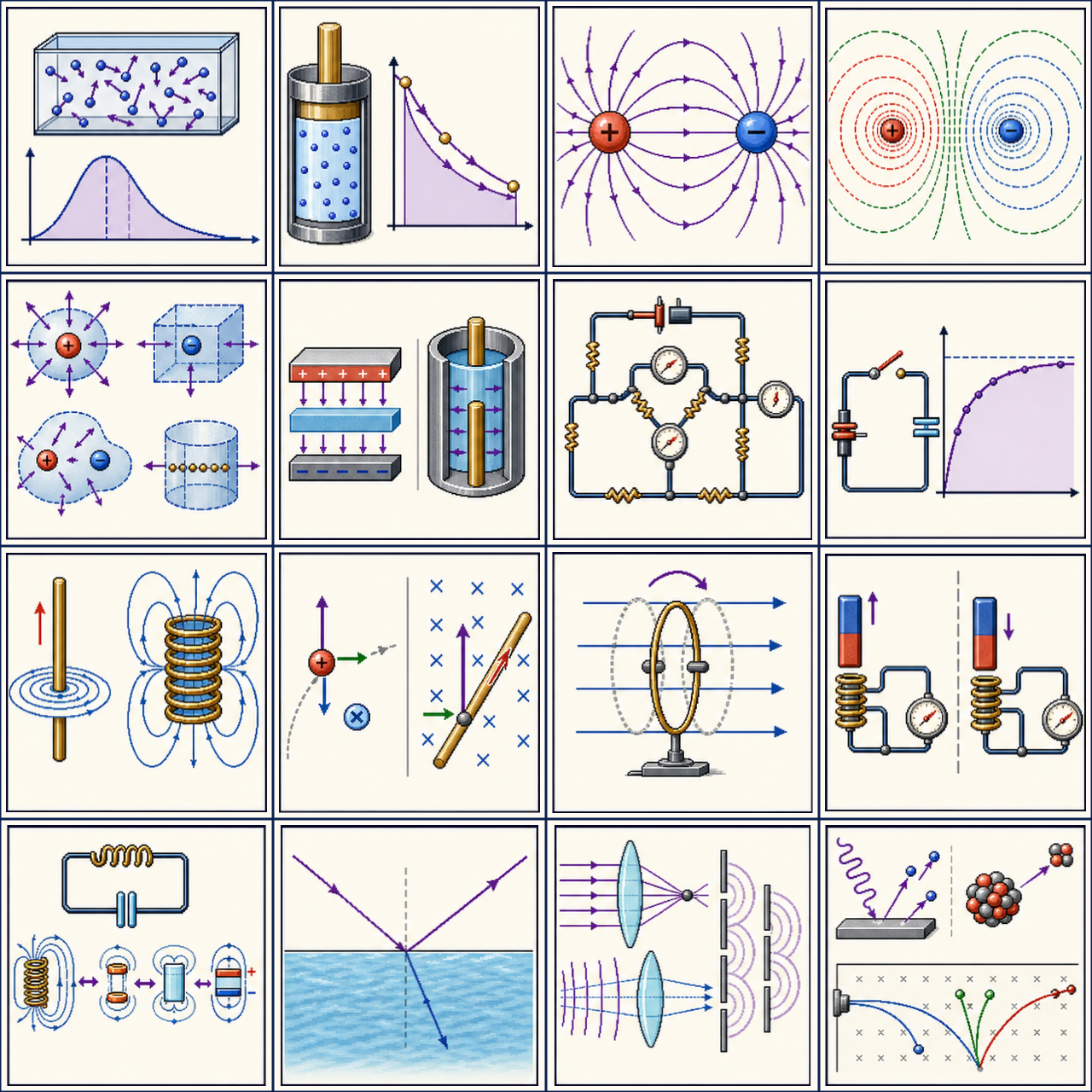
3. Detailed Visual Model
4. Worked Example and Lab Link
A 340 Hz tone travels at 340 m/s. Find its wavelength.
Answer: λ=v/f=1.00 m.
Investigation idea: Measure standing-wave nodes in an air column or string and compare allowed wavelengths with boundary conditions.
Common trap: Wave speed is determined by the medium; changing frequency usually changes wavelength, not the medium's speed.
Expanded Topic 14.5 Lesson
5. Learning Targets
- Explain a Doppler shift by changes in wavefront spacing or wavefront arrival rate.
- Predict the sign of a frequency shift from the radial motion of a source and observer.
- Derive and apply the one-dimensional Doppler equation for waves in a stationary medium.
- Analyze two-stage frequency shifts produced by reflection from a moving target.
- Distinguish the classical sound-wave model from the relativistic Doppler shift of electromagnetic waves.
6. What Actually Changes?
The Doppler effect is a difference between the frequency emitted by a source and the frequency measured by an observer because their separation changes. It does not require the source frequency itself to change.
- Approaching: wavefronts arrive more often, so \(f_{\mathrm{obs}}>f_s\).
- Receding: wavefronts arrive less often, so \(f_{\mathrm{obs}}
- No radial motion: the first-order classical Doppler shift is zero even if there is sideways motion.
Pitch is the human perception associated with sound frequency. Frequency shift is the measurable wave effect; loudness or intensity can change independently.
7. Moving Source and Moving Observer Are Different
For sound, air supplies a preferred frame because sound speed \(v\) is measured relative to the air.
- A moving source changes the spacing between wavefronts already placed in the medium.
- A moving observer does not change that spacing in the air; it changes how quickly the observer encounters the fronts.
Therefore two situations with the same source-observer closing speed need not give exactly the same sound frequency. This distinction disappears only in the low-speed approximation.
8. Original Wavefront Model
9. Derive One Formula Without Sign Guessing
Choose \(+x\) from source to observer and consider a wave traveling in \(+x\). Let \(u_s\) and \(u_o\) be signed source and observer velocities relative to the medium.
During one source period \(T_s=1/f_s\), the first crest travels \(vT_s\), while the source moves \(u_sT_s\). Thus the forward wavelength is
The observer meets those crests at relative speed \(v-u_o\), so
This signed-coordinate form is valid for the stated one-dimensional geometry. Draw the axis first: an observer moving toward the source has \(u_o<0\), and a source moving toward the observer has \(u_s>0\).
10. Direction Guide for Sound
An equivalent magnitude-only form is \(f_o=f_s(v\pm v_o)/(v\mp v_s)\), but every sign must be chosen to make approach raise and recession lower the predicted frequency.
11. Worked Sound Example: Both Move
A \(600\,\mathrm{Hz}\) siren moves toward a cyclist at \(25\,\mathrm{m/s}\). The cyclist moves toward the siren at \(10\,\mathrm{m/s}\). The air is still and \(v=343\,\mathrm{m/s}\).
Take \(+x\) from the siren to the cyclist. Then \(u_s=+25\,\mathrm{m/s}\) and \(u_o=-10\,\mathrm{m/s}\):
Both motions increase the arrival rate, so the result must exceed \(600\,\mathrm{Hz}\). This qualitative check catches most sign errors.
12. Passing Motion and Radial Velocity
Only the component of velocity along the instantaneous source-observer line enters the one-dimensional model:
For a vehicle that passes beside an observer, the radial component shrinks toward zero near closest approach and changes sign afterward. Real recorded pitch changes are therefore continuous; the idealized “high before, low after” model hides the changing geometry and sound-travel delay.
13. From Doppler Compression to a Shock Wave
As a source speed approaches the sound speed, forward wavefronts crowd together. If \(v_s>v\), the source outruns its earlier disturbances and a Mach cone forms.
A sonic boom is the passage of the shock front past an observer, not a sound emitted only at the instant the source “breaks” the sound barrier.
14. Reflection Produces Two Shifts
For sound reflected from a target approaching a stationary transmitter-receiver at speed \(u\), the target first acts as a moving observer and then as a moving source:
With \(f_0=40.0\,\mathrm{kHz}\), \(u=5.0\,\mathrm{m/s}\), and \(v=343\,\mathrm{m/s}\),
Medical Doppler ultrasound and motion sensing use reflected-wave shifts, but actual instruments also account for beam angle, tissue speed, and signal processing.
15. Why Light Needs a Different Equation
Light in vacuum has no material medium frame, and every inertial observer measures the same vacuum speed \(c\). Consequently the sound equation cannot be reused by replacing \(v\) with \(c\).
For one-dimensional relative motion, define \(\beta=v_r/c\), positive when source and observer recede. Special relativity gives
Recession produces lower frequency and longer wavelength (redshift); approach corresponds to \(\beta<0\) and produces blueshift.
16. Worked Electromagnetic-Wave Example
A probe recedes at \(0.20c\) while transmitting at \(10.0\,\mathrm{GHz}\):
The observed wavelength is larger by the reciprocal factor:
The receiver still measures the wave traveling at \(c\); frequency and wavelength change together so that \(c=f_o\lambda_o\).
17. Reading a Spectral-Line Shift
A known atomic line supplies a rest wavelength \(\lambda_s\). Define the measured fractional shift
\(z<0\)rest line
\(z=0\)redshift
\(z>0\)
For \(|v_r|\ll c\), the Doppler approximation is \(z\approx v_r/c\), with positive \(v_r\) for recession. At large speeds use the relativistic expression. A measured astronomical redshift can also include cosmic expansion or gravitational effects, so not every redshift should be interpreted as a simple local Doppler velocity.
18. Application Map
- Weather radar: reflected microwave frequency estimates radial motion of precipitation.
- Medical ultrasound: an echo shift helps estimate blood-flow velocity along the beam.
- Astronomy: shifted absorption or emission lines reveal line-of-sight motion.
- Speed sensing: reflected radio, microwave, light, or sound can encode target speed.
Each device measures a frequency shift first. Converting that shift to a speed requires the correct wave model, reflection factor, geometry, and sign convention.
19. Evidence-Building Investigation
- Draw equally spaced time marks for a source emitting one crest every \(0.010\,\mathrm s\).
- Let the wave travel \(3.4\,\mathrm m\) per interval and the source move \(0.40\,\mathrm m\) per interval.
- Measure forward and backward crest spacing in the drawing.
- Use \(f=v/\lambda\) to predict the two observed frequencies and compare their directions of shift.
- Use a teacher-provided recording of a steady tone passing a stationary microphone; do not conduct the activity near traffic.
- Read dominant frequency at several times from an audio-spectrum tool.
- Graph frequency against time and identify approach, closest passage, and recession.
- Explain deviations using radial geometry, reflections, background noise, and sampling resolution.
20. Common Reasoning Traps
- Confusing frequency with loudness: distance can change intensity without causing the same frequency change.
- Using only relative speed for sound: source and observer velocities are measured relative to the medium and enter differently.
- Changing the speed of sound: source motion changes wavelength, not the wave speed relative to still air.
- Using total speed instead of radial speed: perpendicular motion gives no first-order classical shift.
- Putting \(c\) into the sound formula: electromagnetic waves require the relativistic relation.
- Forgetting the second shift on reflection: a moving target is both receiver and re-emitter.
21. AP-Style Reasoning Checks
- A stationary listener hears a source approaching through still air. What happens to measured frequency, wavelength in front, and sound speed?
- Why does a moving observer change received frequency without changing wavefront spacing in the air?
- A source and observer move together at the same velocity relative to still air. Does the observer necessarily measure \(f_s\)?
- A galaxy's known spectral line is observed at a longer wavelength. What radial-motion interpretation is consistent with a simple Doppler model?
- Why is an echo from an approaching target shifted twice?
Answers: frequency increases, forward wavelength decreases, and sound speed in the air stays fixed; the observer changes the crest encounter rate; yes in the collinear one-dimensional formula because numerator and denominator change by the same amount; recession; the target first receives as a moving observer and then reflects as a moving source.
Explain how frequency shifts from relative motion supports or limits this conclusion: λ=v/f=1.00 m.
Official curriculum reference: College Board AP Physics 2 course page. The explanation and worked example are independently written for this study site.