AP Physics C: Electricity and Magnetism · Unit 10 · Topic 10.1
Electrostatics with Conductors
Boundary conditions, geometry, dielectrics, and circuit connections determine capacitance and stored field energy.
1. Topic Lens
Electrostatics with Conductors is studied through conductors and capacitors. Connect the system boundary, interacting parts, and measurable evidence before applying a formula.
2. Why the Formula Works
The relationship is built from definitions and conservation reasoning:
- During charging, the instantaneous potential is V(q)=q/C.
- Incremental work is dW=V(q)dq.
- Integrate from zero to Q and substitute Q=CV for equivalent forms.
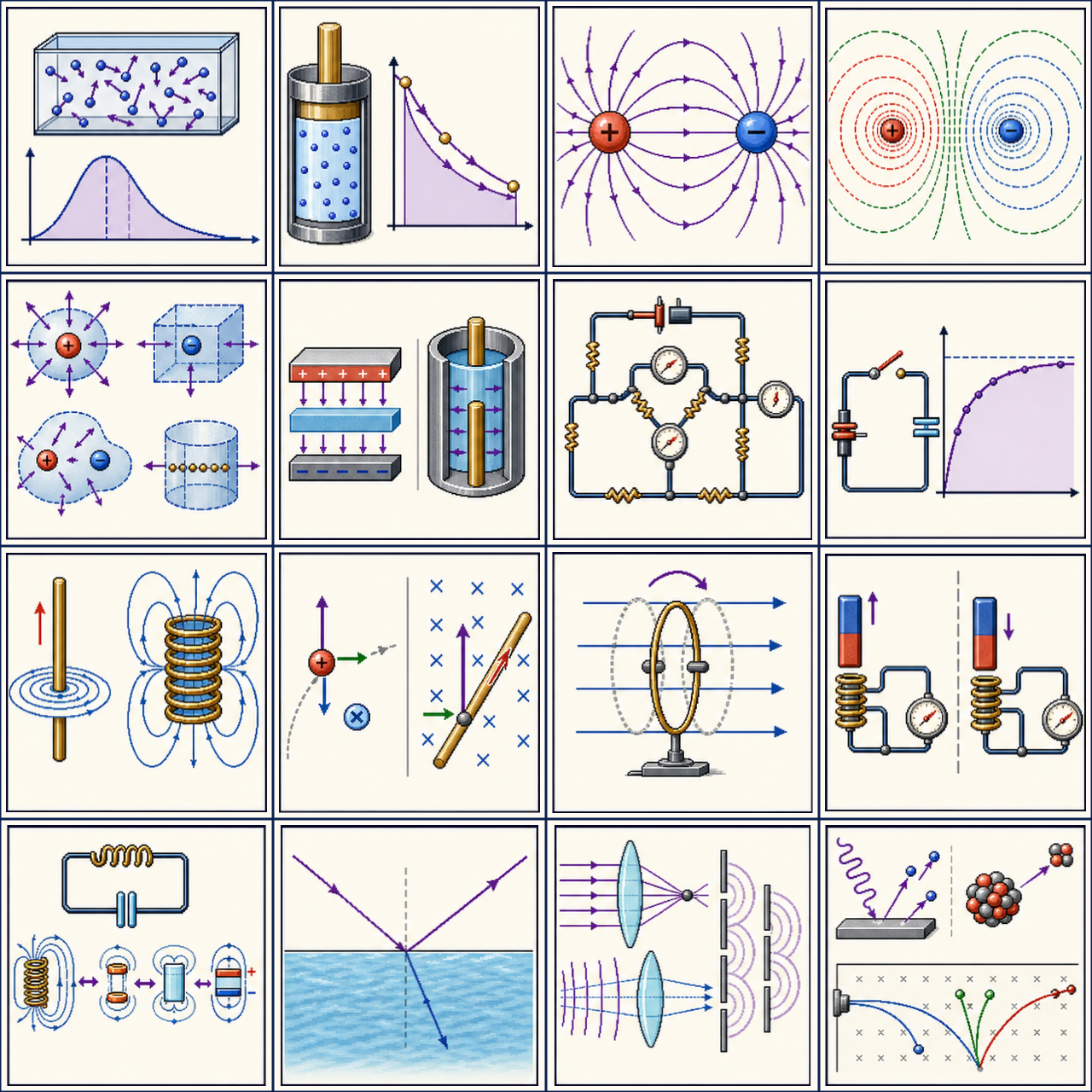
3. Detailed Visual Model
4. Worked Example and Lab Link
A 2 F capacitor is charged to 3 V. Find stored energy.
Answer: U=½(2)(3²)=9 J.
Investigation idea: Measure voltage during safe low-voltage charging and infer capacitance from charge or time data.
Common trap: Capacitance is primarily geometric; changing Q does not by itself change an ideal capacitor's C.
Explain how electrostatics with conductors supports or limits this conclusion: U=½(2)(3²)=9 J.
Official curriculum reference: College Board AP Physics C: Electricity and Magnetism course page. The explanation and worked example are independently written for this study site.