AP Physics C: Electricity and Magnetism · Unit 13 · Topic 13.1
Magnetic Flux
Changing magnetic flux creates electric circulation, induced current, inductive energy, and coupled electric-magnetic dynamics.
1. Topic Lens
Magnetic Flux is studied through electromagnetic induction. Connect the system boundary, interacting parts, and measurable evidence before applying a formula.
2. Why the Formula Works
The relationship is built from definitions and conservation reasoning:
- A moving rod sweeps area at rate dA/dt=Lv.
- For uniform perpendicular B, flux is ΦB=BA.
- Faraday's law gives magnitude |ℰ|=B(dA/dt)=BLv; Lenz's law supplies the direction.
3. Detailed Visual Model
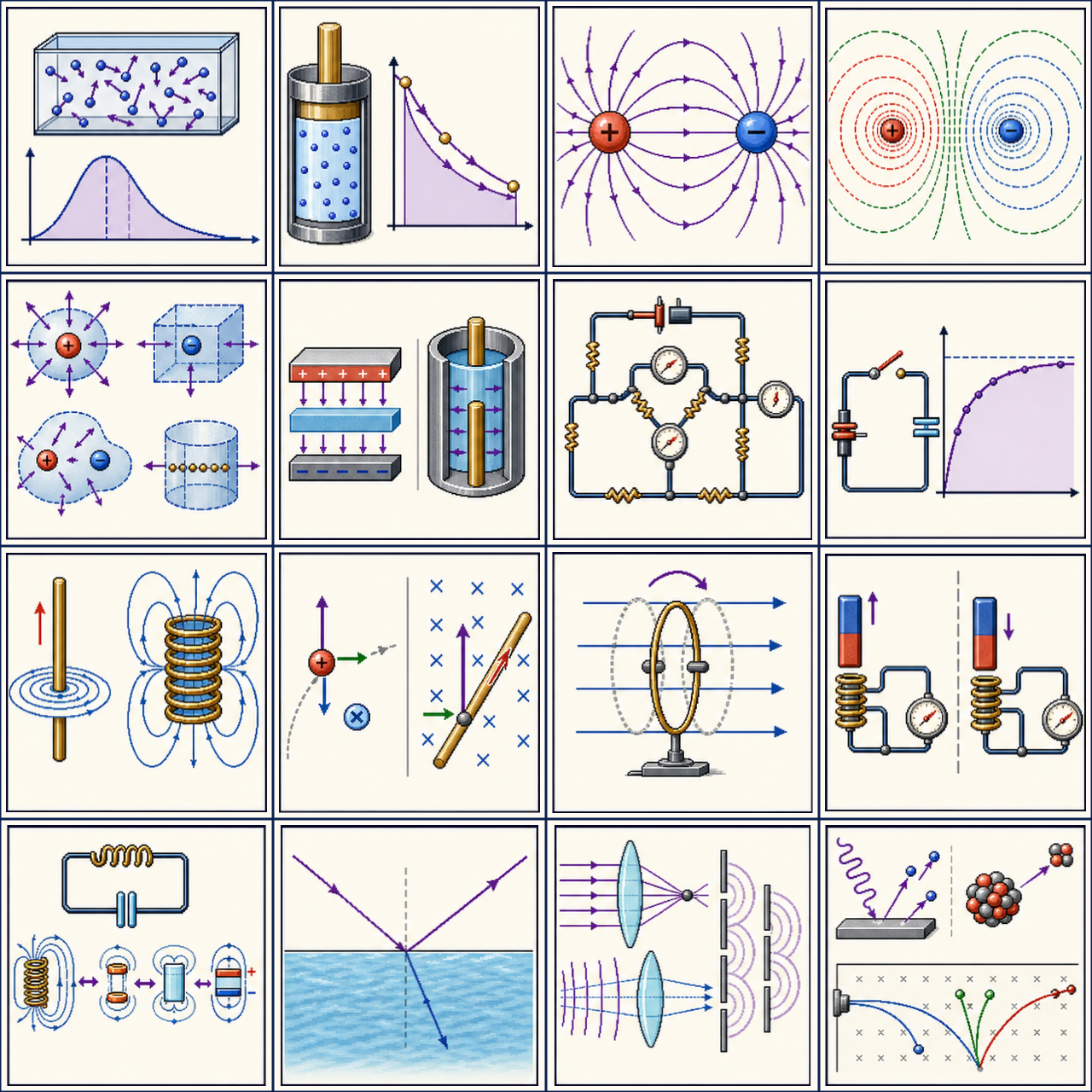
4. Worked Example and Lab Link
A 0.50 m rod moves at 4 m/s perpendicular to a 2 T field. Find motional emf.
Answer: |ℰ|=(2)(0.50)(4)=4 V.
Investigation idea: Move a magnet through a coil at varied speeds and compare signed voltage-area with flux change.
Common trap: The minus sign represents opposition to flux change, not a claim that induced emf is numerically negative in every coordinate choice.
Explain how magnetic flux supports or limits this conclusion: |ℰ|=(2)(0.50)(4)=4 V.
Official curriculum reference: College Board AP Physics C: Electricity and Magnetism course page. The explanation and worked example are independently written for this study site.