AP Physics C: Electricity and Magnetism · Unit 9 · Topic 9.3
Conservation of Electric Energy
Scalar potential and vector field are linked by line integrals and gradients, simplifying energy and distribution problems.
1. Topic Lens
Conservation of Electric Energy is studied through electric potential. Connect the system boundary, interacting parts, and measurable evidence before applying a formula.
2. Why the Formula Works
The relationship is built from definitions and conservation reasoning:
- Electric potential change is negative work per unit charge done by the field.
- For an infinitesimal displacement, dV=-E·dℓ.
- The directional-derivative identity for every direction gives E=-∇V.
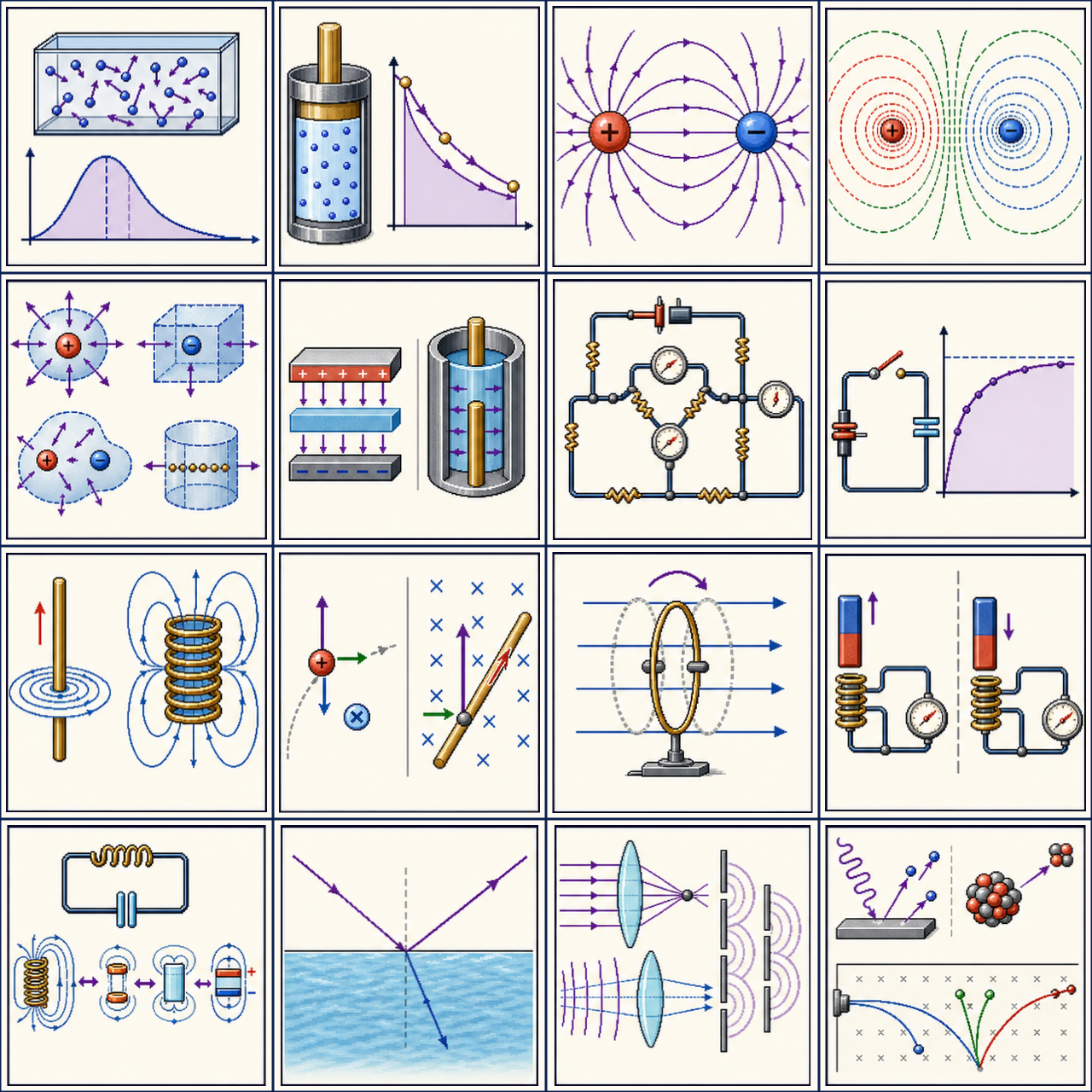
3. Detailed Visual Model
4. Worked Example and Lab Link
A charge q=2 C moves through ΔV=-5 V. Find its potential-energy change.
Answer: ΔU=qΔV=(2)(-5)=-10 J.
Investigation idea: Create a numerical potential map for multiple charges and compare gradient arrows with directly summed fields.
Common trap: Potential can be zero where field is not zero; potential reference choice does not change measurable differences.
Explain how conservation of electric energy supports or limits this conclusion: ΔU=qΔV=(2)(-5)=-10 J.
Official curriculum reference: College Board AP Physics C: Electricity and Magnetism course page. The explanation and worked example are independently written for this study site.