AP Physics C: Electricity and Magnetism · Unit 12 · Topic 12.2
Magnetism and Moving Charges
Vector products, superposition, and symmetry determine magnetic fields and their forces on charges, wires, and loops.
1. Topic Lens
Magnetism and Moving Charges is studied through magnetic fields and electromagnetism. Connect the system boundary, interacting parts, and measurable evidence before applying a formula.
2. Why the Formula Works
The relationship is built from definitions and conservation reasoning:
- The Biot-Savart law superposes current-element contributions.
- For a highly symmetric current, the tangential field has constant magnitude on an Ampèrian loop.
- Pulling B outside the line integral gives B times loop length equals μ₀Ienc.
3. Detailed Visual Model
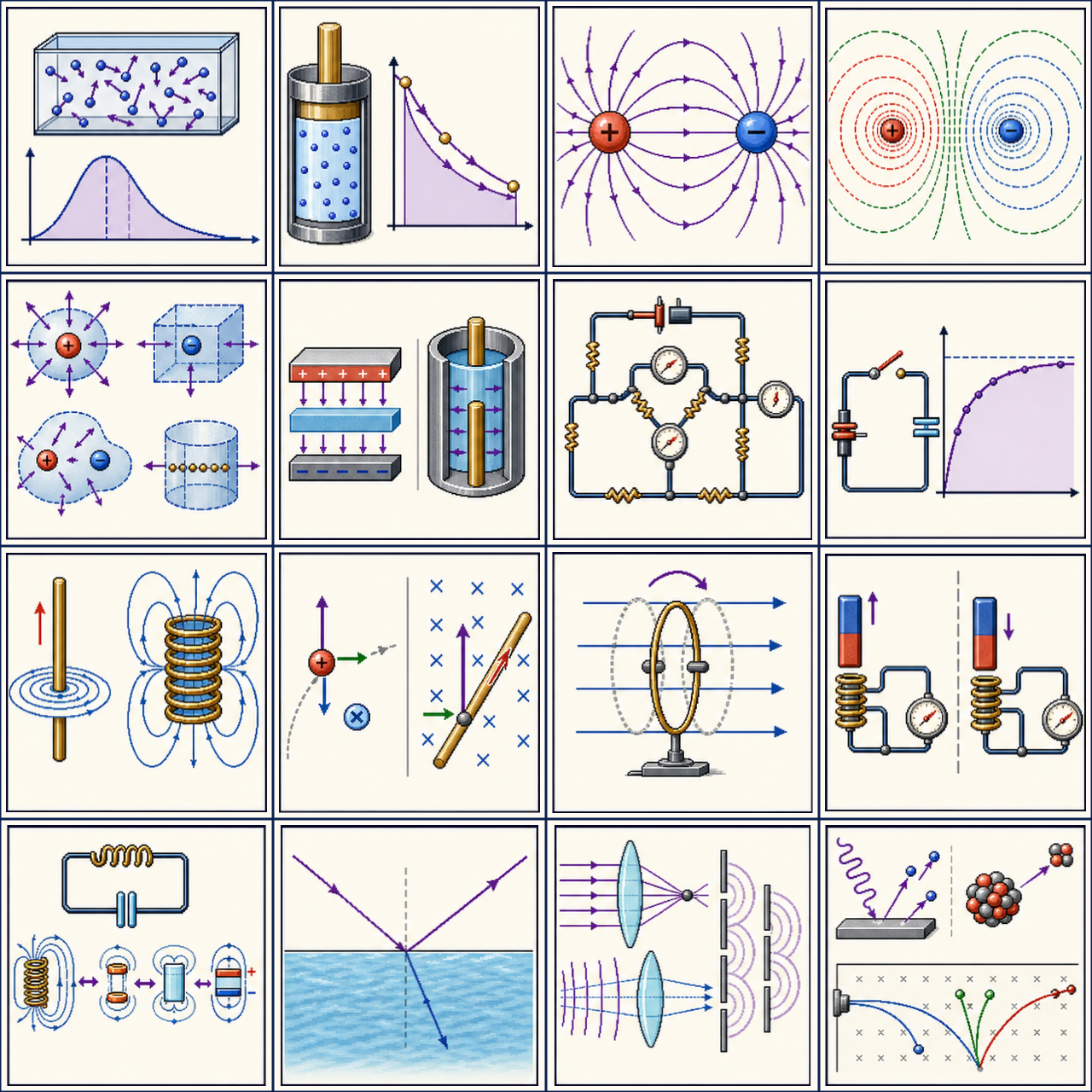
4. Worked Example and Lab Link
For a long straight wire, doubling current while holding radius fixed does what to B?
Answer: Since B=μ₀I/(2πr), the field doubles.
Investigation idea: Map B around a long conductor at several radii and test the predicted inverse-radius pattern.
Common trap: Ampère's law is always valid in magnetostatics, but using it to solve for B requires enough symmetry.
Explain how magnetism and moving charges supports or limits this conclusion: Since B=μ₀I/(2πr), the field doubles.
Official curriculum reference: College Board AP Physics C: Electricity and Magnetism course page. The explanation and worked example are independently written for this study site.