AP Physics C: Electricity and Magnetism · Unit 11 · Topic 11.4
Electric Power
Differential equations and conservation rules predict steady and transient behavior in resistive-capacitive networks.
1. Topic Lens
Electric Power is studied through electric circuits. Connect the system boundary, interacting parts, and measurable evidence before applying a formula.
2. Why the Formula Works
The relationship is built from definitions and conservation reasoning:
- For a charging loop, Kirchhoff's rule gives ℰ-IR-Q/C=0.
- Use I=dQ/dt to form R dQ/dt+Q/C=ℰ.
- Solving the first-order equation with Q(0)=0 gives Q=Cℰ(1-e^{-t/RC}) and V=Q/C.
3. Detailed Visual Model
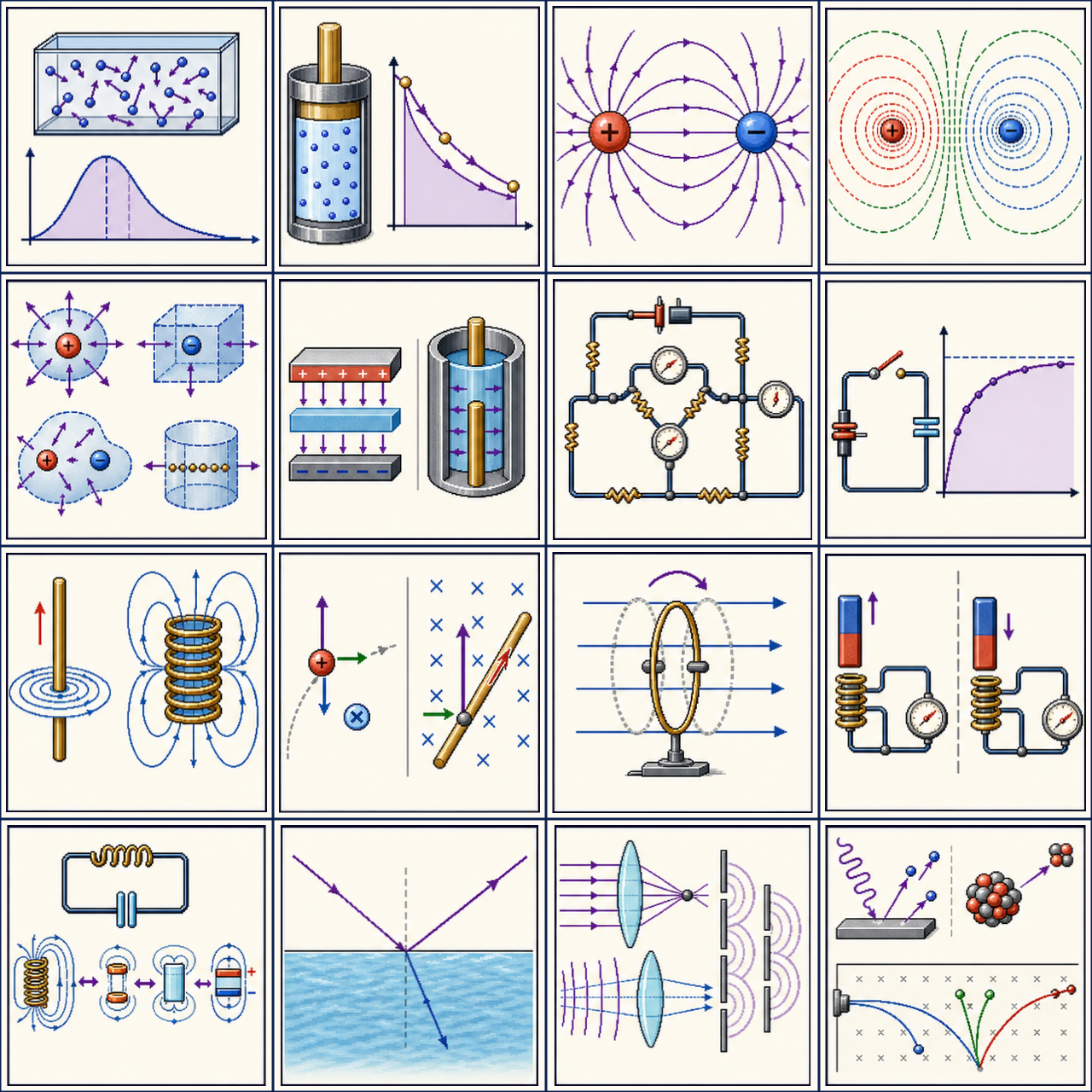
4. Worked Example and Lab Link
For R=2 MΩ and C=3 μF, find the time constant.
Answer: τ=RC=(2×10⁶)(3×10⁻⁶)=6 s.
Investigation idea: Collect capacitor voltage versus time, linearize the exponential, and estimate R or C with uncertainty.
Common trap: At one time constant a charging capacitor reaches about 63%, not 100%, of its final voltage.
Explain how electric power supports or limits this conclusion: τ=RC=(2×10⁶)(3×10⁻⁶)=6 s.
Official curriculum reference: College Board AP Physics C: Electricity and Magnetism course page. The explanation and worked example are independently written for this study site.