AP Physics C: Electricity and Magnetism · Unit 8 · Topic 8.5
Electric Flux
Vector integration, symmetry, flux, and conductor conditions determine electrostatic fields from discrete and continuous charge.
1. Topic Lens
Electric Flux is studied through electric charges, fields, and gauss’s law. Connect the system boundary, interacting parts, and measurable evidence before applying a formula.
2. Why the Formula Works
The relationship is built from definitions and conservation reasoning:
- Superpose the differential field contributions dq from a continuous distribution.
- Electric flux sums the normal field component over a closed surface.
- For inverse-square sources, the closed-surface flux depends only on enclosed charge, yielding Gauss's law.
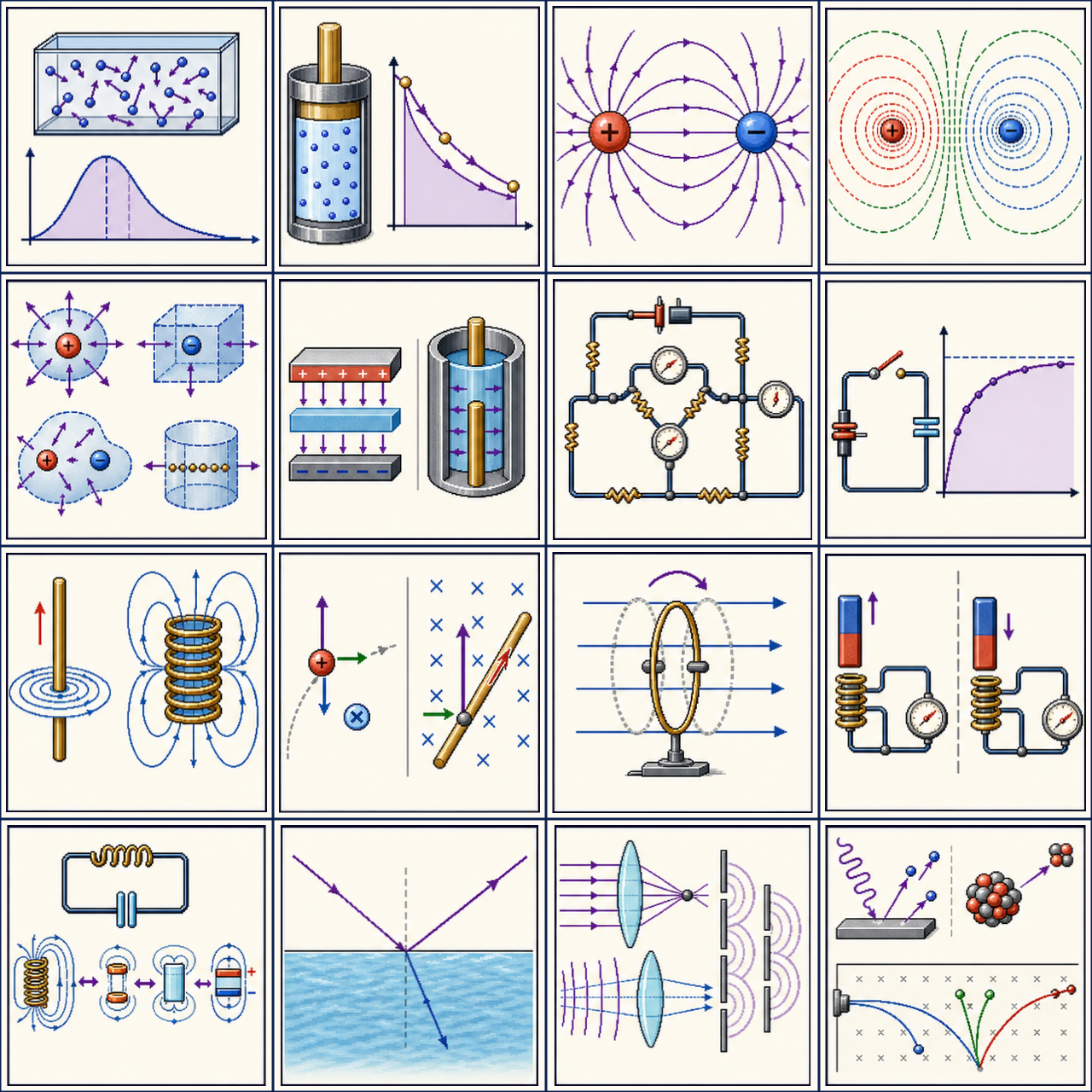
3. Detailed Visual Model
4. Worked Example and Lab Link
A closed surface encloses charge Q. What is the total electric flux through it?
Answer: The flux is Q/ε₀, independent of the surface shape.
Investigation idea: Numerically integrate the field of a finite line of charge and compare with symmetry-based limiting cases.
Common trap: Gauss's law is always true, but it is only easy for finding E when symmetry makes the field behavior known.
Explain how electric flux supports or limits this conclusion: The flux is Q/ε₀, independent of the surface shape.
Official curriculum reference: College Board AP Physics C: Electricity and Magnetism course page. The explanation and worked example are independently written for this study site.