Algebra 1 · Unit 3 · Topic 3.4
Absolute Value as Distance and Equations
Interpret absolute value as distance, solve two-branch equations, and use a V-shaped graph and number line to explain two, one, or no solutions.
Distance explains the two possible signs
The numbers \(5\) and \(-5\) are on opposite sides of zero, but each is \(5\) units from it. Absolute value keeps that distance, not the direction: \(|5|=5\) and \(|-5|=5\). For a real number \(u\),
\[ |u|=\begin{cases} u,&u\ge0,\\ -u,&u<0. \end{cases} \]
The second branch makes a negative input's distance positive. In this lesson the variables are real numbers without physical units. A distance is never negative, so \(|u|\ge0\) for every allowed input.
The expression \(|x-a|\) measures the distance between \(x\) and a reference point \(a\) on a number line. If that distance must equal a positive number \(k\), \(x\) can lie \(k\) units to the left or \(k\) units to the right of \(a\):
\[ |x-a|=k,\quad k>0 \quad\Longleftrightarrow\quad x=a-k\ \text{or}\ x=a+k. \]
The word “or” matters: each position is a separate solution. If \(k=0\), the two positions coincide at \(x=a\), giving one solution. If \(k<0\), there is no solution because a distance cannot be negative. These are conclusions about the isolated absolute-value expression; if other operations surround it, undo those operations first.
Solve the original equation in two branches
The existing example is \(|2x-3|=7\). Since the right side is positive, the expression inside the bars may be \(7\) or \(-7\). Solve each resulting linear equation:
\[ \begin{aligned} 2x-3=7 &\quad\Longrightarrow\quad 2x=10 \quad\Longrightarrow\quad x=5,\\ 2x-3=-7 &\quad\Longrightarrow\quad 2x=-4 \quad\Longrightarrow\quad x=-2. \end{aligned} \]
Both solutions pass a check in the original equation: \(|2(5)-3|=|7|=7\) and \(|2(-2)-3|=|-7|=7\). Keeping only the positive branch would lose \(-2\). Writing \(2x-3=7\) or \(2x-3=7\) after “removing” the bars would repeat one branch rather than find both.
There is also a distance interpretation hidden in the coefficient \(2\):
\[ |2x-3| =\left|2\left(x-\frac32\right)\right| =2\left|x-\frac32\right|. \]
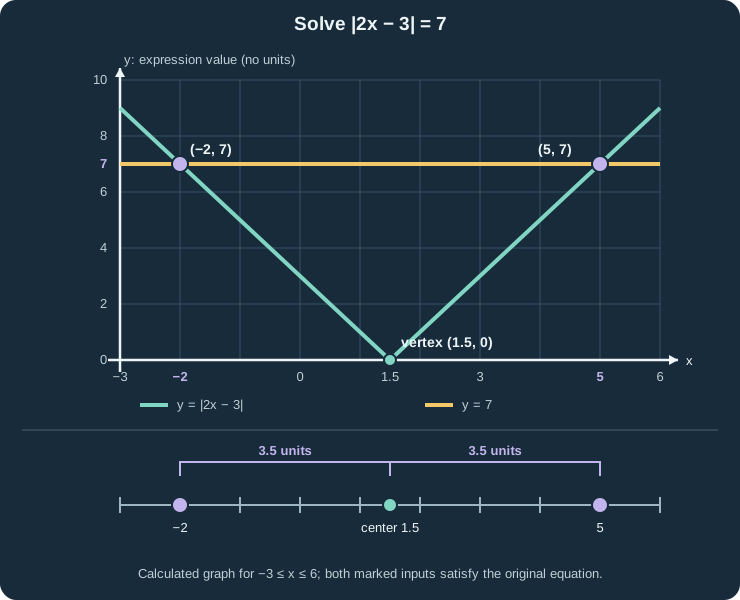
Because \(2>0\), \(|2v|=2|v|\). Divide the equation by \(2\) to obtain \(\left|x-\tfrac32\right|=\tfrac72\). Thus \(x\) is \(3.5\) units from the center \(1.5\), giving \(1.5-3.5=-2\) and \(1.5+3.5=5\). This does not say that \(x\) is \(7\) units from \(3\); the factor \(2\) changes the distance scale.
One graph, two intersections
Graph \(y=|2x-3|\) and the horizontal line \(y=7\). The first is a V with its lowest point at \((1.5,0)\): to the left, \(2x-3\) is negative and the absolute value reflects it upward; to the right, \(2x-3\) is positive and rises normally. The horizontal line meets the V at \((-2,7)\) and \((5,7)\). The \(x\)-coordinates, not the shared \(y\)-coordinate \(7\), are the equation's solutions.
| Input \(x\) | \(2x-3\) | \(|2x-3|\) | | ---: | ---: | ---: | | \(-2\) | \(-7\) | \(7\) | | \(1.5\) | \(0\) | \(0\) | | \(5\) | \(7\) | \(7\) |
Isolate the bars before deciding how many branches exist
For example, solve \(3|x+1|-2=10\). Adding \(2\) and dividing by positive \(3\) first gives \(|x+1|=4\). Now the two branches are \(x+1=4\) or \(x+1=-4\), so \(x=3\) or \(x=-5\). Check: either input makes \(|x+1|=4\), hence \(3(4)-2=10\). Branching before isolating the bars could incorrectly equate \(x+1\) to \(10\), which ignores the outside operations.
If the isolated equation is \(|x-4|=0\), only \(x=4\) works. If it is \(|x-4|=-2\), no real number works. On the graph of \(y=|x-4|\), a line at height \(0\) touches the V once, while a line at height \(-2\) stays below it and never meets it. This graphical test agrees with the distance test because every absolute-value output is nonnegative.
Be careful not to replace \(|x-3|\) with \(x-3\) for every \(x\): at \(x=1\), the inside value is \(-2\), but the distance \(|1-3|\) is \(2\). First isolate the absolute value, inspect whether the target distance is positive, zero, or negative, and only then form the appropriate branches and check any candidates in the starting equation.
Further reading
The distance definition and graph behavior were checked against OpenStax Elementary Algebra 2e, §1.3: Add and Subtract Integers and OpenStax Algebra and Trigonometry 2e, §3.6: Absolute Value Functions. The prose, worked interpretations, table, and SVG diagram here were independently created; textbook wording, exercises, and artwork were not reproduced.