Algebra 1 · Unit 2 · Topic 2.2
Multi-Step Linear Equations
Solve multi-step linear equations by distributing, combining like terms, preserving equality, and checking the answer against the original equation and graph.
First see the operations around the variable
In \(4(2x-1)+3=23\), the variable \(x\) is inside a difference, that difference is multiplied by \(4\), and then \(3\) is added. The equation is linear because distributing and collecting terms leaves only a first power of \(x\). Here \(x\) is any real number; the numbers are abstract, with no physical units attached. Our goal is to find the input that makes the two sides equal, not simply to make the expression shorter.
There are two sensible routes. We can simplify the left side first, or we can undo the outer operations in reverse order. Each route must preserve equality by doing the same reversible operation to both sides.
Route 1: distribute and collect before isolating
Start with the original equation. The \(4\) multiplies both \(2x\) and \(-1\); the extra \(+3\) is outside the parentheses:
\[ \begin{aligned} 4(2x-1)+3&=23\\ 8x-4+3&=23 &&\text{distribute }4\\ 8x-1&=23 &&\text{combine the constants}\\ 8x&=24 &&\text{add }1\text{ to both sides}\\ x&=3. &&\text{divide both sides by }8 \end{aligned} \]
The division is allowed because \(8\ne0\). Every displayed equation has the same solution set as the preceding one. A common wrong expansion is \(8x-1+3\): it multiplies \(2x\) by \(4\) but forgets to multiply \(-1\) by \(4\). Keeping a separate line for distribution makes that missing product easier to spot.
Check the answer in the original equation, not only in \(8x-1=23\):
\[ 4(2\cdot3-1)+3=4(6-1)+3=4(5)+3=23. \]
The result equals the original right side, so \(x=3\) works. Since the equivalent equation \(8x=24\) has only one solution, there are no other real solutions.
Route 2: undo the outside operations
The parentheses can also stay intact. The left side first adds \(3\), so subtract \(3\) from both sides. Then the grouped quantity is multiplied by \(4\), so divide both sides by \(4\):
\[ \begin{aligned} 4(2x-1)+3&=23\\ 4(2x-1)&=20 &&\text{subtract }3\\ 2x-1&=5 &&\text{divide by }4\\ 2x&=6 &&\text{add }1\\ x&=3. &&\text{divide by }2 \end{aligned} \]
This route reverses the order in which the expression was built: add \(3\), multiply by \(4\), subtract \(1\), multiply \(x\) by \(2\). We undo those steps from the outside inward. Both methods are valid here; neither requires a mysterious rule about “moving a number across the equals sign.” Each line records an operation on both sides.
The graph shows where the sides meet
Let \(L(x)=4(2x-1)+3=8x-1\) be the left-side value and \(R(x)=23\) the right-side value. The graph below has input \(x\) on the horizontal axis and the value of each side on the vertical axis. It is an original calculated diagram, not experimental data. The sloping teal line represents \(L\); the horizontal gold line represents \(R\).
| \(x\) | Left side \(4(2x-1)+3\) | Right side | Equal? |
|---|---|---|---|
| \(2\) | \(4(4-1)+3=15\) | \(23\) | No |
| \(3\) | \(4(6-1)+3=23\) | \(23\) | Yes |
| \(4\) | \(4(8-1)+3=31\) | \(23\) | No |
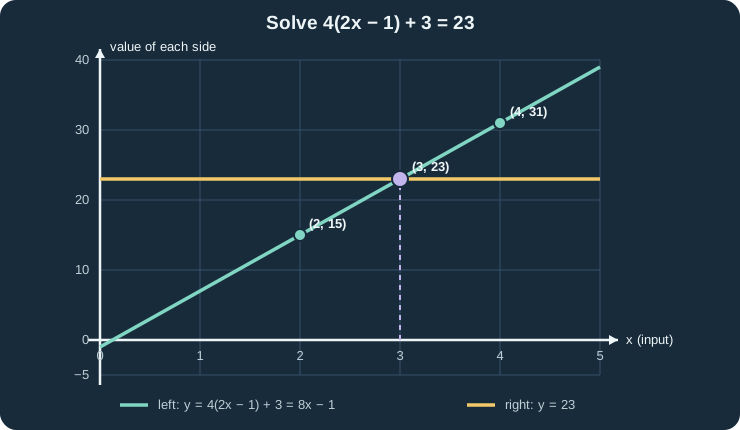
The graph helps check the answer, but the algebra establishes it exactly. The displayed picture covers only \(0\le x\le5\), while the solving steps apply to every real \(x\). A graph's limited viewing window should not be mistaken for a restriction in the original equation.
A negative multiplier needs the same care
Consider \(-2(3t-4)+5=19\), with \(t\) any real number. Distributing \(-2\) changes both signs inside the parentheses:
\[ \begin{aligned} -2(3t-4)+5&=19\\ -6t+8+5&=19\\ -6t+13&=19\\ -6t&=6\\ t&=-1. \end{aligned} \]
Substitution checks the sign: \(-2(3(-1)-4)+5=-2(-7)+5=19\). If the second product were written as \(-8\) instead of \(+8\), the equation would change and the answer would fail this check. Simplification is useful precisely because it exposes signed terms before we isolate the variable.
Further reading
The solving principles and topic scope were checked against OpenStax Elementary Algebra, §2.4: A General Strategy to Solve Linear Equations and §2.2: Division and Multiplication Properties of Equality. The prose, worked examples, table, and SVG graph here were independently created; textbook text, exercises, and artwork were not reproduced.