Algebra 1 · Unit 2 · Topic 2.3
Variables on Both Sides and Solution Types
Solve linear equations with variables on both sides, and use equations and graphs to distinguish one solution, no solution, and infinitely many solutions.
When both sides depend on \(x\)
An equation such as \(5x+2=3x+10\) asks a precise question: which input makes the two expressions have the same value? Both sides change as \(x\) changes. That is why we cannot find the answer by looking only at the constants \(2\) and \(10\). In this lesson \(x\) is a real number, and the expressions have no physical units or restrictions on their domain.
Subtracting the same quantity from both sides preserves equality. We can use that fact even when the quantity contains \(x\). For the example above, subtract \(3x\) from each side, then subtract \(2\) from each side:
\[ \begin{aligned} 5x+2&=3x+10\\ 2x+2&=10 &&\text{after subtracting }3x\\ 2x&=8 &&\text{after subtracting }2\\ x&=4. &&\text{after dividing by }2 \end{aligned} \]
The final division is valid because \(2\ne0\). Check the result in the original equation: \(5(4)+2=22\) and \(3(4)+10=22\). Thus \(x=4\) works. Every step was reversible, so it is the only real solution. Writing “move \(3x\) to the left” may be a useful shortcut later, but the actual operation is subtracting \(3x\) on both sides; that detail keeps the signs reliable.
Why some equations have no answer, while others have every answer
Now compare two equations that look almost identical:
\[ \begin{aligned} 2(x+3)&=2x+7\\ 2x+6&=2x+7\\ 6&=7 &&\text{after subtracting }2x. \end{aligned} \]
The statement \(6=7\) is false regardless of \(x\). This equation has no solution. The variable disappearing does not mean \(x=0\); it means the two sides differ by \(1\) for every input. For instance, at \(x=0\) they are \(6\) and \(7\), and at \(x=4\) they are \(14\) and \(15\).
Change only the right-hand constant from \(7\) to \(6\):
\[ \begin{aligned} 2(x+3)&=2x+6\\ 2x+6&=2x+6\\ 6&=6 &&\text{after subtracting }2x. \end{aligned} \]
Here the remaining statement is true. Both sides are exactly the same expression, so every real number is a solution. For example, \(x=-3\) gives \(0=0\), and \(x=4\) gives \(14=14\). This is called an identity. A true statement after the variable disappears is not “one solution at zero”; there are infinitely many real solutions.
See the three outcomes as graphs
For each equation, graph the value of its left side and the value of its right side against the same input \(x\). A solution is an \(x\)-coordinate where the two graphs meet. The diagrams below are original, calculated line graphs. Their vertical scales differ between rows so that the two close, parallel lines in the middle row remain distinguishable; each horizontal axis shows only \(0\le x\le5\), although the algebraic conclusions apply to all real \(x\).
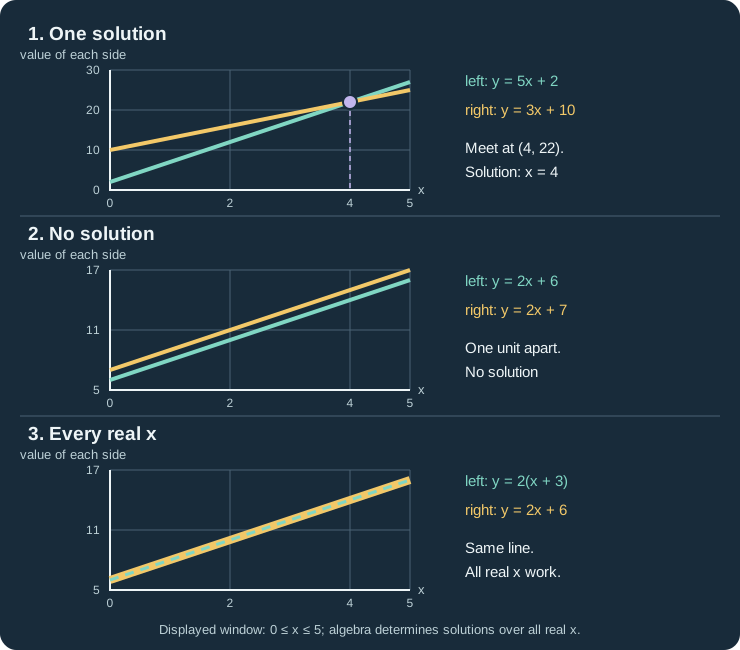
The first pair of lines has different slopes, \(5\) and \(3\), so they cross once at \((4,22)\). The second pair has the same slope \(2\) but different vertical intercepts, \(6\) and \(7\), so they remain one unit apart. In the third pair, distributing \(2(x+3)\) gives \(2x+6\): both names describe the same line. If two drawn lines overlap, the graph may look like only one line; that is exactly what the identity predicts.
A general test before dividing
Any equation of the form \(ax+b=cx+d\), where \(a,b,c,d\) are real constants, can be rewritten by subtracting \(cx\) and then \(b\):
\[ (a-c)x=d-b. \]
This form explains all three cases without guessing:
| After simplifying | What it means | Solution set |
|---|---|---|
| \(a-c\ne0\) | Divide by a nonzero coefficient | One value: \(x=\dfrac{d-b}{a-c}\) |
| \(a-c=0\), \(d-b\ne0\) | \(0x=\text{nonzero}\) is false | No solution |
| \(a-c=0\), \(d-b=0\) | \(0x=0\) is true for every input | All real numbers |
Do not divide by \(a-c\) before checking whether it is zero. Dividing by zero is undefined, and it would hide the difference between a contradiction and an identity. Also, this “all real numbers” conclusion assumes the original expressions are defined for all real \(x\), as they are for these linear expressions. If a later equation contains a denominator or another domain restriction, excluded inputs remain excluded even when simplification produces a true statement.
To check your own work, simplify each side carefully, gather variable terms with the same operation on both sides, and inspect the final equality. If one value remains, substitute it into the original equation. If the variable disappears, decide whether the remaining numerical statement is true or false; do not invent \(x=0\) as an answer.
Further reading
The algebraic cases were checked against OpenStax Elementary Algebra 2e, §2.3: Variables and Constants on Both Sides and §2.4: General Strategy for Linear Equations. This explanation, its examples, and the graph were independently created; textbook wording, exercises, and artwork were not reproduced.