Algebra 1 · Unit 3 · Topic 3.5
Absolute-Value Inequalities and Tolerances
Use absolute-value inequalities to model tolerances, distinguish values inside and outside a distance limit, and interpret endpoints on V graphs and number lines.
A tolerance measures distance from a target
A manufactured part need not be exactly \(10\text{ cm}\) long to meet a specification. Suppose the allowed difference from \(10\text{ cm}\) is at most \(0.2\text{ cm}\). Let \(L\) be the measured length in centimeters, so the number \(L-10\) is a signed deviation in centimeters: negative below the target, positive above it. The absolute value \(|L-10|\) removes the direction and retains the size of the deviation. The acceptance rule is therefore
\[ |L-10|\le0.2, \]
with both numbers expressed in centimeters. This is a mathematical acceptance rule, not a claim that a particular factory produces parts uniformly or that a measuring instrument has zero error. We assume \(L\) can vary continuously; the physical domain also requires \(L\ge0\).
For a real input \(x\), a target \(a\), and a positive radius \(r\), the condition \(|x-a|\le r\) means the input is no farther than \(r\) from \(a\). It must be at least \(a-r\) and at most \(a+r\). With strict \(<\), both endpoints are excluded:
\[ |x-a|\le r\ \Longleftrightarrow\ a-r\le x\le a+r, \qquad |x-a|<r\ \Longleftrightarrow\ a-r<x<a+r \quad(r>0). \]
The word and is essential: a value must obey both the lower and the upper bound to be inside the tolerance band.
Solve the original \(10\pm0.2\) cm example
First express the allowed distance as a three-part inequality, then add \(10\) to all three parts:
\[ \begin{aligned} |L-10|&\le0.2\\ -0.2&\le L-10\le0.2\\ 9.8&\le L\le10.2. \end{aligned} \]
Thus the acceptable lengths are \(\left[9.8,10.2\right]\text{ cm}\). At \(L=10.15\text{ cm}\), the deviation is \(|10.15-10|=0.15\text{ cm}\le0.2\text{ cm}\), so the part is accepted. At \(9.8\text{ cm}\) and \(10.2\text{ cm}\), the deviation is exactly \(0.2\text{ cm}\), so both boundary values are included. At \(10.25\text{ cm}\), the deviation is \(0.25\text{ cm}\), so it is outside the allowed range.
The graph below plots calculated deviation \(y=|L-10|\) against length \(L\), together with the limit \(y=0.2\). The V reaches zero at the target \(10\text{ cm}\). Its intersections with the limit occur at \(9.8\) and \(10.2\text{ cm}\). For lengths between these values, the V is at or below the limit. The two number lines distinguish acceptable lengths, \(|L-10|\le0.2\), from lengths strictly outside the band, \(|L-10|>0.2\).
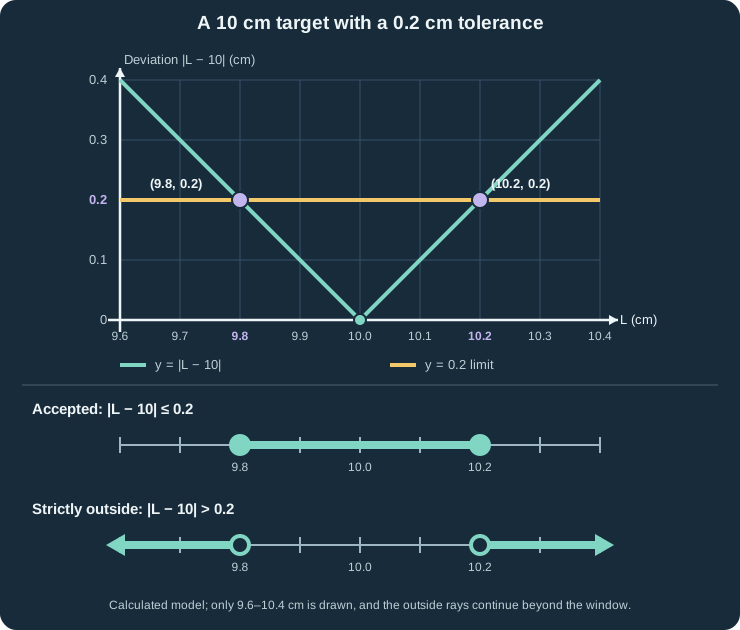
The graph displays only \(9.6\le L\le10.4\text{ cm}\), while the algebraic outside-tolerance set extends beyond that viewing window. Physical lengths are nonnegative; a real measurement process would also need to account separately for measurement uncertainty.
“Outside” joins two regions with “or”
To be more than \(r>0\) units from \(a\), \(x\) must lie farther left than \(a-r\) or farther right than \(a+r\):
\[ |x-a|>r \ \Longleftrightarrow\ x<a-r\ \text{or}\ x>a+r. \]
For the same part, \(|L-10|>0.2\) means \(L<9.8\) or \(L>10.2\text{ cm}\). Its interval notation over the nonnegative physical domain is \(\left[0,9.8\right)\cup\left(10.2,\infty\right)\text{ cm}\); if \(L\) were allowed to be any real number, the first interval would instead extend to \(-\infty\). That domain distinction matters: a negative length belongs to an abstract number-line inequality but cannot describe this part.
Changing the symbol changes the endpoint rule. The statement \(|L-10|\ge0.2\) includes \(9.8\) and \(10.2\); it describes deviations at least \(0.2\text{ cm}\), not failures under the original “at most \(0.2\text{ cm}\)” specification. Decide whether the wording says at most, less than, at least, or more than before selecting open or filled endpoints.
Isolate the distance before splitting the cases
Suppose \(2|x-3|+1<9\), with \(x\) any real number. The bars are not yet isolated. Subtract \(1\), divide by positive \(2\), and only then turn the distance condition into an “and” inequality:
\[ \begin{aligned} 2|x-3|+1&<9\\ 2|x-3|&<8\\ |x-3|&<4\\ -4&<x-3<4\\ -1&<x<7. \end{aligned} \]
The solution is \(\left(-1,7\right)\). The midpoint \(x=3\) gives \(1<9\), but either endpoint gives \(9<9\), which is false. If we had split into cases before removing the outside \(2\) and \(+1\), the thresholds would have been wrong.
For an outside example, \(|2x+1|\ge5\) gives \(2x+1\le-5\) or \(2x+1\ge5\), hence \(x\le-3\) or \(x\ge2\). Check the boundaries in the original: at \(-3\) and \(2\), the absolute value is exactly \(5\), so both are included. At \(x=0\), the value is only \(1\), confirming the gap between the rays.
Check the threshold before using the usual pattern
The inside/outside formulas above assume \(r>0\). If the isolated threshold is \(0\), then \(|u|\le0\) holds only when \(u=0\), while \(|u|<0\) has no solution. Also \(|u|\ge0\) holds for every real input for which \(u\) is defined, and \(|u|>0\) excludes only the inputs that make \(u=0\). If the threshold is negative, \(|u|<r\) and \(|u|\le r\) have no solutions, while \(|u|>r\) and \(|u|\ge r\) hold for every allowed input. These follow from the nonnegativity of absolute value; blindly applying the positive-radius “between” or “outside” picture would give the wrong result.
When checking an answer, compare a point inside the band, a point outside it, and each boundary with the original inequality. The equation, graph, interval notation, and real-world acceptance wording should all agree about those same points.
Further reading
The distance-to-interval and distance-to-rays reasoning was checked against OpenStax Intermediate Algebra 2e, §2.7: Solve Absolute Value Inequalities. The explanation, numerical checks, tolerance scenario details, and SVG diagram here were independently written or drawn; textbook wording, exercises, and artwork were not reproduced.