Algebra 1 · Unit 1 · Topic 1.4
Terms, Coefficients, and Simplification
Identify signed terms and coefficients, combine only like variable parts, and use a graph to understand why coefficients add.
Read an expression as signed pieces
In \(7x^2-2x+3x^2+9x-6\), the minus signs belong to the pieces that follow them. Rewrite subtraction as addition of a negative to see the five terms:
\[ 7x^2+(-2x)+3x^2+9x+(-6). \]
A term is a number, a variable, or a product of numbers and variables. The numerical factor of a variable term is its coefficient. In \(-2x\) the coefficient is \(-2\), not \(2\); in \(x\) the unwritten coefficient is \(1\); and in \(-x\) it is \(-1\). The number \(-6\) is a constant term because it contains no variable. Keep the sign with each term when rearranging an expression: moving \(-2x\) means moving the whole negative term.
The variable part tells us which terms may be combined. Terms are like terms only when they have exactly the same variables raised to exactly the same powers. Their coefficients may differ:
| Term pair | Like terms? | Reason |
|---|---|---|
| \(7x^2\) and \(3x^2\) | Yes | Both have the variable part \(x^2\). |
| \(-2x\) and \(9x\) | Yes | Both have the variable part \(x\). |
| \(x^2\) and \(x\) | No | The exponents \(2\) and \(1\) differ. |
| \(4xy\) and \(-xy\) | Yes | Both contain one \(x\) and one \(y\). |
| \(4xy\) and \(4x^2y\) | No | The power of \(x\) differs. |
| \(-6\) and \(11\) | Yes | Any two constants can be added. |
Why only coefficients add
For any real input \(x\), \(2x\) means two copies of \(x\), and \(3x\) means three more copies. Together they make five copies:
\[ 2x+3x=(2+3)x=5x. \]
This is the distributive property used backward. It still works when \(x\) is negative: at \(x=-1\), the outputs are \(-2+(-3)=-5\). The following original graph plots those three expressions for \(-2\le x\le2\). Both axes are in abstract number units; this is a calculated relationship, not measured data. At \(x=1\), the teal line gives \(2\), the gold line gives \(3\), and the lavender line gives their sum \(5\).
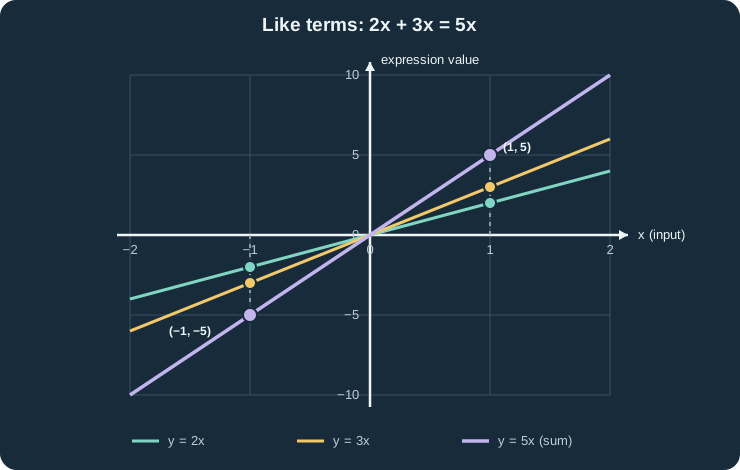
The graph helps interpret the rule, but the equation \((2+3)x=5x\) proves it for every real \(x\), not just the inputs shown. If the variable parts differed, there would be no common factor \(x\) to pull out in this way. For example, \(x^2+x\) does not become \(x^3\). At \(x=2\), the sum is \(4+2=6\), whereas \(x^3=8\). The exponent rule \(x^2\cdot x=x^3\) applies to multiplication, not addition.
Simplify the original expression without losing a sign
Return to \(7x^2-2x+3x^2+9x-6\). Group terms by their variable parts. Reordering terms of a sum does not change its value, provided each term keeps its sign:
\[ \begin{aligned} 7x^2-2x+3x^2+9x-6 &=(7x^2+3x^2)+(-2x+9x)-6\\ &=(7+3)x^2+(-2+9)x-6\\ &=10x^2+7x-6. \end{aligned} \]
The \(x^2\)-terms combine with each other, the \(x\)-terms combine with each other, and the constant remains \(-6\). “Simplified” does not mean that every term has been merged into one; it means no like terms remain to combine.
Substitution can catch an arithmetic error. At \(x=-1\), the original gives \(7(1)-2(-1)+3(1)+9(-1)-6=7+2+3-9-6=-3\). The simplified form gives \(10(1)+7(-1)-6=10-7-6=-3\). Agreement at one input is a check, not a proof of equivalence; the signed-term regrouping and coefficient arithmetic establish the identity for all real \(x\).
When simplification must stop
Consider \(5a-2b+3a+b\), where \(a\) and \(b\) may vary independently. The \(a\)-terms form \(8a\), and the \(b\)-terms form \(-b\), so the result is \(8a-b\). Replacing it with \(7a\) would silently assume \(a=b\), a condition we were never given. Matching numerical coefficients alone never makes terms alike; the entire variable part must match.
The same care applies when parentheses are present. First distribute so that each term and its sign are visible; then group like terms. For instance, \(2(x+3)-x=2x+6-x=x+6\). The last step is \((2-1)x=x\), while the constant \(6\) stays separate.
Further reading
The definitions and topic scope were checked against OpenStax Prealgebra 2e, §2.2: Evaluate, Simplify, and Translate Expressions and OpenStax Elementary Algebra 2e, §1.2: Use the Language of Algebra. The prose, examples, table, and SVG graph here were independently created; textbook text, exercises, and artwork were not reproduced.