Algebra 1 · Unit 1 · Topic 1.1
Real Numbers and the Number Line
Classify rational and irrational numbers, locate fractions and square roots on a number line, and use order and absolute value to compare positions.
A place for every real number
The integers give us useful landmarks on a number line, but they leave gaps between the marks. A measurement of \(\frac18\) unit belongs just to the right of zero; \(\sqrt3\) also has a position, even though its decimal digits do not end. Real numbers are the numbers that can be placed on this continuous line. Moving right means the value increases, regardless of whether the label is a fraction, a decimal, or a square root.
We use the following nested groups to describe them:
| Group | What belongs in it | Examples |
|---|---|---|
| Counting numbers | The positive integers used to count | \(1,2,3,\ldots\) |
| Whole numbers | Counting numbers together with zero | \(0,1,2,3,\ldots\) |
| Integers | Whole numbers and their negative opposites | \(\ldots,-2,-1,0,1,2,\ldots\) |
| Rational numbers | Numbers expressible as \(\frac pq\), where \(p,q\) are integers and \(q\ne0\) | \(-\frac74,\;0,\;0.125\) |
| Irrational numbers | Real numbers that cannot be expressed as such a ratio | \(\sqrt3,\;\pi\) |
Every integer is rational because \(n=\frac n1\). Every rational number is real, but not every real number is rational. In symbols, if \(\mathbb{N}\) starts at \(1\) and \(\mathbb{W}\) includes \(0\), then
\[ \mathbb{N}\subset\mathbb{W}\subset\mathbb{Z}\subset\mathbb{Q}\subset\mathbb{R}, \qquad \mathbb{R}=\mathbb{Q}\cup\{\text{irrational real numbers}\}. \]
The groups describe a number's value, not its appearance. \(0.125=\frac{125}{1000}=\frac18\) is rational because its decimal ends. A repeating decimal is rational too: if \(x=0.\overline{27}=0.272727\ldots\), then \(100x=27.272727\ldots\). Subtracting the first equation from the second gives \(99x=27\), so \(x=\frac{27}{99}=\frac3{11}\). A decimal that neither ends nor repeats is irrational. Writing only a few digits of an irrational number is an approximation, not a new exact value.
Plot fractions and roots without pretending they are integers
The graph is an original number-line diagram, not measured data. Its horizontal axis shows real-number position in units: one equal-length step changes the value by \(1\). The marked points are \(A=-\frac74\), \(B=\frac18\), and \(C=\sqrt3\). The green points are rational; the gold point is irrational.
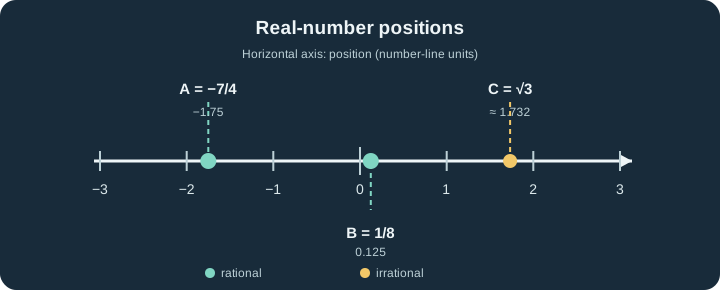
To place \(A\), rewrite \(-\frac74=-1\frac34=-1.75\). It lies between \(-2\) and \(-1\), one quarter of a unit to the right of \(-2\). For \(B\), \(\frac18=0.125\), so divide the interval from \(0\) to \(1\) into eight equal parts and take the first mark. Both conversions preserve the exact value.
For \(C\), we can first bound the square root without knowing all its digits. Because squaring preserves order for nonnegative numbers, \(1^2<3<2^2\) gives \(1<\sqrt3<2\). To refine the location, \(1.7^2=2.89<3\) and \(1.8^2=3.24>3\), so \(1.7<\sqrt3<1.8\). The graph places \(C\) near \(1.732\); \(\sqrt3\), not \(1.732\), is its exact label.
Read order and distance from the same line
A point farther right represents a greater number. From the graph,
\[ -\frac74<\frac18<\sqrt3. \]
This also explains why \(-1.75<-1.4\): \(-1.75\) is farther left, even though \(1.75>1.4\) when the minus signs are removed. If a graph is unavailable, converting fractions to a common denominator or to exact terminating decimals can settle a comparison. Do not round close values prematurely. For example, \(\sqrt3<\frac74\) because both are positive and \(3<\left(\frac74\right)^2=\frac{49}{16}\). Rounding both numbers to the nearest integer would hide the distinction.
The absolute value \(|a|\) is the distance, in number-line units, from \(a\) to zero. Distance cannot be negative, so \(|-\frac74|=\frac74\) and \(|\frac74|=\frac74\), even though the points lie on opposite sides of zero. More generally, the distance between two real-number positions \(a\) and \(b\) is
\[ d(a,b)=|b-a|=|a-b|. \]
For points \(A\) and \(B\), subtracting their coordinates gives
\[ d\!\left(-\frac74,\frac18\right) =\left|\frac18-\left(-\frac74\right)\right| =\left|\frac18+\frac{14}{8}\right| =\frac{15}{8}=1\frac78\text{ units}. \]
The positive result agrees with the picture: there are \(\frac74\) units from \(A\) to zero and another \(\frac18\) unit from zero to \(B\). If the scale instead represented centimeters or seconds, the same subtraction would carry that unit; the diagram here uses abstract number-line units.
Classify the value before the notation
Consider \(-7\), \(0.125\), and \(\sqrt3\). The number \(-7\) is an integer, a rational number (\(-7=-\frac71\)), and a real number. The number \(0.125\) is rational and real, but not an integer. The number \(\sqrt3\) is irrational and real: \(3\) is not a perfect square, and no ratio of integers squares to \(3\). Its position is between \(1\) and \(2\), as the graph shows.
Two notation traps are worth checking before classifying. First, \(\sqrt9=3\), so a square-root symbol does not automatically mean “irrational.” Second, \(\sqrt{-9}\) is not a real number: the square of any real number is nonnegative. That is a limit of the real-number line, not a missing point somewhere to its left.
Further reading
The topic scope and definitions were checked against OpenStax Elementary Algebra 2e, §1.8: The Real Numbers and OpenStax Algebra and Trigonometry 2e, §1.1: Real Numbers. This lesson's prose, worked values, table, and SVG diagram were independently created; no textbook text, exercises, or artwork were copied.