Algebra 1 · Unit 2 · Topic 2.1
Equality and One-Step Equations
Solve one-step equations by preserving equality on both sides, check solutions by substitution, and read a solution as a graph intersection.
An equation asks which input makes a statement true
An expression such as \(x/4\) has a value for each real number \(x\). The equation \(x/4=-6\) makes a stronger claim: it says that the expression's value equals \(-6\). This claim is false for most inputs. For \(x=-20\), the left side is \(-5\), not \(-6\); for \(x=-24\), the left side is \(-6\). A solution is an allowed input that makes the original equality true. Solving means finding all such inputs, not merely making the variable appear alone on a line of working.
Equality is preserved if the same number is added to or subtracted from both sides. Multiplication or division can also be used, provided we do not divide by zero. In symbols, for real numbers \(a,b,c\),
\[ a=b\ \Longleftrightarrow\ a+c=b+c, \qquad a=b\ \Longleftrightarrow\ ac=bc\quad(c\ne0). \]
The double arrow means the two equations have the same truth value under these conditions. Multiplication by a nonzero number can be undone by division by that number. Multiplication by zero cannot: \(2=3\) is false, but \(0\cdot2=0\cdot3\) is true. It would turn every proposed equality into \(0=0\) and erase the information we need to solve.
Undo the operation on the variable
In the existing example, \(x/4=-6\), the variable is divided by \(4\). Multiplying both sides by \(4\) undoes that division. The denominator is nonzero, so this step is reversible:
\[ \begin{aligned} \frac{x}{4}&=-6\\ 4\left(\frac{x}{4}\right)&=4(-6) &&\text{multiply both sides by }4\\ x&=-24. &&\text{since }4/4=1 \end{aligned} \]
Check the original equation, not just the last line: \((-24)/4=-6\), matching the right side. Thus the solution set is \(\{-24\}\). If only the left side had been multiplied by \(4\), the new statement \(x=-6\) would be a different equation with the wrong solution.
The operation to undo depends on what was done to the variable:
| One-step equation | Reversible operation on both sides | Solution and check |
|---|---|---|
| \(u+7=2\) | Subtract \(7\) | \(u=-5\); \(-5+7=2\) |
| \(v-9=-1\) | Add \(9\) | \(v=8\); \(8-9=-1\) |
| \(-5w=35\) | Divide by \(-5\) | \(w=-7\); \((-5)(-7)=35\) |
| \(x/4=-6\) | Multiply by \(4\) | \(x=-24\); \((-24)/4=-6\) |
In the third row, the coefficient is \(-5\), not \(5\). Dividing only by \(5\) would leave a minus sign attached to \(w\). For \(cw=d\), division by \(c\) is valid only when \(c\ne0\); if \(c=0\), the equation needs a separate check rather than division.
A graph gives the equality a location
We can picture the original equation by graphing its two sides as separate outputs: \(L(x)=x/4\) and \(R(x)=-6\). The horizontal axis is the input \(x\), and the vertical axis is the value of each side. These are abstract number values, not measurements. Where the lines cross, the two sides have the same value.
| Input \(x\) | Left side \(L(x)=x/4\) | Right side \(R(x)=-6\) | Equal? |
|---|---|---|---|
| \(-32\) | \(-8\) | \(-6\) | No |
| \(-28\) | \(-7\) | \(-6\) | No |
| \(-24\) | \(-6\) | \(-6\) | Yes |
| \(-20\) | \(-5\) | \(-6\) | No |
| \(-16\) | \(-4\) | \(-6\) | No |
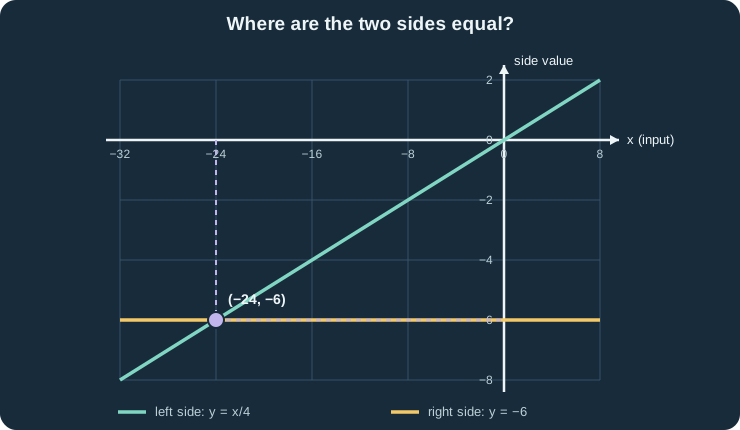
The table and graph help us see where equality happens. The algebraic operation shows why \(-24\) is the only solution: if \(x/4=-6\), multiplying by \(4\) forces \(x=-24\). No other real input can satisfy the same equation. The graph displays only \(-32\le x\le8\), but the algebraic conclusion applies to all real \(x\).
Check what the operation does to the solution set
The slogan “do the same thing to both sides” is useful, but it needs the condition above. Adding \(7\) to both sides of \(u+7=2\) would preserve equality yet make the variable harder to isolate. Subtracting \(7\) is chosen because it reverses the addition beside \(u\). Similarly, multiplying \(x/4=-6\) by \(4\) is chosen because it reverses division by \(4\).
If a one-step equation reads \(0z=5\), no real \(z\) works, since the left side is always \(0\). If it reads \(0z=0\), every real \(z\) works. Dividing either equation by \(0\) would be undefined and would hide this difference. This is why a valid solving step must preserve the solutions, not just produce a tidier-looking expression.
Further reading
The equality rules and topic scope were checked against OpenStax Elementary Algebra, §2.1: Addition and Subtraction Properties of Equality and §2.2: Division and Multiplication Properties of Equality. The prose, table, worked values, and SVG graph here were independently created; textbook text, exercises, and artwork were not reproduced.