Algebra 1 · Unit 3 · Topic 3.2
Solving Linear Inequalities
Solve linear inequalities step by step, explain why a negative multiplier reverses the sign, and check the solution set on graphs and in the original inequality.
An inequality asks for a whole set of inputs
For \(-3x+4<16\), the task is not to find an \(x\) that makes the two sides equal. We need every input for which the left side is smaller. Here \(x\) is any real number, and the expressions are abstract numbers with no physical units. The boundary where the two sides tie will help locate the answer, but because the comparison is strict, that boundary will not itself be a solution.
As with equations, adding or subtracting the same value on both sides preserves a comparison. For instance, \(2<5\) remains true after subtracting \(4\): \(-2<1\). Multiplication needs more care. Multiplying \(2<5\) by \(-1\) produces \(-2>-5\), not \(-2<-5\). On a number line, negation reflects both values across zero and reverses their left-to-right order. That is why multiplying or dividing an inequality by a negative number must reverse \(<\) to \(>\), or \(\le\) to \(\ge\). A positive multiplier preserves the direction.
Solve, then test both sides of the boundary
Keep the original example. Subtract \(4\) from both sides first; this does not change the direction. Then divide by the known negative coefficient \(-3\), reversing the comparison:
\[ \begin{aligned} -3x+4&<16\\ -3x&<12 &&\text{subtract }4\text{ from both sides}\\ x&>-4. &&\text{divide both sides by }-3\text{ and reverse }< \end{aligned} \]
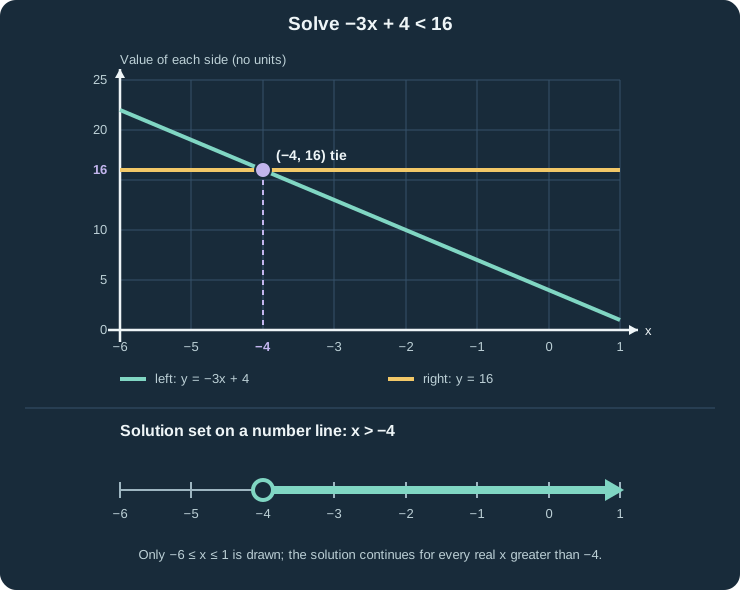
The solution set is \(\left(-4,\infty\right)\). Put an open point at \(-4\) and draw a ray to the right. Why open? Substituting \(-4\) into the starting inequality gives \(-3(-4)+4=16\), and \(16<16\) is false. Testing values on opposite sides checks the direction: \(x=0\) gives \(4<16\), true, whereas \(x=-5\) gives \(19<16\), false. A test value supports the result; the equivalent algebraic steps establish the whole solution set.
The original graph below displays the two values \(y=-3x+4\) and \(y=16\) against \(x\). They meet at \((-4,16)\). To the right of \(-4\), the sloping left-side line lies below the horizontal right-side line, so the inequality holds. The lower number line records exactly those inputs with an open circle at the tie. Both plots show only \(-6\le x\le1\); the actual solution ray continues without bound.
If the coefficient is positive, keep the direction
Compare a problem with a positive coefficient after simplification:
\[ \begin{aligned} 2(x-1)&\le x+4\\ 2x-2&\le x+4 &&\text{distribute }2\\ x-2&\le4 &&\text{subtract }x\\ x&\le6. &&\text{add }2 \end{aligned} \]
No negative multiplication or division occurred, so \(\le\) stays \(\le\). The endpoint belongs to the solution set: at \(x=6\), the original sides are \(2(6-1)=10\) and \(6+4=10\). At \(x=7\), the sides are \(12\) and \(11\), so \(7\) must be excluded. The interval is \(\left(-\infty,6\right]\). The bracket includes \(6\); infinity always takes a parenthesis because it is not a number in the set.
What can go wrong when a symbol disappears
The direction change is tied to multiplying or dividing by a negative number, not to merely seeing a minus sign. Subtracting \(x\), subtracting \(-3\), and distributing a negative coefficient are different actions; identify the operation actually performed on both sides before changing a symbol. Never divide by an expression whose sign is unknown without first checking its possible signs.
Sometimes the variable terms cancel. Then inspect the resulting statement instead of inventing a boundary:
\[ 2(x+1)<2x+5 \quad\Longrightarrow\quad 2<5, \]
which is true for every real \(x\). In contrast, \(3x+1\le3x-1\) becomes \(1\le-1\), which is false for every real \(x\), so its solution set is empty. These outcomes mirror the one-solution, no-solution, and identity checks for equations, but the final question here is whether the comparison is true.
For a final check, simplify each side, record every operation on both sides, reverse the sign only when multiplying or dividing by a known negative, and test the boundary plus one value on either side in the original inequality. The open or filled endpoint and the shaded direction should tell the same story as those tests.
Further reading
The order properties and graph conventions were checked against OpenStax Elementary Algebra 2e, §2.7: Solve Linear Inequalities and OpenStax Intermediate Algebra 2e, §2.5: Solve Linear Inequalities. The explanation, worked checks, comparison, and SVG graph here were independently written or drawn; textbook wording, exercises, and artwork were not reproduced.