Algebra 1 · Unit 2 · Topic 2.5
Rate, Percent, and Mixture Equations
Build and check rate, percent, and mixture equations by identifying the quantity that each term measures; interpret a mixture equation on a graph.
Decide what the equation is measuring
The arithmetic in a word problem becomes much easier once both sides of the equation represent the same kind of quantity. Distance can be added to distance, money to money, and the amount of dissolved substance to the amount of dissolved substance. A speed cannot be added directly to a time, and two percentage labels cannot simply be added to find the concentration of a mixture.
Three useful relationships are \(d=rt\) for constant-speed travel, \(\text{part}=p(\text{whole})\) for a percentage \(p\) written as a decimal, and \(\text{solute amount}=cV\) for concentration \(c\) and solution volume \(V\). Each product has a unit: \((\text{km/h})(\text{h})=\text{km}\), a dimensionless percent times dollars gives dollars, and a volume fraction times liters gives liters of solute. Before solving, name the unknown and ask which measured amount the equation must balance.
Rate: add distances, not speeds without a reason
Imagine two cyclists leaving the same point at the same time in opposite directions. They maintain constant speeds of \(14\text{ km/h}\) and \(16\text{ km/h}\). Let \(t\) be the elapsed time in hours, with \(t\ge0\). After \(t\) hours their traveled distances are \(14t\) and \(16t\) kilometers. Because they move in opposite directions along the same straight road, their separation is the sum of those distances:
\[ \begin{aligned} 14t+16t&=90 &&\text{when they are }90\text{ km apart}\\ 30t&=90\\ t&=3\text{ h}. \end{aligned} \]
The check is about the situation, not merely the last line: in \(3\) hours they travel \(42\text{ km}\) and \(48\text{ km}\), which together make \(90\text{ km}\). Writing \(14+16=30\text{ km/h}\) is legitimate here as their rate of separation, but only after explaining the opposite-direction geometry. If both traveled in the same direction, their separation rate would be the difference of the speeds instead.
Percent: identify the whole before multiplying
Suppose a store price is reduced by \(15\%\) and the sale price is \(\$102\). Let \(P\) dollars be the original price. The discount is \(0.15P\), not \(0.15(102)\), because “15% off” refers to the original price. Original minus discount equals sale price:
\[ \begin{aligned} P-0.15P&=102\\ 0.85P&=102\\ P&=120. \end{aligned} \]
Check: \(15\%\) of \(\$120\) is \(\$18\), and \(\$120-\$18=\$102\). The decimal \(0.85\) represents the \(85\%\) remaining after the discount. This is not the same operation as adding \(15\%\) to the sale price: \(15\%\) of \(\$102\) uses a different base and would not recover the original amount.
Mixture: balance the amount of solute
Return to the original question: how many liters \(x\) of a \(10\%\) solution should be mixed with \(2\) liters of a \(40\%\) solution to make a \(20\%\) solution? Assume the percentages are volume fractions of one solute, the solute is conserved, the liquids mix uniformly, and their volumes add. These are simplifying model assumptions; some real liquid mixtures do not have exactly additive volumes. Require \(x\ge0\).
The two starting solutions contribute solute, and the finished solution must contain the same total amount. Keep the percentage as a decimal and the unit as liters of solute:
| Portion | Solution volume (L) | Solute fraction | Solute amount (L) |
|---|---|---|---|
| First solution | \(x\) | \(0.10\) | \(0.10x\) |
| Second solution | \(2\) | \(0.40\) | \(0.40(2)=0.80\) |
| Finished mixture | \(x+2\) | \(0.20\) | \(0.20(x+2)\) |
The first two rows must add to the third row in the solute column:
\[ \begin{aligned} 0.10x+0.40(2)&=0.20(x+2)\\ 0.10x+0.80&=0.20x+0.40\\ 0.40&=0.10x &&\text{subtract }0.10x\text{ and }0.40\\ x&=4\text{ L}. \end{aligned} \]
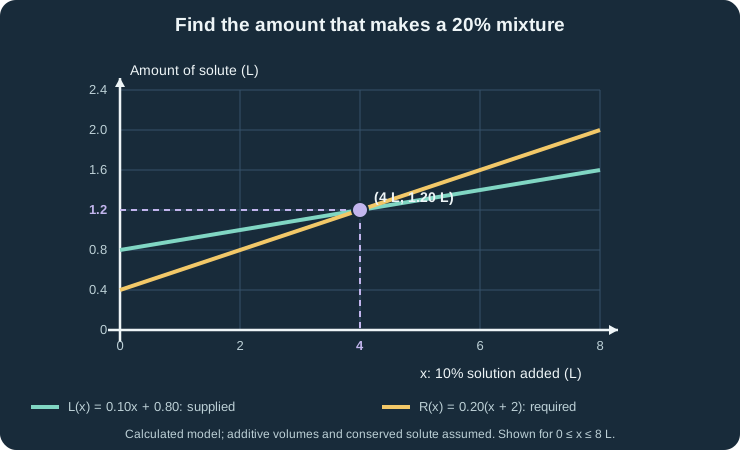
At \(x=4\), the first solution contributes \(0.40\text{ L}\) of solute and the second contributes \(0.80\text{ L}\). The total \(1.20\text{ L}\) of solute in \(6\text{ L}\) of solution gives \(1.20/6=0.20=20\%\). The answer is nonnegative, and the target \(20\%\) lies between the two starting concentrations \(10\%\) and \(40\%\), so the result passes a useful reasonableness check.
The graph compares \(L(x)=0.10x+0.80\), the solute actually supplied by the starting liquids, with \(R(x)=0.20(x+2)\), the solute required if the final concentration is \(20\%\). Both vertical values are liters of solute; the horizontal value is liters of \(10\%\) solution. Their single intersection \((4,1.20)\) is exactly the volume that makes the solute balance true. The graph is a calculated picture of the model, not experimental data.
Why not average \(10\%\) and \(40\%\) to get \(25\%\)? That would weight the two solutions equally, even though this mixture uses \(4\text{ L}\) of one and \(2\text{ L}\) of the other. Concentration is a ratio, so first combine the amounts and volumes, then form the final ratio. This also explains why adding \(10\%+40\%\) is meaningless here.
In any of these models, solve only after the quantities and their units agree. Then return to the original story: a negative time or volume, a percentage based on the wrong whole, or a mixture concentration outside the range of its ingredients signals that the setup or assumptions need another look.
Further reading
The underlying models were checked against OpenStax Elementary Algebra 2e, §3.2: Percent Applications, §3.3: Mixture Applications, and OpenStax Intermediate Algebra 2e, §2.4: Mixture and Uniform Motion Applications. The prose, rate and percent examples, checks, table, and graph here were independently written or drawn; textbook wording, exercises, and artwork were not reproduced.