AP Chemistry · Unit 3 · Topic 3.13
Beer-Lambert Law
Particle attractions, spacing, motion, and light interactions explain phases, solutions, gases, and spectroscopic measurements.
1. Topic Lens
Beer-Lambert Law is studied through properties of substances and mixtures. Connect the system boundary, interacting parts, and measurable evidence before applying a formula.
2. Why the Formula Works
The relationship is built from definitions and conservation reasoning:
- Model ideal-gas particles as having negligible volume and elastic collisions.
- Pressure results from particle-wall momentum transfer and rises with particle number and temperature.
- Combining proportionalities gives PV=nRT; rearrange only after defining the system units.
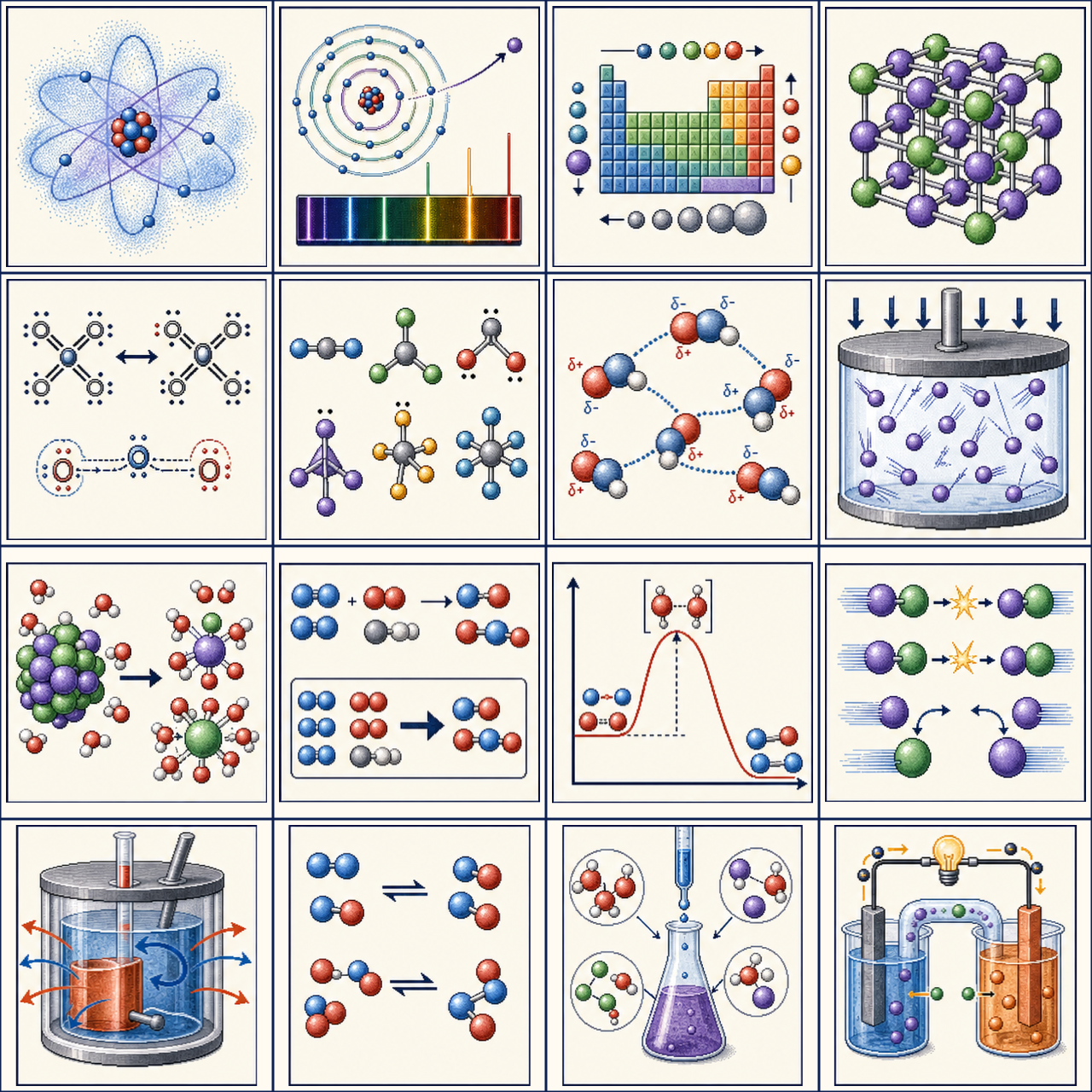
3. Detailed Visual Model
4. Worked Example and Lab Link
A 1.00 mol ideal gas occupies 24.6 L at 300 K. Using R=0.0821 L·atm·mol⁻¹·K⁻¹, find P.
Answer: P=(1.00)(0.0821)(300)/24.6≈1.00 atm.
Investigation idea: Collect pressure-temperature data at constant volume and evaluate the linear model and residuals.
Common trap: Use kelvin in gas laws and distinguish intramolecular bonds from intermolecular attractions.
Explain how beer-lambert law supports or limits this conclusion: P=(1.00)(0.0821)(300)/24.6≈1.00 atm.
Official curriculum reference: College Board AP Chemistry course page. The explanation and worked example are independently written for this study site.