AP Chemistry · Unit 5 · Topic 5.4
Elementary Reactions
Collision frequency, orientation, activation energy, and mechanisms explain measured rate laws.
1. Topic Lens
Elementary Reactions is studied through kinetics. Connect the system boundary, interacting parts, and measurable evidence before applying a formula.
2. Why the Formula Works
The relationship is built from definitions and conservation reasoning:
- Experiments reveal how rate responds to concentration; coefficients alone do not determine orders for an overall reaction.
- Take logarithms to convert the multiplicative rate law to an additive relationship.
- Slopes or trial ratios determine orders, while the intercept contains k.
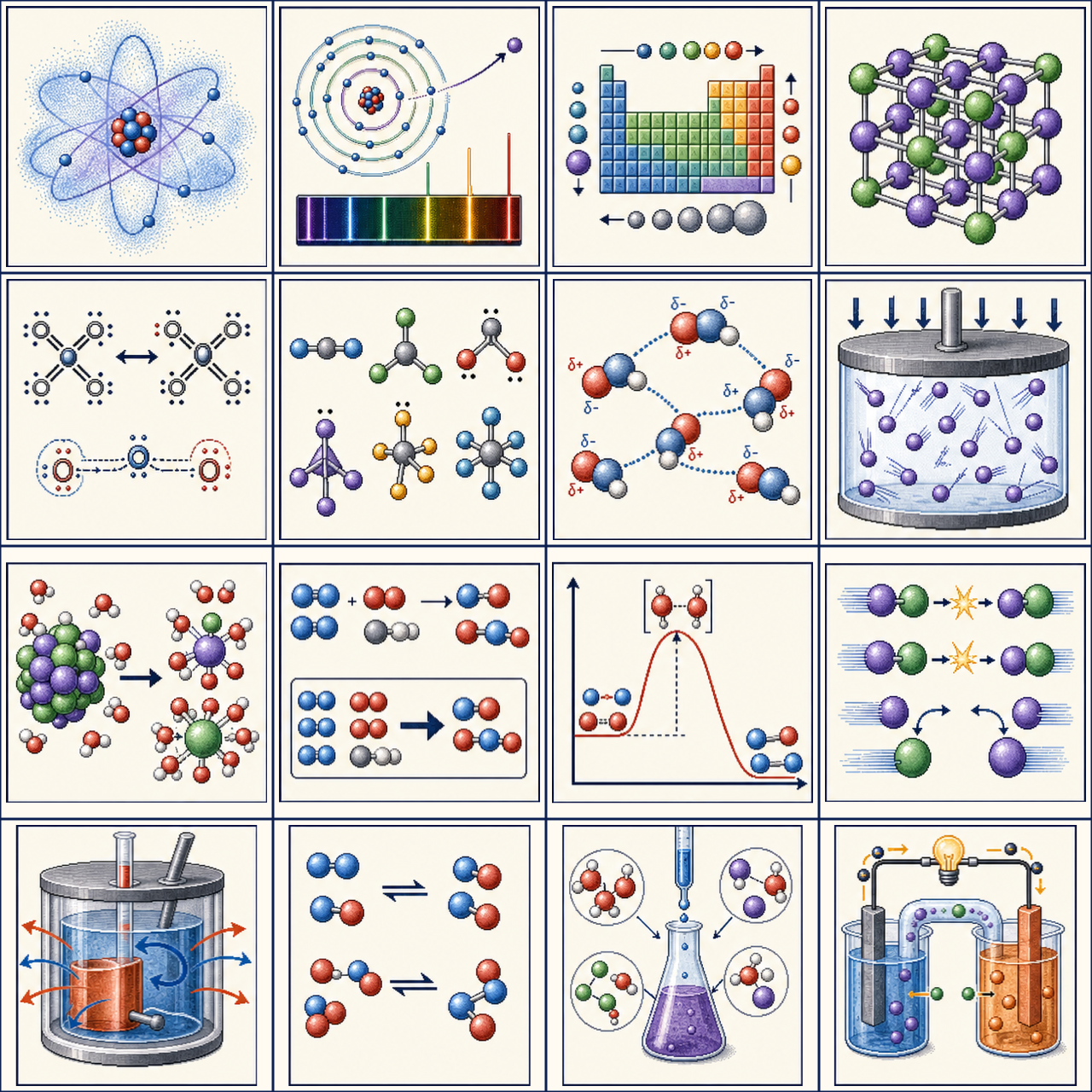
3. Detailed Visual Model
4. Worked Example and Lab Link
Doubling [A] quadruples the rate while [B] is fixed. What is the order in A?
Answer: Because 2^m=4, m=2; the reaction is second order in A.
Investigation idea: Use original concentration-time data to determine initial rates and test candidate rate laws.
Common trap: Reaction orders are experimental unless the step is explicitly elementary; a catalyst does not change equilibrium K.
Explain how elementary reactions supports or limits this conclusion: Because 2^m=4, m=2; the reaction is second order in A.
Official curriculum reference: College Board AP Chemistry course page. The explanation and worked example are independently written for this study site.