AP Chemistry · Unit 3 · Topic 3.9
Separation of Solutions and Mixtures
Particle attractions, spacing, motion, and light interactions explain phases, solutions, gases, and spectroscopic measurements.
1. Topic Lens
Separation of Solutions and Mixtures is studied through properties of substances and mixtures. Connect the system boundary, interacting parts, and measurable evidence before applying a formula.
2. Why the Formula Works
The relationship is built from definitions and conservation reasoning:
- Model ideal-gas particles as having negligible volume and elastic collisions.
- Pressure results from particle-wall momentum transfer and rises with particle number and temperature.
- Combining proportionalities gives PV=nRT; rearrange only after defining the system units.
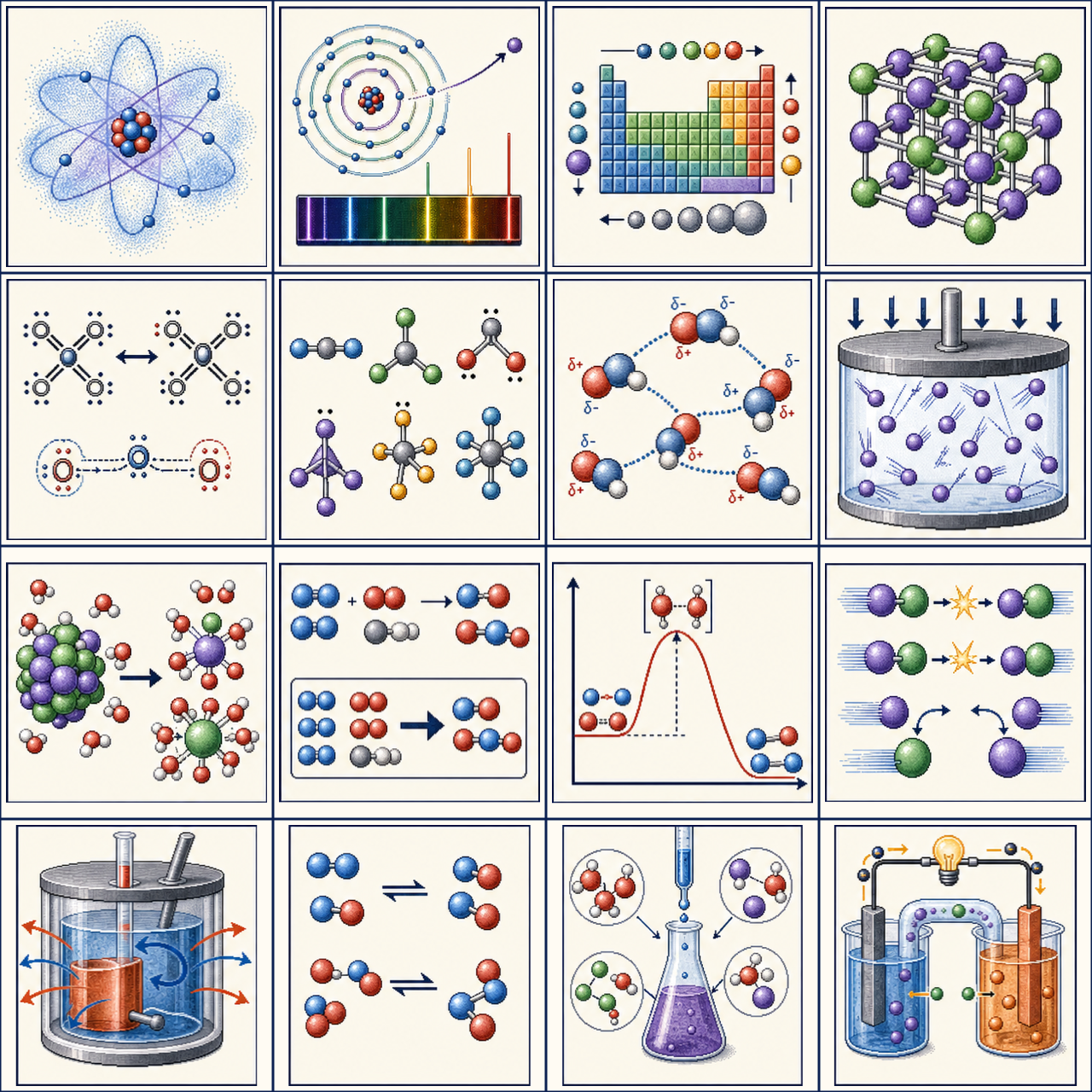
3. Detailed Visual Model
4. Worked Example and Lab Link
A 1.00 mol ideal gas occupies 24.6 L at 300 K. Using R=0.0821 L·atm·mol⁻¹·K⁻¹, find P.
Answer: P=(1.00)(0.0821)(300)/24.6≈1.00 atm.
Investigation idea: Collect pressure-temperature data at constant volume and evaluate the linear model and residuals.
Common trap: Use kelvin in gas laws and distinguish intramolecular bonds from intermolecular attractions.
Explain how separation of solutions and mixtures supports or limits this conclusion: P=(1.00)(0.0821)(300)/24.6≈1.00 atm.
Official curriculum reference: College Board AP Chemistry course page. The explanation and worked example are independently written for this study site.