AP Chemistry · Unit 5 · Topic 5.9
Pre-Equilibrium Approximation
Collision frequency, orientation, activation energy, and mechanisms explain measured rate laws.
1. Topic Lens
Pre-Equilibrium Approximation is studied through kinetics. Connect the system boundary, interacting parts, and measurable evidence before applying a formula.
2. Why the Formula Works
The relationship is built from definitions and conservation reasoning:
- Experiments reveal how rate responds to concentration; coefficients alone do not determine orders for an overall reaction.
- Take logarithms to convert the multiplicative rate law to an additive relationship.
- Slopes or trial ratios determine orders, while the intercept contains k.
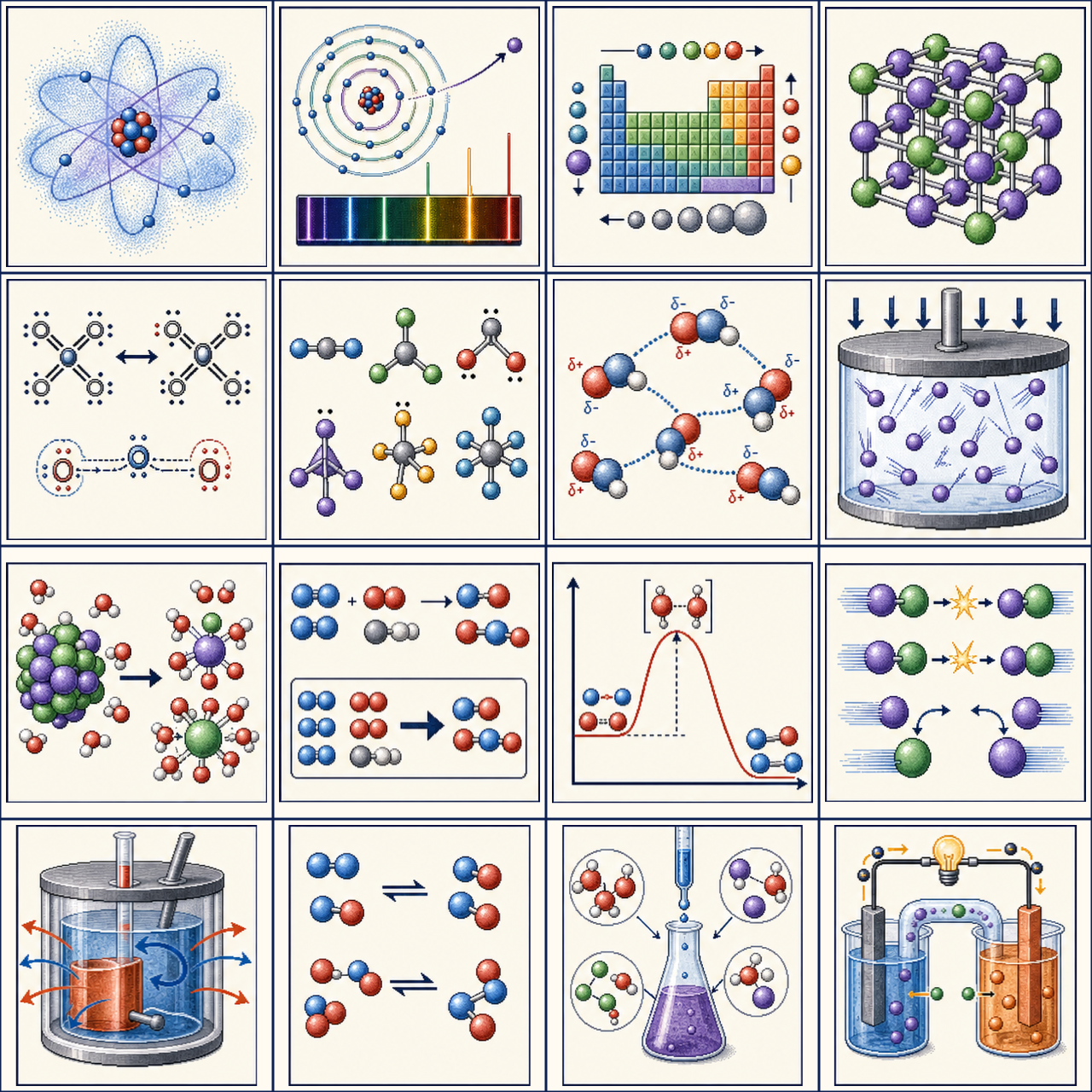
3. Detailed Visual Model
4. Worked Example and Lab Link
Doubling [A] quadruples the rate while [B] is fixed. What is the order in A?
Answer: Because 2^m=4, m=2; the reaction is second order in A.
Investigation idea: Use original concentration-time data to determine initial rates and test candidate rate laws.
Common trap: Reaction orders are experimental unless the step is explicitly elementary; a catalyst does not change equilibrium K.
Explain how pre-equilibrium approximation supports or limits this conclusion: Because 2^m=4, m=2; the reaction is second order in A.
Official curriculum reference: College Board AP Chemistry course page. The explanation and worked example are independently written for this study site.