AP Chemistry · Unit 9 · Topic 9.8
Galvanic (Voltaic) and Electrolytic Cells
Entropy, free energy, equilibrium, and electrochemical work provide compatible tests of thermodynamic favorability.
1. Topic Lens
Galvanic (Voltaic) and Electrolytic Cells is studied through thermodynamics and electrochemistry. Connect the system boundary, interacting parts, and measurable evidence before applying a formula.
2. Why the Formula Works
The relationship is built from definitions and conservation reasoning:
- Electrical work for n moles of electrons crossing potential E is nFE.
- A spontaneous galvanic cell can deliver work, giving ΔG°=-nFE°.
- Combining this with ΔG°=-RT lnK connects cell voltage to equilibrium.
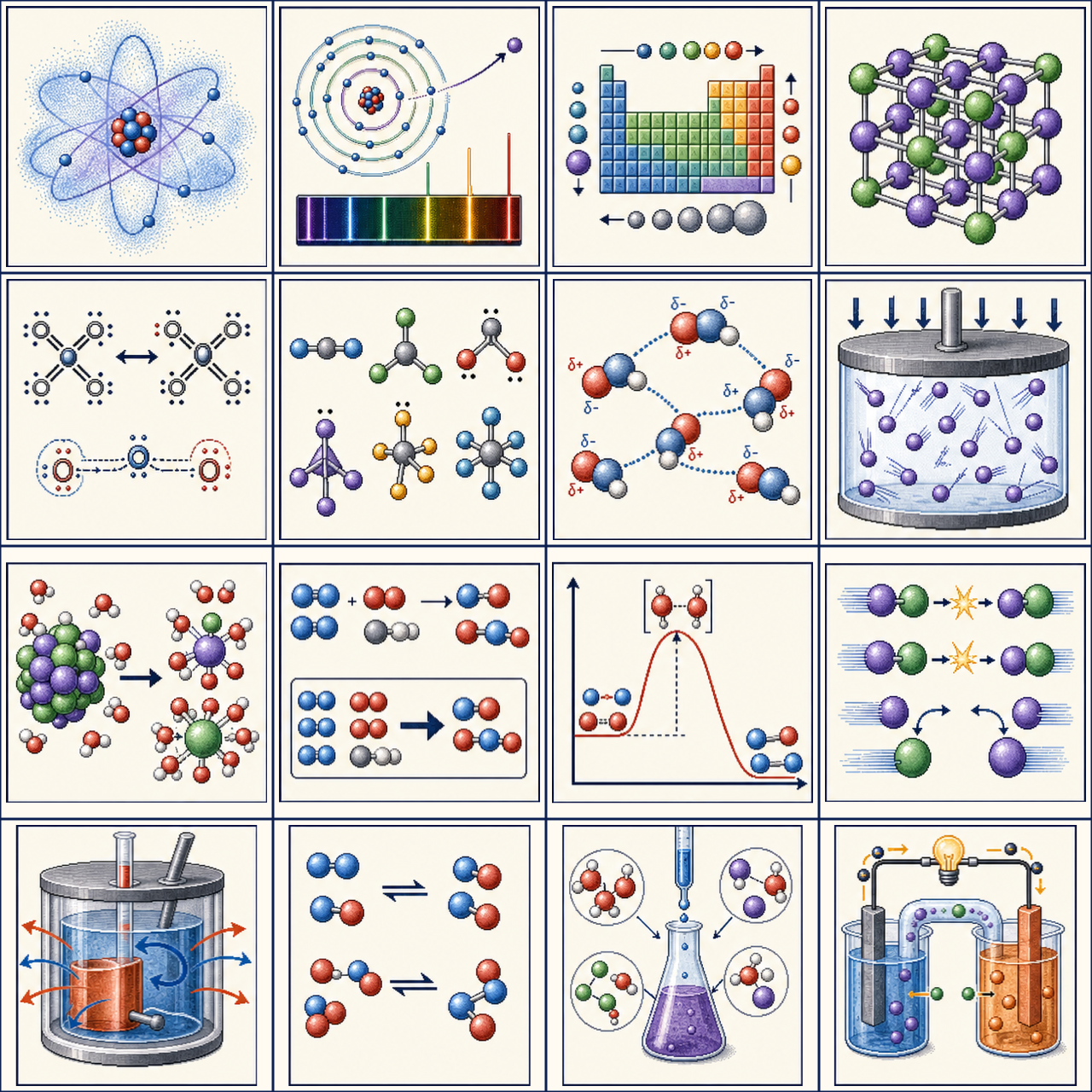
3. Detailed Visual Model
4. Worked Example and Lab Link
A cell transfers 2 mol e⁻ at E°=1.10 V. Using F=96485 C/mol, estimate ΔG°.
Answer: ΔG°≈-2.12×10⁵ J/mol, or -212 kJ/mol.
Investigation idea: Construct safe microscale galvanic cells with several metal pairs and compare measured and predicted voltage.
Common trap: Positive E° pairs with negative ΔG° for the reaction as written; it says nothing about how fast the reaction occurs.
Explain how galvanic (voltaic) and electrolytic cells supports or limits this conclusion: ΔG°≈-2.12×10⁵ J/mol, or -212 kJ/mol.
Official curriculum reference: College Board AP Chemistry course page. The explanation and worked example are independently written for this study site.