AP Chemistry · Unit 4 · Topic 4.3
Representations of Reactions
Conservation of atoms and charge organizes reaction representations and quantitative stoichiometry.
1. Topic Lens
Representations of Reactions is studied through chemical reactions. Connect the system boundary, interacting parts, and measurable evidence before applying a formula.
2. Why the Formula Works
The relationship is built from definitions and conservation reasoning:
- Convert the known mass to moles.
- Use coefficients from the balanced equation as a mole ratio.
- Convert the desired moles to the requested unit and test limiting-reagent assumptions.
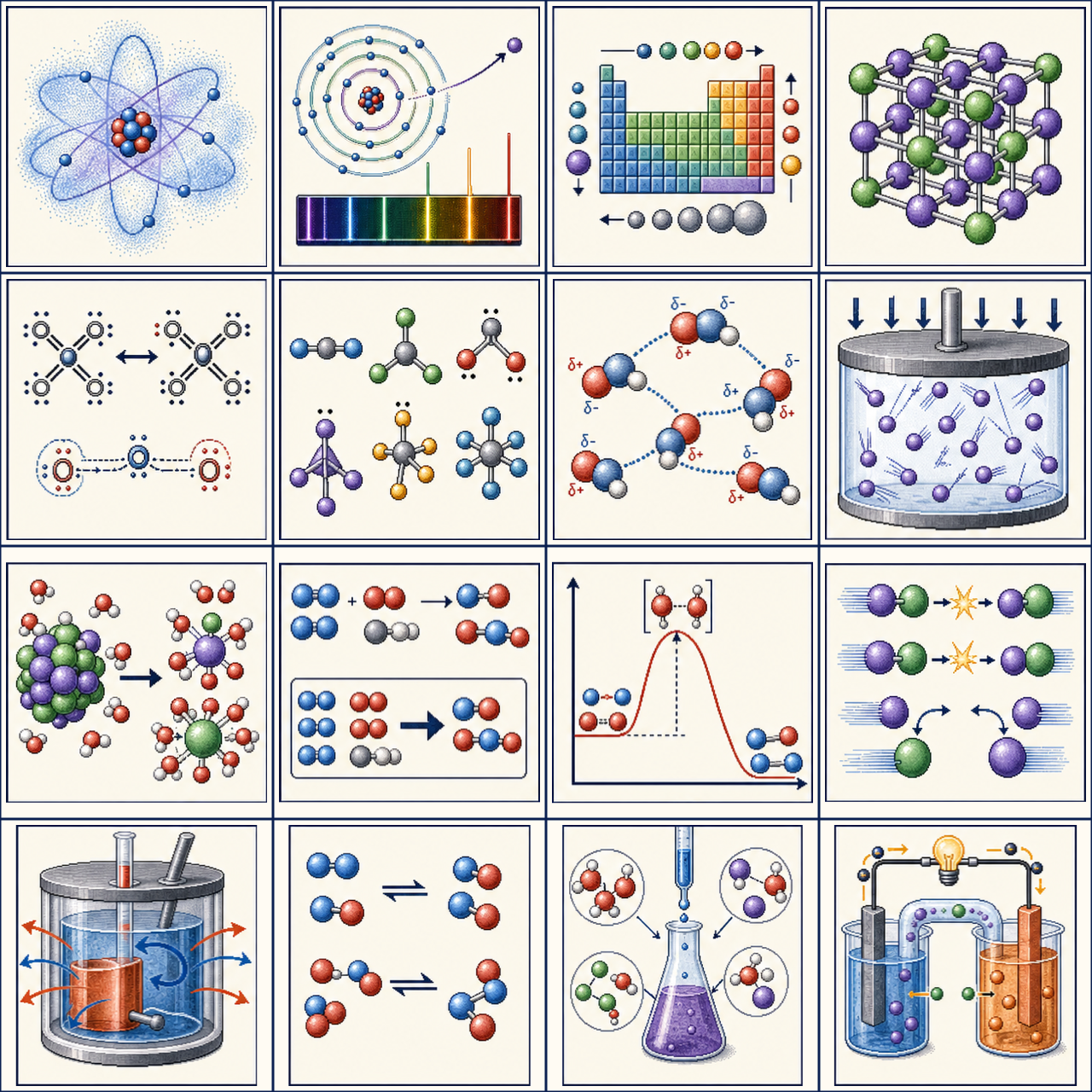
3. Detailed Visual Model
4. Worked Example and Lab Link
For 2H₂+O₂→2H₂O, how many moles of water form from 3.0 mol O₂ with excess H₂?
Answer: The coefficient ratio gives 6.0 mol H₂O.
Investigation idea: Mix microscale ionic solutions, record precipitate evidence, and construct complete and net ionic equations.
Common trap: Never change subscripts to balance an equation, and do not leave spectator ions in a net ionic equation.
Explain how representations of reactions supports or limits this conclusion: The coefficient ratio gives 6.0 mol H₂O.
Official curriculum reference: College Board AP Chemistry course page. The explanation and worked example are independently written for this study site.