AP Biology · Unit 3 · Topic 3.4
Photosynthesis
Photosynthesis links energy capture to the construction of organic molecules. Follow four different things—light energy, electrons, hydrogen ions, and carbon atoms—without treating them as interchangeable. Then use that model to predict what happens when light, carbon dioxide, or membrane function changes.
Learning Goals and AP Scope
- Locate the light reactions and carbon fixation within a chloroplast.
- Explain how electron transfer establishes a proton gradient that supports ATP synthesis.
- Distinguish the roles of ATP, NADPH, water, and carbon dioxide.
- Interpret tracer, gas-exchange, and limiting-factor experiments.
Prioritize mechanisms and evidence. The official AP scope does not require memorizing every Calvin-cycle intermediate, enzyme name, or electron carrier. Optional carbon bookkeeping below supports understanding rather than a memorization list.
1. The Summary Equation Is Not a Mechanism
This is a simplified net account for oxygenic photosynthesis, not a single reaction producing a glucose molecule. Carbon dioxide supplies carbon for organic products; water supplies the electrons that ultimately replace those lost from photosystem II. Released oxygen comes from water. Light contributes energy, not carbon atoms.
Tracer prediction: supply water labeled with oxygen-18 and expect the released oxygen gas to become labeled. Supply carbon-13 dioxide and expect label in newly fixed organic carbon. These are predictions for controlled tracer experiments, not conclusions obtained from balancing the net equation alone.
2. Structure Makes Coupling Possible
The thylakoid membrane contains photosystems, electron-transfer components, and ATP synthase. It separates the lumen from the stroma, allowing a proton gradient. Carbon fixation occurs in the stroma. A granum is a stack of thylakoids; stomata are leaf pores, not spaces inside chloroplasts.
Apply the distinction: breaking the thylakoid membrane can impair gradient-dependent ATP synthesis even if pigments still absorb light. Light absorption alone does not demonstrate successful carbon fixation.
3. Trace Electrons and Protons Separately
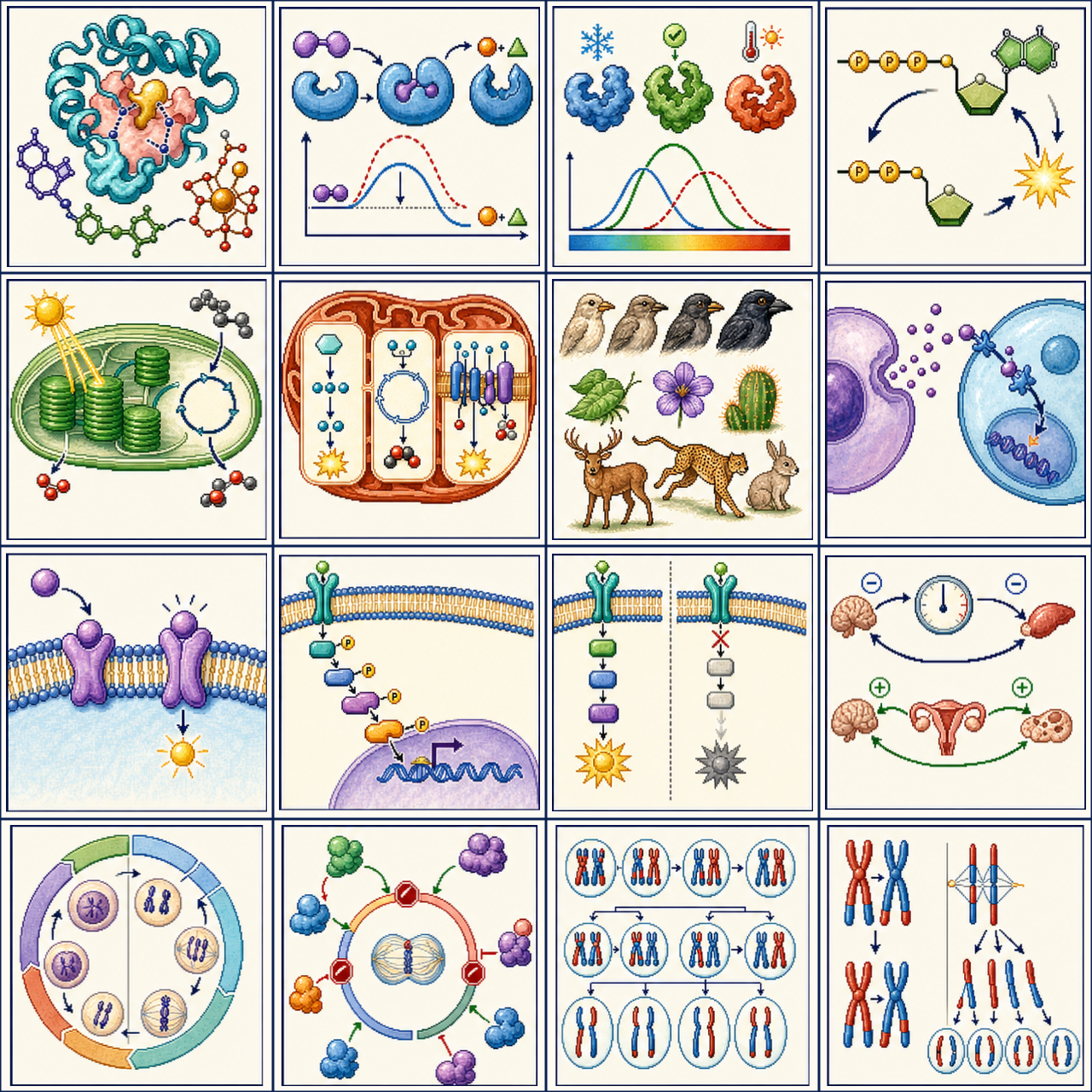
Light excites electrons in PSII and again in PSI. Linear flow transfers electrons from water toward NADP+, producing NADPH. Electron transfer helps build the lumen's high proton concentration; water oxidation also contributes lumen protons. Return flow through ATP synthase supports ATP formation on the stromal side. This gradient-driven process is chemiosmosis.
Diagnostic question: do electrons pass through ATP synthase to make ATP? No. Proton flow through ATP synthase is coupled to synthesis; the electrons follow the electron-transfer pathway.
4. Light Color and Light Quantity Are Different Variables
An absorption spectrum measures which wavelengths a pigment absorbs. An action spectrum measures a biological response at different wavelengths. Accessory pigments can broaden usable light and contribute to photoprotection. Green light is not automatically useless simply because a leaf looks green.
Design challenge: to compare blue and red light, match photon flux, leaf area, temperature, carbon dioxide availability, and exposure time. Equal lamp wattage or equal distance does not ensure equal photons reaching the sample. Include independent samples and identify whether the response is oxygen release, carbon uptake, or another proxy.
5. Carbon Fixation Uses Both Energy and Reducing Power
The Calvin cycle incorporates carbon dioxide, reduces carbon compounds using ATP and NADPH, and regenerates the carbon acceptor. Its net three-carbon output, G3P, can contribute to carbohydrate synthesis. ATP supports energy-requiring steps; NADPH supplies reducing electrons. They are not interchangeable inputs.
“Light-independent” means that these reactions do not directly absorb photons. It does not mean they normally run only at night or indefinitely without light-reaction products. ATP and NADPH supply, along with light-dependent regulation, link the two processes.
Optional carbon bookkeeping: what is needed for two net G3P?
Using the standard idealized account of 3 CO₂, 9 ATP, and 6 NADPH per net G3P, double each amount: 6 CO₂, 18 ATP, and 12 NADPH. Two three-carbon outputs supply six carbon atoms for later carbohydrate synthesis. This is not the complete energetic cost of making every downstream carbohydrate.
6. Predict a Disruption Before Naming Its Outcome
| Change | Immediate consequence | Expected downstream effect |
|---|---|---|
| Block electron flow after PSII | Linear electron transfer toward PSI is restricted | NADPH supply and gradient generation tend to fall |
| Allow H+ leakage across the membrane | Gradient dissipates without all protons using ATP synthase | Gradient-driven ATP production falls |
| Remove CO₂ while maintaining light | Carbon fixation lacks a substrate | New organic carbon output falls despite illumination |
These are initial predictions, not claims that all components instantly stop. Preexisting pools, alternative electron routes, feedback, and treatment duration affect the observed response. Cyclic electron flow around PSI can support extra ATP production without net NADPH production or oxygen release from that route.
7. Read a Limiting-Factor Graph
Interpretation: increasing light from level 1 to 2 increases net oxygen exchange from 2 to 5. Increasing it from 3 to 4 has no measured effect. This suggests light is no longer the main limitation over that interval; it does not identify CO₂ shortage as the only possible cause.
Follow-up: vary CO₂ at the same high light while controlling temperature. A rise would support CO₂ limitation under those conditions. The light compensation point lies between levels 0 and 1; zero net exchange there does not mean photosynthesis and respiration have both stopped.
8. Calculate Net and Gross Rates Carefully
For an illustrative leaf, measured net oxygen production in light is \(6\ \mathrm{\mu mol\,m^{-2}\,s^{-1}}\). In darkness, oxygen uptake has magnitude \(2\ \mathrm{\mu mol\,m^{-2}\,s^{-1}}\).
Estimate gross oxygen production and state the assumption
If oxygen consumption in light equals the measured dark rate and other relevant fluxes are negligible, gross production is \(6+2=8\ \mathrm{\mu mol\,m^{-2}\,s^{-1}}\). Net production equals gross production minus consumption.
The assumption matters: respiration and other oxygen-consuming processes can differ in light and dark. Do not automatically equate a measured oxygen flux to carbon-fixation rate under all conditions.
9. Use Gas Exchange as Evidence, Not a Shortcut
In a constructed investigation, compare equal-area leaf samples at several photon fluxes in a calibrated chamber. Hold temperature and CO₂ steady, record oxygen against time, and calculate slopes after a stable response is reached. Use a chamber blank to detect instrument drift and replicate with independent leaves.
If using floating leaf disks instead, flotation reflects accumulated gas and buoyancy—not a direct count of glucose molecules. Match disk size and infiltration procedure, include a dark comparison, and avoid interpreting one floating disk as a precise rate measurement.
Claim-evidence-reasoning: “Light raises net oxygen production in this sample” is supported by a positive change in its controlled oxygen-time slope. A mechanism connects absorbed light to electron transfer and water oxidation. The measurement alone does not locate every intermediate step.
10. Evolution and Environmental Trade-Offs
Photosynthesis originated in prokaryotes. Oxygen-producing cyanobacteria contributed to atmospheric oxygenation, and chloroplast ancestry links eukaryotic photosynthesis to bacterial systems. Photosynthetic organisms are therefore not limited to plants, and photosynthesis does not require chloroplasts in prokaryotes.
Environmental scenario: stomatal closure conserves water but can lower internal CO₂ and constrain fixation. In C₃ plants, low CO₂ relative to O₂ can favor photorespiration. C₄ and CAM strategies help concentrate CO₂ through spatial or temporal organization; these are useful extensions, not substitutes for understanding the common light-reaction mechanism.
11. Check Your Understanding
1. Where does the carbon in newly made carbohydrate originate?
From fixed CO₂. Neither light nor ATP supplies those carbon atoms in the carbon-fixation account.
2. Why does a proton leak reduce ATP production?
It dissipates the electrochemical gradient without coupling all return flow to ATP synthase. Absorbed light may still excite electrons, but less gradient energy is available for ATP synthesis.
3. Does adding light rescue a sample with no available CO₂?
Not sustained carbon fixation. Energy input cannot replace a missing carbon substrate. Existing carbon intermediates may permit short transients, so specify the observation period.
4. Must the Calvin cycle wait until darkness?
No. Its reactions do not directly require photons but normally rely on products and regulation associated with the light reactions.
5. Does zero net oxygen exchange imply no metabolism?
No. Oxygen production and consumption can balance. Distinguish a net measurement from the underlying opposing fluxes.
Locate the compartments, trace electrons separately from protons and carbon, and make every experimental conclusion match what was actually measured.
Concept references: OpenStax Biology 2e, Overview of Photosynthesis, Light-Dependent Reactions, and Carbon Fixation; scope checked against the College Board AP Biology Course and Exam Description, Topic 3.4. Explanations, SVG diagrams, simulated data, investigation prompts, and worked questions are independently authored for Insomnia Studyroom. Source figures and worksheets are not reproduced.
Official curriculum reference: College Board AP Biology course page. The explanation and worked example are independently written for this study site.