AP Biology · Unit 6 · Topic 6.4
Translation
An mRNA is a sequence of nucleotides, but a protein is a sequence of amino acids. Complementary base pairing alone cannot convert one into the other. Translation needs an adaptor that recognizes RNA and carries an amino acid, plus a molecular machine that joins those amino acids in the specified order. Those roles belong to tRNA and the ribosome.
A code requires a direction and a starting position
A codon is a three-nucleotide unit in an mRNA reading frame. Ribosomes read the message 5′ to 3′ in successive, nonoverlapping triplets. With four possible bases at each position, there are \(4^3=64\) triplets. In the standard genetic code, 61 specify amino acids and three—UAA, UAG, and UGA—signal termination.
The code is redundant: several codons can specify the same amino acid. It is not ordinarily ambiguous: one particular codon does not randomly choose among amino acids. Most organisms share the same assignments, supporting common ancestry, although exceptions exist, including some organelle codes. Use the standard code unless a problem states otherwise.
AUG specifies methionine and commonly serves as the start codon. Initiation establishes the reading frame; an internal AUG can simply add another methionine. In eukaryotes, initiation usually involves recognition of the 5′ cap and scanning to an appropriate start site, so “start at every AUG” is not a valid rule. UTRs remain part of the message but lie outside the translated region.
The tRNA has two jobs that must agree
A tRNA has an anticodon that pairs with a codon and an amino-acid attachment site at its 3′ end. An enzyme called an aminoacyl-tRNA synthetase attaches the appropriate amino acid, using ATP. This is called charging the tRNA. Charging occurs before that tRNA delivers its amino acid to the ribosome.
Consider the codon 5′-GAA-3′, which specifies glutamate. Under simple complementary pairing, its anticodon aligns as 3′-CUU-5′. If the answer must be written 5′ to 3′, it is 5′-UUC-3′. A codon table is read using the mRNA codon GAA, not the anticodon CUU.
The ribosome checks codon–anticodon pairing; that is not the same as directly checking the identity of the amino acid attached to the tRNA. In a hypothetical mischarging experiment, a correctly pairing tRNA carrying the wrong amino acid can deliver that wrong amino acid. Accurate charging is therefore part of accurate translation, not an optional preparation step.
Some tRNAs recognize more than one synonymous codon through flexible pairing at the third codon position, called wobble. The simple anticodon examples here assume ordinary complementary pairing; they do not require a different tRNA for every one of the 61 amino-acid codons.
Follow the chain through one elongation cycle
A ribosome contains small and large subunits made of rRNA and proteins. The small subunit helps position the message and decode codons. The large subunit's rRNA contributes the catalytic center for peptide-bond formation. RNA is doing chemical work here, not merely carrying a message.
During initiation, the initiator tRNA occupies the P site at the start codon. During ordinary elongation, a charged tRNA matching the next codon enters the A site. The growing chain is transferred from the P-site tRNA to the amino acid on the A-site tRNA, forming a peptide bond. The chain grows from its amino, or N terminus, toward its carboxyl, or C terminus.
The ribosome then translocates by one codon. The chain-carrying tRNA moves from A to P, while the now uncharged tRNA moves toward the E site and exits. The A site becomes available for the next charged tRNA. GTP-dependent factors support delivery and movement; translation is not powered by codon pairing alone.
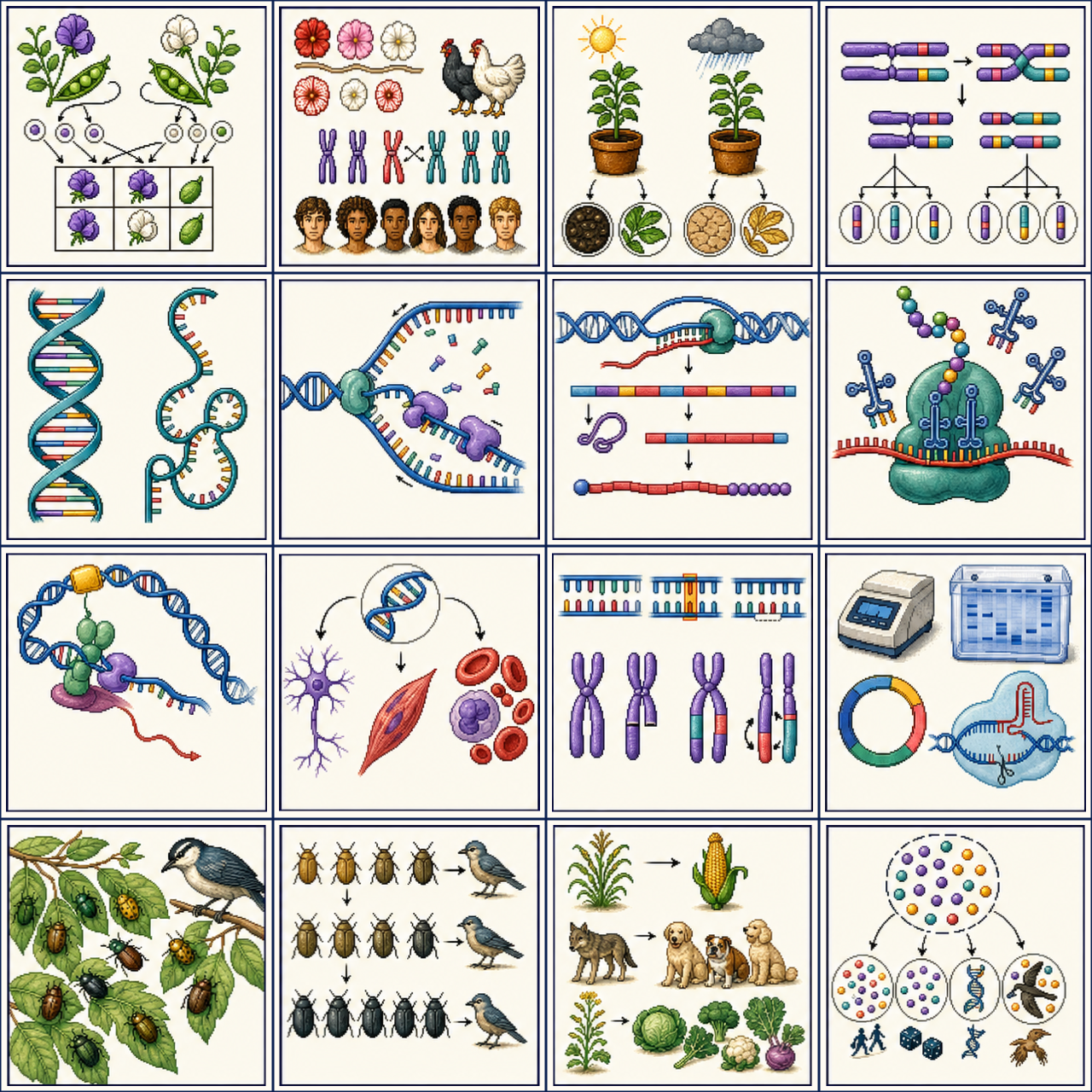
When a stop codon reaches the A site, a release factor promotes release of the polypeptide. An ordinary amino-acid-carrying “stop tRNA” is not inserted, and “Stop” is not an amino acid in the product.
Translate a message with boundaries shown
The following short sequence is invented for practice. The marked AUG is the established start; spaces show the reading frame, and the final GCU lies in the 3′ UTR.
| Triplet | Standard-code meaning | Effect on the chain |
|---|---|---|
| AUG | Methionine (Met) | Initiates this example |
| GCU | Alanine (Ala) | Adds the second residue |
| UUC | Phenylalanine (Phe) | Adds the third residue |
| GAA | Glutamate (Glu) | Adds the fourth residue |
| UGA | Stop | Releases, rather than lengthens, the chain |
The initial product is N–Met–Ala–Phe–Glu–C, with four residues and three peptide bonds. Neither the two upstream bases nor the downstream GCU adds an amino acid. This is the initial translation product; later removal of an initiator residue or other processing could alter the mature product.
Two messages can differ at a synonymous codon and still make the same amino-acid sequence. Conversely, changing where the triplets start can change nearly every later codon even when most letters remain unchanged.
Repair the assumptions behind a length formula
The original length example can be used, but its conditions matter. Suppose 300 nucleotides span a complete, uninterrupted coding region from the designated start through one terminal stop, with no earlier in-frame stop, no UTRs, and no introns.
The minus one removes the stop signal, not the starting methionine. A single linear chain of 99 residues has \(99-1=98\) peptide bonds: one joins each pair of neighbors. These counts describe the initial chain before processing.
For a different invented message, the mature RNA body has 690 nucleotides, including a 60-nucleotide 5′ UTR and a 120-nucleotide 3′ UTR. Exclude the cap and tail from these lengths. If the remaining coding region contains the terminal stop, then:
Dividing the entire mature RNA by three would incorrectly translate the UTRs. A poly-A tail is also not a series of lysine codons appended to the normal protein: ordinary translation has already terminated before that tail.
Predict sequence changes without guessing their severity
Using the worked message, changing UUC to UUU preserves phenylalanine: a synonymous change. Changing GAA to GUA replaces glutamate with valine: a missense change. Changing GAA to UAA introduces an early stop: the initial chain now ends after Met–Ala–Phe. These are sequence predictions, not measurements of protein activity.
A single-base insertion or deletion within the translated region shifts downstream triplet grouping. For a concrete example, insert C immediately after the starting AUG in AUG GCU UUC GAA UGA. Regroup from that same start: AUG CGC UUU CGA AUG…. The original terminal UGA is no longer in frame. More downstream sequence is needed to locate the new stop; a frameshift need not immediately shorten the protein.
Deleting three bases generally preserves the downstream frame, but can still remove essential residues or change a codon at a junction. Likewise, a synonymous substitution does not guarantee no biological effect, because RNA behavior can change. To connect genotype to phenotype, follow the chain of evidence: altered sequence → altered amount or properties of protein → altered cellular process. Do not assume every substitution destroys function.
Location and abundance are separate questions
For eukaryotic nuclear genes, translation occurs after RNA export, on free cytoplasmic ribosomes or ribosomes associated with the cytoplasmic face of rough ER. Protein targeting signals help determine whether an emerging chain is directed toward the ER. Mitochondria and chloroplasts also have their own translation machinery. Bacteria can begin translating a transcript before its transcription is complete because no nuclear barrier separates the processes.
Several ribosomes can translate one mRNA simultaneously, forming a polysome; each makes its own chain. Ribosomes do not divide one protein into pieces to assemble later. The same message can therefore support production of many protein copies.
If a hypothetical treatment leaves mRNA abundance unchanged but lowers protein abundance, it does not by itself prove that translation stopped. Faster protein degradation is another explanation. Compare newly synthesized protein and protein turnover, alongside RNA measurements and untreated controls, to distinguish these mechanisms.
Reverse transcription is not reverse translation
Retroviruses use reverse transcriptase to copy an RNA genome into DNA. That DNA can integrate into the host genome, then serve as a source of RNA transcripts used in producing viral components. The information route includes RNA → DNA → RNA → protein.
The RNA-to-DNA step still copies a nucleotide sequence into another nucleotide sequence. It does not turn a polypeptide back into RNA, and it does not replace the ribosome's role in producing viral proteins. Distinguish the molecule being made before naming the process: DNA from RNA is reverse transcription; a polypeptide from an mRNA is translation.
Practice the connections
1. What anticodon pairs with 5′-GCU-3′, written 5′ to 3′ under simple complementary pairing?
Align it as 3′-CGA-5′, then reverse the written order: 5′-AGC-3′. The amino acid is found from codon GCU, which specifies alanine.
2. A complete coding region includes 453 nucleotides and one terminal stop. How many residues and peptide bonds?
With no introns, UTRs, or earlier in-frame stop, there are \(453/3=151\) codons. One is the stop, leaving 150 residues and 149 peptide bonds in a single initial linear chain.
3. Why is the initiator tRNA an exception to “tRNAs enter at the A site”?
Initiation places the initiator tRNA in the P site. Subsequent charged tRNAs ordinarily enter the A site during elongation. The general statement needs its stage specified.
4. A tRNA has the correct anticodon but is experimentally charged with the wrong amino acid. Will the codon table repair that mistake?
No. The table describes the normal mapping established by charging and decoding. If the mischarged tRNA is accepted, its attached amino acid can be incorporated. The table is not a separate checking mechanism.
5. Does UUC → UUU shift the reading frame?
No. It replaces one base without changing the number of bases. Both codons specify phenylalanine, so this change is synonymous under the standard code. A reading-frame shift requires an insertion or deletion not divisible by three within the translated region.
6. Why does blocking peptide-bond formation not necessarily lower mRNA abundance?
Transcription makes mRNA; translation uses it. A direct block at the ribosome can reduce new protein synthesis while preexisting RNA remains. Secondary effects may occur, so the molecular target and measurement time must be specified.
Concept references: OpenStax Biology 2e: the genetic code; OpenStax: ribosomes and protein synthesis; OpenStax: coupled transcription and translation; College Board AP Biology framework, Topic 6.4. Explanations, hypothetical messages, diagram, numerical examples, and worked questions were independently authored; no source illustration or worksheet is reproduced. Ribosomal site names and charging details support the mechanism rather than serve as an additional AP memorization checklist.
Official curriculum reference: College Board AP Biology course page. The explanation and worked example are independently written for this study site.