Prealgebra · Unit 8 · Topic 8.1
Angles and Triangle Relationships
Use angle pairs, triangle angle sums, side-length conditions, and the Pythagorean theorem to reason from a diagram and check a result.
Reading an angle before calculating it
An angle measures a turn between two rays that meet at a vertex. Its measure is written in degrees (°). A quarter turn is a right angle, \(90^\circ\); a half turn is a straight angle, \(180^\circ\). A drawing can help us see which angles touch, but its apparent size is not evidence of an exact measure. Use the labelled numbers and the relationships they imply.
When two adjacent angles form a straight line, their measures add to \(180^\circ\). If one is \(128^\circ\), the other is \(180^\circ-128^\circ=52^\circ\). Such a pair is supplementary. Two angles whose measures add to \(90^\circ\) are complementary; the two acute angles of a right triangle are an example. Supplementary and complementary describe sums, not necessarily positions: the angles need not be next to one another.
Why the three angles of a triangle add to 180°
For a triangle with interior angles \(A\), \(B\), and \(C\), measured in degrees in a flat plane,
\[A+B+C=180^\circ.\]
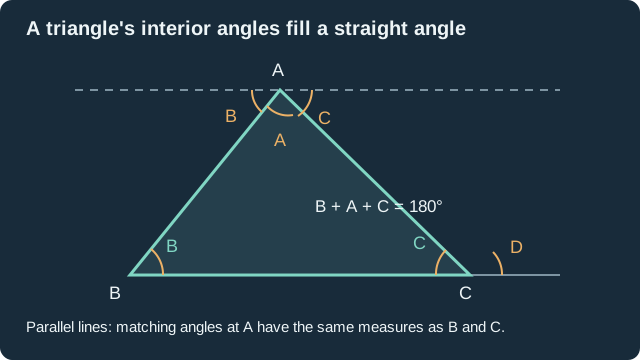
This is more than a pattern seen in drawings. Draw a line through the top vertex parallel to the base. The two angles along that line beside \(A\) match \(B\) and \(C\): each is made by a side crossing parallel lines. Those three adjacent angles fill a straight angle, so \(B+A+C=180^\circ\). Figure 1 marks the matching angles. The parallel-line argument explains why changing the shape does not change the total.
Example. A triangle has angles \(47^\circ\) and \(68^\circ\). Let the third angle be \(x\). Write the relationship before subtracting:
\[47^\circ+68^\circ+x=180^\circ,\qquad x=180^\circ-115^\circ=65^\circ.\]
The check is \(47+68+65=180\). The degree symbol matters: these are angle measures, not side lengths.
Exterior angles: a useful second route
Extend one side of a triangle past a vertex. The new angle outside the triangle is an exterior angle. It and the adjacent interior angle form a straight line. In Figure 1, call the exterior angle at \(C\) by \(D\). Then \(C+D=180^\circ\). Since \(A+B+C=180^\circ\), subtracting \(C\) from both equations gives
\[D=A+B.\]
Thus an exterior angle equals the sum of the two nonadjacent interior angles. In the preceding example, the exterior angle next to the \(65^\circ\) angle is \(47^\circ+68^\circ=115^\circ\). It is also \(180^\circ-65^\circ=115^\circ\). These two calculations check one another. Do not add the exterior angle to all three interior angles and set the total equal to \(180^\circ\); it is not a fourth interior angle.
Which three lengths can form a triangle?
An angle equation alone cannot tell us whether three proposed side lengths will meet. For positive lengths \(a\), \(b\), and \(c\), the triangle inequality says each side must be shorter than the sum of the other two. When \(c\) is the unknown side, an equivalent test is
\[|a-b|<c<a+b.\]
The inequalities are strict. If \(c=a+b\), the pieces lie in a straight line and have no triangular interior. For lengths 4 cm and 7 cm, the third side must satisfy \(3<c<11\) cm. If it must be a whole number of centimetres, it can be 4, 5, 6, 7, 8, 9, or 10 cm. A third side of 3 cm or 11 cm does not form a triangle.
The longer side is opposite the larger angle. This is useful for checking a sketch: a labelled \(70^\circ\) angle cannot be opposite a shorter side than a labelled \(40^\circ\) angle in the same triangle. It does not tell us exact side lengths without more information.
Right triangles and a coordinate diagram
A triangle is right when one interior angle is \(90^\circ\). Its two sides touching that angle are the legs \(a\) and \(b\). The side opposite it is the hypotenuse \(c\), always the longest side. Only for a right triangle do we use
\[a^2+b^2=c^2,\qquad c=\sqrt{a^2+b^2}.\]
Here \(a\), \(b\), and \(c\) are lengths in the same unit. Squaring produces square units; taking the square root returns a length. Figure 2 shows an original coordinate diagram with one grid interval representing one unit. Its horizontal and vertical legs meet at \(90^\circ\).
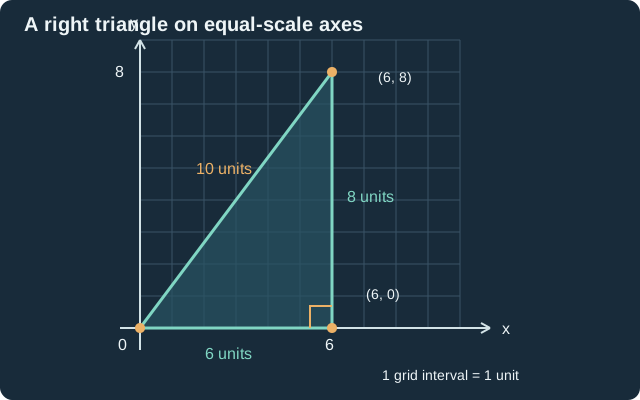
The horizontal leg runs from \((0,0)\) to \((6,0)\), so \(a=6\) units. The vertical leg runs from \((6,0)\) to \((6,8)\), so \(b=8\) units. The slanted side is not eight or six grid intervals long; calculate it:
\[c^2=6^2+8^2=36+64=100,\qquad c=\sqrt{100}=10\text{ units}.\]
Choose the positive square root because a length cannot be negative. Also check \(10<6+8\), as the triangle inequality requires. The two acute angles add to \(90^\circ\), although their individual measures cannot be read exactly from this diagram.
Why the squared-length relationship works
There is an area argument behind the formula. Arrange four copies of a right triangle with legs \(a\) and \(b\) inside a large square whose side is \(a+b\), leaving a central square whose side is \(c\). The same total area can be counted in two ways:
\[(a+b)^2=4\left(\frac{ab}{2}\right)+c^2.\]
Expanding the left side gives \(a^2+2ab+b^2=2ab+c^2\). Subtract \(2ab\) from both sides to obtain \(a^2+b^2=c^2\). This argument uses the fact that each copied triangle has a right angle; it does not establish this formula for every triangle.
If a leg is missing instead, rearrange first. For a right triangle with hypotenuse 13 cm and one leg 5 cm,
\[b^2=13^2-5^2=169-25=144,\qquad b=12\text{ cm}.\]
The hypotenuse must be the 13 cm side: subtracting the square of 13 from the square of 5 would not describe this geometry. The result checks because \(5^2+12^2=13^2\). Conversely, if three positive side lengths satisfy this equation with \(c\) the longest, they form a right triangle; without that check, do not assume a labelled sketch is right.
Deciding which relationship to use
When a problem supplies angles, identify whether they make a straight line, a right angle, three interior angles of one triangle, or an exterior/interior pair. When it supplies three possible side lengths, test whether a triangle can form before applying any special formula. When a right angle is given or justified and two side lengths are known, identify the hypotenuse first, then use squared lengths.
These relationships answer different questions. \(A+B+C=180^\circ\) connects angles in any plane triangle; \(|a-b|<c<a+b\) tests possible side lengths; \(a^2+b^2=c^2\) connects side lengths only in a right triangle. Keeping the diagram's labels, units, and conditions beside each equation is more reliable than choosing a formula from the picture's appearance.
Further reading
The topic scope and standard angle and right-triangle relationships were checked against OpenStax Prealgebra 2e, §9.3. This lesson's explanation, examples, and diagrams were independently created; no textbook prose, exercises, or artwork were reproduced.