Prealgebra · Unit 10 · Topic 10.4
Exponent Rules and Scientific Notation
Derive product, quotient, zero, and negative exponent rules; read a powers graph; and convert and calculate with scientific notation.
What the exponent counts
The expression \(2^4\) means \(2\cdot2\cdot2\cdot2=16\), not \(2\cdot4\). The base is 2 and the exponent counts four factors. This lets us describe a value without writing a long product. For a positive whole-number exponent \(n\), \(a^n\) is a product of \(n\) copies of the base \(a\).
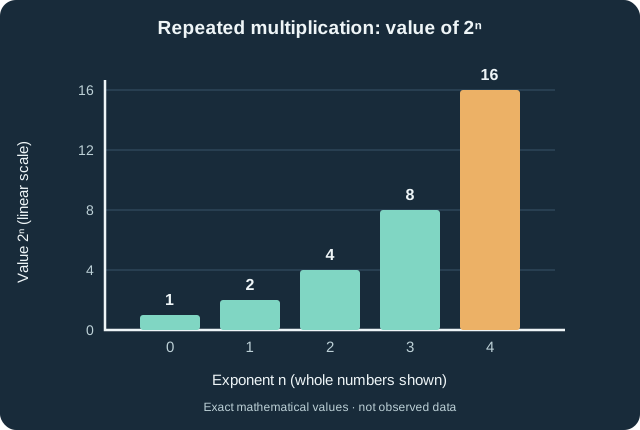
The graph records \(2^n\) for whole-number exponents from 0 through 4. Each step right doubles the preceding value: \(1,2,4,8,16\). The vertical axis is a linear value scale, so the height difference grows: the last jump is \(16-8=8\), much larger than the first jump \(2-1=1\). Exponents describe repeated multiplication, not a fixed amount of addition.
Combine powers by counting factors
When two powers have the same base, their factors join into one longer product. For example,
\[ 2^3\cdot2^4 =(2\cdot2\cdot2)(2\cdot2\cdot2\cdot2) =2^{3+4} =2^7 =128. \]
For any base \(a\) and nonnegative whole numbers \(m,n\), this gives \(a^m a^n=a^{m+n}\) wherever the powers are defined. The exponent counts add because the factors are joined. By contrast, \(2^3+2^4=8+16=24\), not \(2^7\): addition does not join factors.
Division removes matching factors, provided the base is nonzero. Cancel three factors in \(5^6/5^3\), leaving three:
\[ \frac{5^6}{5^3}=5^{6-3}=5^3=125. \]
More generally, for \(a\ne0\), \(\frac{a^m}{a^n}=a^{m-n}\). Why require \(a\ne0\)? The original denominator \(a^n\) cannot be zero. The same rule explains the zero exponent: since \(\frac{a^3}{a^3}=1\), it must also equal \(a^{3-3}=a^0\). Hence \(a^0=1\) for \(a\ne0\); it is not zero. We do not use this argument to assign a value to \(0^0\).
If more factors are removed than remain, the exponent becomes negative. Check \(10^2/10^5\) two ways:
\[ \frac{10^2}{10^5} =\frac{1}{10^3} =10^{2-5} =10^{-3} =0.001. \]
Thus \(a^{-n}=1/a^n\) for \(a\ne0\) and positive integer \(n\). A negative exponent does not make a positive base negative: \(10^{-3}\) is positive. And a power raised to another power repeats a whole group of factors, so \((a^m)^n=a^{mn}\); for example, \((2^3)^2=2^3\cdot2^3=2^6=64\). These rules rely on the indicated operations—multiplication, division, or a power of a power—not on similar-looking addition.
Write very large or small numbers with powers of ten
Scientific notation expresses a nonzero number as \(c\times10^n\), where \(n\) is an integer and \(1\leq |c|<10\). For a positive number, this is the familiar \(1\leq c<10\); a negative number keeps its minus sign in \(c\). This range makes the notation standardized: \(72\times10^4\) has the right value but is not normalized, while \(7.2\times10^5\) is.
To rewrite \(720{,}000\), place the decimal after its first nonzero digit: \(7.2\). We must multiply \(7.2\) by \(100{,}000=10^5\) to recover the original value:
\[ 720{,}000=7.2\times10^5. \]
For the small number \(0.00072\), the coefficient is again \(7.2\), but now it must be divided by \(10{,}000\). Since \(10^{-4}=1/10^4=0.0001\),
\[ 0.00072=7.2\times10^{-4} =7.2\times0.0001. \]
The sign of the exponent tells us whether the power of ten enlarges or shrinks the coefficient. A useful check is to multiply back: \(7.2\times10^{-4}\) must be much smaller than 7.2. For a nonzero number already between 1 and 10, the exponent is zero, such as \(6.4=6.4\times10^0\). Zero itself is simply 0; it has no normalized scientific-notation coefficient satisfying \(1\leq|c|<10\).
Powers of ten also simplify calculations, but both the coefficients and powers must be handled:
\[ (3\times10^4)(2\times10^{-2}) =(3\cdot2)\times10^{4+(-2)} =6\times10^2 =600. \]
We multiplied the coefficients \(3\) and \(2\), then added exponents only for the two factors with base 10. As a magnitude check, \(3\times10^4=30{,}000\) and \(2\times10^{-2}=0.02\); their product is indeed 600. When a coefficient falls outside the interval from 1 to 10 after multiplication, adjust it and the exponent together: \(12\times10^3=1.2\times10^4\), because dividing 12 by 10 must be balanced by multiplying \(10^3\) by 10.
Further reading
The exponent product and power rules were checked against OpenStax Prealgebra 2e §10.2, the zero exponent against §10.4, and negative exponents and scientific notation against §10.5. The wording, examples, calculations, and graph here were independently created; textbook prose, exercises, and artwork were not reproduced.