Prealgebra · Unit 8 · Topic 8.2
Perimeter and Polygon Area
Distinguish perimeter from area, derive polygon area formulas, and use a coordinate grid to find the area and boundary length of composite shapes.
Two measurements of the same shape
A rectangular garden may need a fence around its edge and soil over its surface. Perimeter answers the fence question: add the lengths of the outer boundary segments. Area answers the soil question: count how many unit squares cover the region without gaps or overlaps. Perimeter has length units, such as metres; area has square units, such as square metres.
A 1 cm by 1 cm square has area \(1\text{ cm}^2\), not 1 cm. If you change the length unit, convert before calculating. A side of 2 m is 200 cm; mixing 2 m with 30 cm in the same formula would make the result meaningless.
In this lesson, polygons are flat figures with straight sides. Lengths and heights are nonnegative, and a height is measured perpendicular to the chosen base. The diagrams are constructed examples, not measured land parcels.
Rectangles: rows of unit squares and boundary segments
Let a rectangle have length \(l\) and width \(w\), both measured in the same unit. There are two sides of each length, so
\[P=2l+2w=2(l+w).\]
If \(l\) and \(w\) are whole numbers of grid units, the rectangle contains \(l\) columns and \(w\) rows of unit squares. Multiplication counts them: \(A=lw\). The same formula works for fractional dimensions because the unit squares can be divided into smaller equal pieces.
For a rectangle 8 cm long and 3 cm wide,
\[P=2(8+3)=22\text{ cm},\qquad A=8\cdot3=24\text{ cm}^2.\]
Notice that 22 and 24 describe different kinds of quantity. Do not compare them as if they were two estimates of one measurement. For a square of side \(s\), set \(l=w=s\), giving \(P=4s\) and \(A=s^2\).
Triangles: why one-half appears
Choose any side of a triangle as its base \(b\). The matching height \(h\) is the shortest distance from the opposite vertex to the line containing that base. It meets the base line at \(90^\circ\); it is not usually a slanted side.
Two copies of a triangle can be arranged into a parallelogram with base \(b\) and perpendicular height \(h\). The parallelogram has area \(bh\), so one triangle has half that area:
\[A_{\text{triangle}}=\frac12bh.\]
This remains true when the perpendicular height lands outside the base segment, as in an obtuse triangle. Figure 1 shows the height to an extended base line rather than to a sloping side.
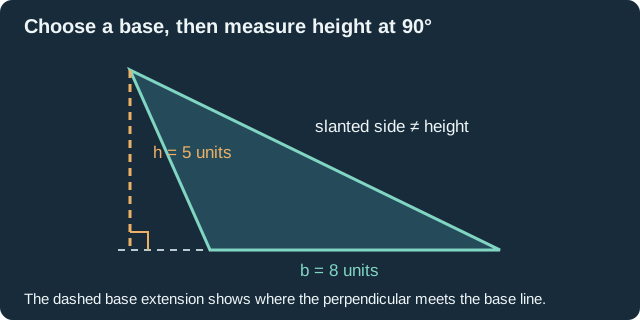
For a triangle with base 14 cm and perpendicular height 5 cm,
\[A=\frac12(14)(5)=35\text{ cm}^2.\]
The formula does not determine its perimeter. To add the three side lengths, we need those lengths or enough other information to calculate them. A triangle with the same base and height can have its top vertex shifted sideways, changing the sloping sides while leaving its area at \(35\text{ cm}^2\).
Parallelograms and trapezoids
A parallelogram has two pairs of parallel sides. Cut a right triangle from one end and move it to the other; the pieces form a rectangle with the same base \(b\) and perpendicular height \(h\). Rearranging does not change area, so \(A_{\text{parallelogram}}=bh\). Its slanted side is not a substitute for \(h\). Its perimeter still adds boundary lengths: \(P=2(a+b)\) if adjacent side lengths are \(a\) and \(b\).
For a trapezoid, name the two parallel bases \(b_1\) and \(b_2\), and let \(h\) be their perpendicular separation. A second congruent trapezoid can be turned and placed next to the first to form a parallelogram with base \(b_1+b_2\) and height \(h\). One trapezoid is half of that area:
\[A_{\text{trapezoid}}=\frac{(b_1+b_2)h}{2}.\]
If the parallel bases are 4 m and 10 m and the height is 5 m, \(A=(4+10)\cdot5/2=35\text{ m}^2\). The bases and height alone are not enough to find its perimeter, because the two remaining side lengths are unknown.
| Shape | Area | Perimeter when the named side lengths are known |
|---|---|---|
| Rectangle | \(lw\) | \(2l+2w\) |
| Square | \(s^2\) | \(4s\) |
| Triangle | \(bh/2\) | \(a+b+c\), where \(a,b,c\) are its three sides |
| Parallelogram | \(bh\) | \(2(a+b)\), where \(a,b\) are adjacent sides |
| Trapezoid | \((b_1+b_2)h/2\) | Sum of all four side lengths |
The same letters in different rows may name different segments. Label the actual diagram before substituting into a formula.
Read area and perimeter from a coordinate grid
Figure 2 graphs an L-shaped polygon on equal-scale axes. Each grid interval is one unit in both directions. Its vertices, in order around the boundary, are \((0,0)\), \((8,0)\), \((8,3)\), \((5,3)\), \((5,6)\), and \((0,6)\). Because every edge is horizontal or vertical, its length is the change in one coordinate.
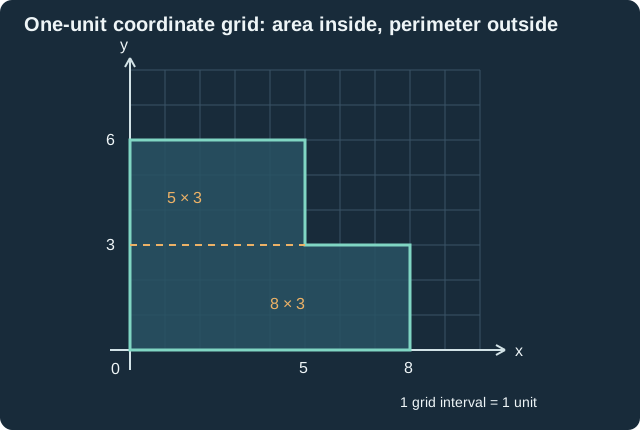
The dashed line splits the region into a lower \(8\times3\) rectangle and an upper-left \(5\times3\) rectangle. Their interiors do not overlap, so their areas add:
\[A=(8\cdot3)+(5\cdot3)=24+15=39\text{ square units}.\]
For perimeter, walk once around the outer edge. The six successive lengths are \(8,3,3,3,5,6\) units. Therefore
\[P=8+3+3+3+5+6=28\text{ units}.\]
Adding the dashed internal segment would count an edge that is not on the boundary. As a check on area, start with the full \(8\times6\) rectangle and remove the missing \(3\times3\) top-right corner: \(48-9=39\) square units again. Addition and subtraction agree because they describe the same region without counting any piece twice.
Choosing and checking a method
First ask what is being measured: boundary length or covered region. Next identify the given lengths and convert them to a common unit. For area, choose a familiar polygon formula or divide a composite figure into nonoverlapping parts. For perimeter, trace only the exterior and account for every edge exactly once.
Three checks catch many errors. An area answer should have square units; a perimeter answer should have length units. A triangle's height must be perpendicular to its chosen base, even if that height falls outside the triangle. Finally, if you split a shape, use the split only to organize the area calculation—do not automatically add that internal line to its perimeter.
Further reading
The standard polygon relationships and topic scope were checked against OpenStax Prealgebra 2e, §9.4 and its discussion of composite figures in §9.5. This lesson's prose, numerical examples, and diagrams were independently created; textbook prose, exercises, and artwork were not reproduced.