Prealgebra · Unit 4 · Topic 4.5
Units and Measurement Conversions
Convert length, mass, volume, time, area, and speed using unit-canceling factors; distinguish squared and cubed conversions and check worked measurement examples.
How do you convert a measurement to another unit?
Multiply by a conversion factor oriented so the original unit cancels and the requested unit remains. A conversion factor is a ratio of two equivalent quantities, such as \(\frac{100\text{ cm}}{1\text{ m}}\). Because 100 centimetres and 1 metre describe the same length, that ratio equals 1 as a ratio of quantities.
Conversion changes the numerical representation, not the physical amount. A 2.4-metre ribbon and a 240-centimetre ribbon have the same length. Using smaller units requires more of them; using larger units requires fewer.
This lesson covers length, mass, volume, time, area, and rates. Always identify the kind of quantity before choosing a factor: length, area, and volume require different powers of the length conversion.
A number needs a unit and a quantity
The number 12 alone does not tell you whether you have 12 metres, 12 grams, or 12 seconds. A unit gives the reference size; the quantity type tells you what is being measured.
| Quantity | Common units | What is measured |
|---|---|---|
| Length | millimetre (mm), centimetre (cm), metre (m), kilometre (km) | Distance or size along one direction |
| Mass | milligram (mg), gram (g), kilogram (kg) | Mass, not volume or gravitational force |
| Volume | cubic centimetre (cm³), millilitre (mL), litre (L) | Three-dimensional space or capacity |
| Time duration | second (s), minute (min), hour (h) | Elapsed time |
| Area | square centimetre (cm²), square metre (m²) | Surface size |
| Speed | metres per second (m/s), kilometres per hour (km/h) | Distance per time |
Here “litre” and “metre” are the same units also spelled “liter” and “meter.” Unit symbols are case-sensitive: m means metre, while L means litre. We use a space between the number and unit, such as 5 cm.
Useful exact relationships
| Relationship | Equivalent quantities |
|---|---|
| Metric length | \(1\text{ km}=1000\text{ m}\); \(1\text{ m}=100\text{ cm}=1000\text{ mm}\) |
| Decimetres | \(1\text{ dm}=10\text{ cm}=0.1\text{ m}\) |
| Metric mass | \(1\text{ kg}=1000\text{ g}\); \(1\text{ g}=1000\text{ mg}\) |
| Capacity | \(1\text{ L}=1000\text{ mL}\) |
| Capacity and cubic volume | \(1\text{ L}=1\text{ dm}^3\); \(1\text{ mL}=1\text{ cm}^3\) |
| Time duration | \(1\text{ min}=60\text{ s}\); \(1\text{ h}=60\text{ min}=3600\text{ s}\) |
| Inch-based length | \(1\text{ ft}=12\text{ in}\); \(1\text{ yd}=3\text{ ft}\); \(1\text{ in}=2.54\text{ cm}\) |
The metric prefixes used here are kilo- (1000), deci- (one tenth), centi- (one hundredth), and milli- (one thousandth). Apply a prefix to its stated unit, rather than guessing a conversion from the number of letters.
The relationships above are exact unit definitions. An exact conversion factor does not make an uncertain physical measurement more precise.
Orient the factor by canceling units
To change metres to centimetres, put metres in the denominator:
\[\text{measurement in m}\times\frac{100\text{ cm}}{1\text{ m}}.\]
To change centimetres to metres, use the reciprocal:
\[\text{measurement in cm}\times\frac{1\text{ m}}{100\text{ cm}}.\]
The matching unit appears above and below and cancels. If your expression leaves units such as \(\text{cm}^2/\text{m}\) when you wanted centimetres, the factor is facing the wrong way.
A reliable conversion routine
- Write the original value with its unit and state the requested unit.
- Confirm that the units describe the same type of quantity.
- Find an exact relationship, or clearly identify an approximate factor if one is supplied.
- Build one or more factors so unwanted units cancel.
- Calculate, keep the final unit, and round only if requested.
- Check the size and reverse the conversion to recover the starting value.
Worked example
Problem: Convert 2.4 metres to centimetres.
\[2.4\text{ m}\times\frac{100\text{ cm}}{1\text{ m}}=240\text{ cm}.\]
Metres cancel, leaving centimetres. The numerical count increases because a centimetre is smaller than a metre.
Reverse check: \(240\text{ cm}\times\frac{1\text{ m}}{100\text{ cm}}=2.4\text{ m}\).
Worked example: convert to a larger unit
Problem: Convert 3750 millimetres to metres.
\[3750\text{ mm}\times\frac{1\text{ m}}{1000\text{ mm}}=3.75\text{ m}.\]
The numerical value decreases because metres are larger. A two-step route agrees:
\[3750\text{ mm}\times\frac{1\text{ cm}}{10\text{ mm}}\times\frac{1\text{ m}}{100\text{ cm}}=3.75\text{ m}.\]
All intermediate units cancel. Do not multiply by 1000 merely because a metric prefix is involved; the direction matters.
Worked example: mass and mixed units
Problem: Express 2 kilograms 350 grams in kilograms.
Convert the gram part first:
\[350\text{ g}\times\frac{1\text{ kg}}{1000\text{ g}}=0.35\text{ kg}.\]
Then add quantities in the same unit: \(2\text{ kg}+0.35\text{ kg}=2.35\text{ kg}\). In grams, the same mass is \(2000+350=2350\text{ g}\).
Do not add the bare numbers \(2+350\) and label the result kilograms. Kilograms measure mass; in physics, weight is a force and is measured in units such as newtons.
Worked example: combine capacities in matching units
Problem: A container holds 1.25 litres, then receives another 450 millilitres. Find the total.
Convert the second amount:
\[450\text{ mL}\times\frac{1\text{ L}}{1000\text{ mL}}=0.45\text{ L}.\]
The total is \(1.25+0.45=1.70\text{ L}\), or 1700 mL. The final zero does not change the numerical value.
Millilitres are volume units; milligrams are mass units. They cannot be converted directly without information about the material, such as its density.
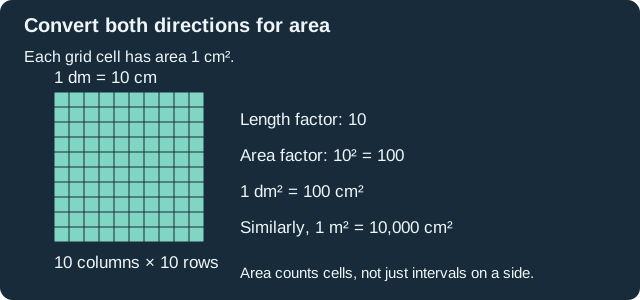
Area conversions square the length factor
Since \(1\text{ m}=100\text{ cm}\), a square one metre on each side has
\[1\text{ m}^2=(100\text{ cm})(100\text{ cm})=10{,}000\text{ cm}^2.\]
Both directions must be converted. A smaller grid makes the same idea easy to see:
Problem: Convert \(0.32\text{ m}^2\) to square centimetres.
\[0.32\text{ m}^2\times\left(\frac{100\text{ cm}}{1\text{ m}}\right)^2=3200\text{ cm}^2.\]
The square on the conversion factor applies to both its numbers and its units. Conversely, \(2500\text{ cm}^2=0.25\text{ m}^2\).
Volume conversions cube the length factor
A cube has three independent lengths. Consequently,
\[1\text{ m}^3=(100\text{ cm})^3=1{,}000{,}000\text{ cm}^3.\]
Also, \(1\text{ m}=10\text{ dm}\), so \(1\text{ m}^3=1000\text{ dm}^3=1000\text{ L}\). Since \(1\text{ dm}=10\text{ cm}\), one litre equals \(1000\text{ cm}^3\), or 1000 mL.
Problem: Convert \(0.004\text{ m}^3\) to litres and millilitres.
\[0.004\text{ m}^3\times\frac{1000\text{ L}}{1\text{ m}^3}=4\text{ L}=4000\text{ mL}.\]
The litre is already a volume unit. Converting L to mL uses the factor 1000 once; do not cube it again.
Worked example: decimal hours are not minutes
Problem: Convert 3.25 hours to minutes.
\[3.25\text{ h}\times\frac{60\text{ min}}{1\text{ h}}=195\text{ min}.\]
The fractional part \(0.25\) hour is 15 minutes, so 3.25 hours means 3 hours 15 minutes. In contrast, 3 hours 25 minutes equals \(3\times60+25=205\) minutes. Time durations do not use 100 minutes per hour.
To convert 2 minutes 45 seconds to seconds, calculate \(2\times60+45=165\text{ s}\).
Worked example: convert an inch-based length
Problem: Express 2 feet 7 inches in centimetres.
First combine in inches: \(2\times12+7=31\text{ in}\). Then use the exact inch definition:
\[31\text{ in}\times\frac{2.54\text{ cm}}{1\text{ in}}=78.74\text{ cm}.\]
This is the exact arithmetic conversion of the stated length. A real measurement may still have uncertainty. For capacity units such as cups or gallons, identify the measurement system first; U.S. and imperial definitions are not interchangeable.
Worked example: convert a rate
Problem: Convert 54 kilometres per hour to metres per second.
Convert the distance unit and the time unit:
\[54\frac{\text{km}}{\text{h}}\times\frac{1000\text{ m}}{1\text{ km}}\times\frac{1\text{ h}}{3600\text{ s}}=15\frac{\text{m}}{\text{s}}.\]
The hour is originally in the denominator, so put hours in the numerator of its conversion factor. Both kilometres and hours cancel.
Check the interpretation: travelling 15 metres each second for 3600 seconds covers 54,000 metres, or 54 kilometres.
Not every conversion is a single multiplier
Length-to-length and mass-to-mass conversions here are proportional. Celsius and Fahrenheit temperature readings, however, involve different zero points:
\[F=\frac95C+32.\]
Here \(C\) is the numerical Celsius reading and \(F\) is the numerical Fahrenheit reading. For example, \(20\,^\circ\text{C}\) corresponds to \(68\,^\circ\text{F}\). A temperature difference uses only the scale factor: a rise of \(10\,^\circ\text{C}\) is a rise of \(18\,^\circ\text{F}\), not 50 degrees.
Likewise, volume and mass are different quantities. A conversion between them requires density and the relevant conditions, not just a metric-prefix table.
Common mistakes
- Using the factor backward: Place the original unit where it will cancel.
- Forgetting powers: Length, area, and volume use the first, second, and third powers of a length conversion.
- Cubing an existing volume conversion: \(1\text{ L}=1000\text{ mL}\); that relationship already accounts for volume.
- Adding unlike units: Convert grams to kilograms, or millilitres to litres, before adding.
- Reading decimal time as minutes: 0.25 hour means 15 minutes, not 25 minutes.
- Confusing mass with volume or weight: g, mL, and newtons measure different quantities.
- Inventing precision: Exact factors preserve the given measurement; they do not improve the measuring instrument.
- Ignoring measurement systems: Identify which cup, gallon, or other system-dependent unit is intended.
Check your understanding
Try these before reading the explanations. These lesson self-checks do not modify the separate Quizzes or Practice tabs.
- Convert 4.7 km to metres.
- Convert 86 cm to metres.
- Convert 0.032 kg to grams.
- Convert 725 mL to litres.
- Express 1 m 35 cm in centimetres and metres.
- Convert \(2.5\text{ m}^2\) to square centimetres.
- Convert \(450\text{ cm}^2\) to square metres.
- Convert \(0.006\text{ m}^3\) to litres.
- Convert 1.75 hours to minutes and state it as hours and minutes.
- Convert 18 inches to centimetres.
- Convert 72 km/h to m/s.
- Can you convert 250 mL of an unspecified substance directly to grams? Explain.
Answers and explanations
- \(4.7\times1000=4700\text{ m}\).
- \(86\div100=0.86\text{ m}\).
- \(0.032\times1000=32\text{ g}\).
- \(725\div1000=0.725\text{ L}\).
- \(100+35=135\text{ cm}\), or \(1+0.35=1.35\text{ m}\).
- \(2.5\times100^2=25{,}000\text{ cm}^2\).
- \(450\div100^2=0.045\text{ m}^2\).
- \(0.006\times1000=6\text{ L}\).
- \(1.75\times60=105\text{ min}\), or 1 hour 45 minutes.
- \(18\times2.54=45.72\text{ cm}\).
- \(72\times1000\div3600=20\text{ m/s}\).
- No. Millilitres measure volume and grams measure mass; the material's density under the relevant conditions is needed.
Common mistake
Do not apply a length conversion unchanged to an area or a volume.
Key takeaway
Unit conversion preserves a quantity while changing its representation. Use ratios of equivalent quantities so unwanted units cancel, and verify the remaining unit. Square length factors for area and cube them for cubic volume. Match units before adding, account for time units in rates, and recognize when offsets or extra physical information are required.
Related lessons
- Calculating with Decimals: multiply and divide conversion factors
- Multiplying and Dividing Fractions: ratios and canceling factors
- Mixed Numbers and Fraction Applications: combine amounts in compatible units
- Exponents and Order of Operations: squared and cubed factors
- Perfect Squares and Square Roots: distinguish area from side length
Sources and authorship
The public educational and standards resources below were consulted for topic coverage and unit relationships. This lesson's explanations, example settings, self-checks, tables, and diagram were independently created; textbook prose, exercise sets, and artwork are not reproduced. Public access does not automatically allow unrestricted reuse; consult the source's current licensing terms before reproducing material.
- OpenStax Prealgebra 2e, 7.5: Systems of Measurement — measurement conversions and temperature conversion coverage.
- OpenStax Prealgebra 2e: preface and reuse conditions
- NIST Guide to the SI: Conversion Factors Listed Alphabetically — verification of unit conversion factors, including the inch.
- NIST: SI Units — Volume — cubic volume, litres, and millilitres.