Prealgebra · Unit 5 · Topic 5.5
Discounts, Taxes, and Simple Interest
Find discount amounts, sale prices, and hypothetical sales taxes; calculate simple interest with annual rates and time in years, and solve for unknown prices, principal, rates, or time.
How do discounts, taxes, and simple interest use percents?
A discount subtracts a percentage of a specified price; an added sales tax adds a percentage of a specified taxable amount; simple interest is calculated from a fixed principal, a rate, and elapsed time. Each calculation needs a clearly identified base.
Convert a percent to a decimal before multiplying: \(15\%=0.15\), not 15. Distinguish the percentage amount from the final total: a $12 discount is not a $12 sale price.
All prices, tax rates, and interest rates below are hypothetical teaching examples. This lesson explains mathematical models, not current tax law, actual financial products, or financial advice. Actual tax bases, fees, exemptions, day-count conventions, and rounding rules require the applicable rules or contract.
Discounts: amount removed versus amount remaining
Let \(L\) be the listed price, \(d\) the decimal discount rate, \(D\) the discount amount, and \(S\) the sale price. For \(L\ge0\) and \(0\le d\le1\):
\[D=Ld,\qquad S=L-D=L(1-d).\]
The multiplier \(d\) finds the part removed; \(1-d\) finds the part remaining. A 15% discount leaves 85% of the listed price.
Worked example: a discount followed by an added tax
Problem: An $80 item has a 15% discount. A hypothetical 5% sales tax applies to the discounted price. Find the discount, sale price, tax, and final total.
- Discount: \(D=80\times0.15=12\) dollars.
- Sale price: \(S=80-12=68\) dollars, or \(80\times0.85=68\).
- Tax: \(T=68\times0.05=3.40\) dollars. The taxable base is $68, not $80.
- Final total: \(C=68+3.40=71.40\) dollars.
The compact calculation is \(80(1-0.15)(1+0.05)=71.40\). Check: the sale price is below $80, the tax increases $68, and the final total is still below $80.
Subtracting 15% and adding 5% to claim a net 10% discount would give $72, which is wrong here. The two rates use different bases. The actual reduction relative to the listed price is \((80-71.40)/80=0.1075\), or 10.75%.
Sales tax: identify the taxable base
Let \(B\) be the taxable amount and \(q\) the decimal tax rate. Then
\[T=Bq.\]
If the entire pretax subtotal is taxable, with no other charges, the total is \(C=B+T=B(1+q)\). Otherwise, calculate tax on the stated taxable portion and add it to the appropriate subtotal.
Example: A hypothetical bill contains $45 of taxable supplies and a $15 tax-exempt item. If the stated tax rate is 8% on the supplies only, \(T=45\times0.08=3.60\) dollars. The bill total is \(45+15+3.60=63.60\) dollars, not \(60\times1.08\).
Do not assume every discount or coupon changes the taxable base in the same way. Follow the problem's stated treatment; actual rules vary by jurisdiction and transaction.
Worked example: recover a pretax price
Problem: A total of $54 includes a hypothetical 8% tax added to the entire pretax price, with no other charges. Find the pretax price and tax.
\[1.08B=54,\qquad B=54/1.08=50.\]
The tax is \(54-50=4\) dollars, checked by \(50\times0.08=4\). Subtracting 8% of $54 would use the tax-inclusive total as the base and would not recover $50.
For a tax-inclusive total in this model, \(B=C/(1+q)\) and \(T=C-B\). Do not add the same tax again to an already tax-inclusive total.
Worked example: find a discount rate or original price
Problem: An item listed at $96 sells for $72 before tax. Find the discount rate.
The discount amount is \(96-72=24\) dollars. Divide by the listed price:
\[d=\frac{24}{96}=0.25=25\%.\]
Check: \(96\times0.75=72\). The discount percentage compares the reduction with the original price, not with the sale price.
Reverse example: A sale price of $54 is 75% of the listed price after a 25% discount. Thus \(L=54/0.75=72\) dollars. A 100% discount leaves zero; the original price cannot be recovered from that zero alone.
Successive discounts depend on the stated sequence
If an item receives a 20% discount and then a 10% discount on the reduced price, the remaining fraction is \(0.80\times0.90=0.72\). The overall discount is 28%, not 30%.
A fixed-dollar coupon is different from a percentage discount. For a constructed $100 purchase, 20% off followed by a $10 coupon gives \(100\times0.80-10=70\) dollars. Applying the coupon first gives \((100-10)\times0.80=72\) dollars. Read the sequence and eligibility conditions; a dollar amount is not a percent rate.
Simple interest: definitions and formula
Simple interest is proportional to the original principal and elapsed time, without charging or earning interest on previously accumulated interest. In this model, the principal and rate stay constant throughout the stated period, with no interim deposits or repayments.
\[I=Prt,\qquad A=P+I=P(1+rt).\]
| Symbol | Meaning | Units or interpretation |
|---|---|---|
| \(P\) | Principal, the starting amount | Dollars or another currency |
| \(r\) | Annual interest rate as a decimal | 4.5% per year uses 0.045 |
| \(t\) | Elapsed time | Years when the rate is annual |
| \(I\) | Interest only | Same currency as the principal |
| \(A\) | Principal plus interest | Same currency as the principal |
Here \(P>0\), \(r\ge0\), and \(t\ge0\). If an annual rate is given, 9 months means \(t=9/12=0.75\) years, not 9 years. For a stated monthly rate, use matching monthly time units instead; do not silently reinterpret an annual rate as monthly. For days, use the explicitly stated day-count convention rather than assuming a year length.
Worked example: interest and total amount
Problem: A fixed $800 principal earns simple interest at a hypothetical annual rate of 4.5% for 30 months. Find the interest and the total amount.
Convert the rate and time: \(r=0.045\), \(t=30/12=2.5\) years. Then
\[I=800\times0.045\times2.5=90,\qquad A=800+90=890.\]
The interest is $90; the total amount is $890. Check: each year contributes \(800\times0.045=36\) dollars, and \(36\times2.5=90\).
For a simplified loan with the same fixed principal, rate, duration, and no fees or interim payments, these formulas give $90 interest and a $890 final repayment. A loan with a changing unpaid balance needs a different calculation; this model is not a universal loan-payment formula.
See why simple interest grows at a constant rate
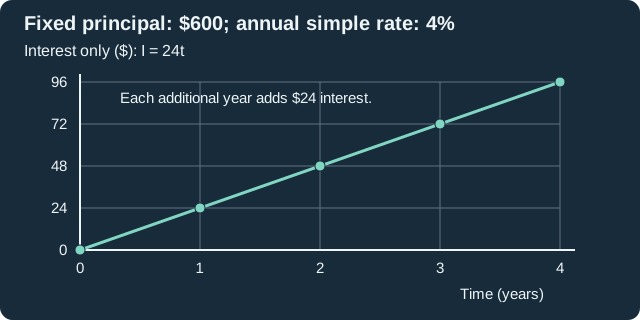
| Time in years | Interest \(I=24t\) | Total \(A=600+24t\) |
|---|---|---|
| 0 | $0 | $600 |
| 1 | $24 | $624 |
| 2 | $48 | $648 |
| 3 | $72 | $672 |
| 4 | $96 | $696 |
The line starts at zero because no interest has accumulated at time zero. The total-amount graph would instead start at $600. Equal time intervals add equal interest amounts when principal and rate remain fixed.
Simple interest is not compound interest
With simple interest on $600 at 4% per year, two years produce \(600\times0.04\times2=48\) dollars of interest and a total of $648.
For comparison, hypothetical annual compounding at the same rate gives \(600\times1.04\times1.04=648.96\) dollars after two years. The second year's interest is calculated on $624, including the first year's interest. That is not the fixed-principal model \(I=Prt\).
Worked examples: solve for a missing interest quantity
Rearrange \(I=Prt\) only when the quantity you divide by is nonzero:
\[P=\frac{I}{rt},\qquad r=\frac{I}{Pt},\qquad t=\frac{I}{Pr}.\]
Find the annual rate: A fixed $900 principal earns $54 simple interest in 18 months. Since \(t=1.5\) years, \(r=54/(900\times1.5)=0.04\), or 4% per year. Check: \(900\times0.04\times1.5=54\).
Find the time: A fixed $1,200 principal earns $72 at 3% annual simple interest. Then \(t=72/(1200\times0.03)=2\) years, or 24 months.
Find the principal: Simple interest of $45 is earned at 5% per year for 9 months. Then \(P=45/(0.05\times0.75)=1200\) dollars. If a problem gives a final total rather than interest alone, use \(A=P(1+rt)\), so \(P=A/(1+rt)\).
Rounding and reasonableness
Keep the exact decimal rate and time fraction through the calculation. Follow any specified rounding rule; in these exercises, round a final monetary answer to the nearest cent if needed. Actual receipts may round individual items or tax at a different stage.
A 6.5% added tax on a hypothetical $23.40 taxable price is \(23.40\times0.065=1.521\) dollars, or $1.52 to the nearest cent. The total is $24.92 under this stated model. The tax should be well below the price because the rate is below 10%.
Common mistakes
- Confusing the discount with the sale price: Subtract the discount from the listed price.
- Using the wrong taxable base: Read whether tax applies to the sale price, original price, or only some items.
- Adding rates with different bases: Use the specified sequence of operations.
- Subtracting tax from a tax-inclusive price by the tax rate: Divide by \(1+q\) in the fully taxable model.
- Treating 4% as 4: Use 0.04 in multiplication.
- Using months as years: Convert time to match the rate's period.
- Reporting the total as interest: \(I\) is the extra amount; \(A=P+I\) includes principal.
- Compounding a simple-interest problem: Simple interest uses the unchanged principal.
- Applying the model to a changing balance: Deposits, repayments, fees, and contract rules can change the calculation.
Check your understanding
These self-checks are independently written and do not change the separate Quizzes or Practice tabs.
- An $84 item is 25% off. Find the discount and sale price before tax.
- A hypothetical 6% tax is added to an entirely taxable $75 purchase. Find the tax and total.
- A $150 item is reduced by 20%; a hypothetical 5% tax applies to its reduced price. Find the final total.
- A $64 item sells for $48 before tax. Find the discount rate.
- A total of $86.40 includes a hypothetical 8% tax on the entire pretax price. Find that price and tax.
- A bill contains $40 of taxable items and $20 of exempt items. Add a hypothetical 5% tax on the taxable portion only.
- Find simple interest and total amount for $700 at 3% annually for 2 years.
- Find simple interest and total amount for $960 at 5% annually for 9 months.
- A fixed $1,500 principal earns $90 simple interest in 2 years. Find the annual rate.
- A fixed $800 principal earns $64 at 4% annual simple interest. Find the time in years and months.
- Find the principal that earns $30 simple interest at 5% annually in 6 months.
- Find the original principal if the total after 2 years at 5% annual simple interest is $990.
Answers and explanations
- Discount: \(84\times0.25=21\) dollars. Sale price: \(84-21=63\) dollars.
- Tax: \(75\times0.06=4.50\) dollars. Total: $79.50.
- \(150\times0.80=120\) dollars before tax; tax is $6; total is $126.
- \((64-48)/64=0.25\): 25% discount.
- Pretax price: \(86.40/1.08=80\) dollars. Tax: $6.40.
- Tax: \(40\times0.05=2\) dollars. Total: \(40+20+2=62\) dollars.
- \(I=700\times0.03\times2=42\) dollars; \(A=742\) dollars.
- \(t=9/12=0.75\); \(I=960\times0.05\times0.75=36\) dollars; \(A=996\) dollars.
- \(r=90/(1500\times2)=0.03\): 3% per year.
- \(t=64/(800\times0.04)=2\) years, or 24 months.
- \(P=30/(0.05\times0.5)=1200\) dollars.
- \(990=P(1+0.05\times2)=1.10P\), so \(P=900\) dollars. Interest is $90.
Key takeaway
For a discount, compute the amount removed and subtract it from the stated base. For an added tax, compute the tax on the specified taxable amount, then add it to the subtotal. For fixed-principal simple interest, use \(I=Prt\) with a decimal annual rate and time in years; \(A=P+I\) is the total. Label the base, units, assumptions, and requested quantity before calculating.
Related lessons
- Percents, Fractions, and Decimals: convert rates correctly
- Percent Increase and Decrease: multipliers, successive changes, and reverse calculations
- Equivalent Ratios and Proportions: solve relative comparisons
- Calculating with Decimals: multiply and divide monetary amounts
- Units and Measurement Conversions: keep rate and time units consistent
Sources and authorship
The publicly accessible educational resources below were consulted for topic coverage and mathematical checks. This lesson's explanations, example settings, tables, self-checks, and graph were independently created; source prose, exercises, and artwork are not reproduced. Public access does not mean unrestricted reuse: consult each resource's current license before reproducing material.