Prealgebra · Unit 7 · Topic 7.4
One-Variable Inequalities
Solve one-variable linear inequalities, reverse the sign when multiplying or dividing by a negative constant, graph included or excluded endpoints, and check solution sets and context restrictions.
What is the solution of an inequality?
A solution is any allowed value that makes an inequality true. Solving a one-variable inequality means describing the complete set of such values, not just one boundary number. For example, \(x>2\) includes 3, 2.5, and every real number greater than 2, but excludes 2 itself.
A linear inequality uses first-degree variable terms after simplification, such as \(ax+b<c\), with real constants. This lesson uses the real-number domain unless a situation restricts x to counts or other allowed values. Its methods do not address squared variables or variable denominators.
All numerical examples, self-checks, and the number-line diagram below were independently created.
Read the symbols and comparison words
| Symbol | Reading | Equality allowed? | Typical wording |
|---|---|---|---|
| \(x<a\) | x is less than a | No | Less than, below |
| \(x>a\) | x is greater than a | No | More than, above |
| \(x\le a\) | x is less than or equal to a | Yes | At most, no more than |
| \(x\ge a\) | x is greater than or equal to a | Yes | At least, no less than |
“At most six” includes six. “Less than six” does not. These distinctions affect both the solution set and the endpoint shown on a graph.
Rewriting \(3<x\) as \(x>3\) describes the same comparison with the sides exchanged. This is not the negative-multiplication rule; the sign must face the correct quantity when the sides switch places.
Inequality properties and their conditions
| Operation on both sides | Effect on the comparison |
|---|---|
| Add or subtract the same real quantity | Keep the inequality direction |
| Multiply or divide by the same positive constant | Keep the inequality direction |
| Multiply or divide by the same negative constant | Reverse the inequality direction |
These operations produce equivalent inequalities on the stated domain when division is defined. Division by zero is never permitted. Multiplying by zero can erase information and is not an equivalent solving step.
Do not multiply or divide by an expression such as x unless its sign and nonzero status have been established; an unknown sign could require separate cases. Use known constants in this lesson's solving steps.
Why a negative multiplier reverses order
Start with \(2<5\). Multiplying both numbers by \(-1\) gives \(-2>-5\), not \(-2<-5\). On the number line, negation reflects positions across zero, reversing which value lies farther right.
Multiplication by any negative constant combines that reflection with a positive scale change, so the order reverses. Accordingly, \(<\) becomes \(>\), and \(\le\) becomes \(\ge\). The endpoint's inclusion status does not change.
Subtracting a positive or negative quantity does not trigger reversal. For example, subtracting 5 from \(2<5\) gives \(-3<0\), with the same direction.
A solve, graph, and check routine
- Distribute and combine like terms on each side.
- Collect variable terms on one side and constants on the other, acting on both sides.
- Divide by the remaining nonzero coefficient. Reverse the sign if that coefficient is negative.
- State the whole solution set and any context restrictions.
- Graph the boundary with an open or filled circle and shade in the correct direction.
- Check an included value, an excluded value, and the boundary in the original inequality.
Sample checks help detect an error but do not prove the entire solution set; the valid algebraic transformations justify it.
Worked example: adding and dividing by a positive number
Problem: Solve \(3x-5\le10\).
Add 5 to both sides, then divide both sides by 3:
\[3x\le15,\qquad x\le5.\]
The direction stays the same because 3 is positive. The graph has a filled circle at 5 and extends left. Check: x = 5 gives \(10\le10\), true; x = 4 gives \(7\le10\), true; x = 6 gives \(13\le10\), false.
Worked example: a negative coefficient and a strict boundary
Problem: Solve \(-2x+3<11\).
Subtract 3, then divide by \(-2\), reversing the sign:
\[-2x<8,\qquad x>-4.\]
The boundary is −4, but −4 is not a solution. Check in the original:
- At x = 0, \(3<11\) is true, so the region to the right is appropriate.
- At x = −5, \(13<11\) is false, so the left side is excluded.
- At x = −4, \(11<11\) is false, confirming the open endpoint.
Do not stop at \(x=-4\); the equation obtained by replacing < with = identifies a boundary, not the inequality's complete answer.
Graph the solution on a number line
Use an open circle for an excluded boundary (< or >) and a filled circle for an included boundary (≤ or ≥). Smaller values lie to the left; larger values lie to the right.
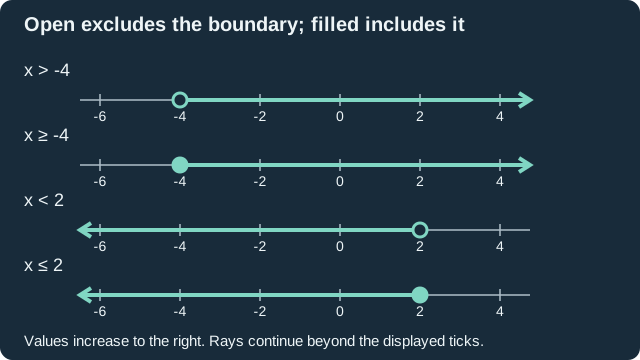
For reference, these sets can also be written in interval notation:
| Inequality | Endpoint and direction | Interval notation |
|---|---|---|
| \(x>a\) | Open at a, right | \((a,\infty)\) |
| \(x\ge a\) | Filled at a, right | \([a,\infty)\) |
| \(x<a\) | Open at a, left | \((-\infty,a)\) |
| \(x\le a\) | Filled at a, left | \((-\infty,a]\) |
A parenthesis excludes a finite endpoint; a square bracket includes it. Infinity is not a real-number endpoint to include, so it always takes a parenthesis. Interval notation is optional here; a correct inequality and graph already describe the set.
Worked example: grouping and variables on both sides
Problem: Solve \(3(x-2)\le x+4\).
\[3x-6\le x+4,\qquad2x-6\le4,\qquad2x\le10,\qquad x\le5.\]
Distribute first, subtract x from both sides, add 6, then divide by positive 2. The endpoint is included. Check: x = 5 gives \(9\le9\), true, while x = 6 gives \(12\le10\), false.
Worked example: fraction and decimal coefficients
Fraction inequality: \(-\frac34x\ge6\). Multiply both sides by \(-\frac43\), a negative reciprocal, and reverse the sign:
\[x\le-8.\]
Check: x = −8 gives \(6\ge6\); x = −12 gives \(9\ge6\); x = 0 gives \(0\ge6\), false.
Decimal inequality: \(0.5x-1.2>2.3\). Add 1.2, then divide by positive 0.5:
\[0.5x>3.5,\qquad x>7.\]
Check: x = 8 gives \(2.8>2.3\), true; the boundary x = 7 gives \(2.3>2.3\), false. Keep exact decimal values rather than rounding the boundary unnecessarily.
When the variable cancels
For \(2x+1<2x-3\), subtract \(2x\) from both sides to obtain \(1<-3\). This is false, so there are no real solutions.
For \(4(x+1)\ge4x+2\), expand and subtract \(4x\): \(4\ge2\). This is true independently of x, so all real numbers satisfy it.
Do not divide by a zero coefficient. Inspect the remaining comparison, including strictness: \(0<0\) is false, but \(0\le0\) is true. If the context restricts the domain, “all” means all permitted values, not necessarily all real numbers.
Worked example: a budget and whole-number solutions
Problem: A constructed activity costs a fixed $8 plus $3 per participant. The budget is at most $26. How many participants can it cover?
Let n count participants, a nonnegative whole number. Then
\[8+3n\le26,\qquad3n\le18,\qquad n\le6.\]
The contextual solution set is \(\{0,1,2,3,4,5,6\}\), assuming the model permits zero participants. The maximum is 6 participants. Six costs $26; seven costs $29 and exceeds the budget. For a count, graph only the allowed integer points rather than claiming every decimal in the continuous ray is feasible.
With a strict limit such as \(4n+5<25\), the algebra gives \(n<5\), so the largest allowed nonnegative whole number is 4, not 5. Conversely, \(n>4.2\) for a whole-number count requires at least 5. Choose a feasible integer from the inequality rather than applying ordinary nearest-integer rounding.
A brief preview of a bounded range
The notation \(-1\le x<3\) means both \(x\ge-1\) and \(x<3\). Graph a filled circle at −1, an open circle at 3, and the segment between them. Its interval is \([-1,3)\).
Do not interpret this as choosing either outside ray. Both conditions must hold at the same time. More complicated compound inequalities are beyond this lesson's main single-comparison focus.
Common mistakes
- Forgetting to reverse after negative multiplication or division: Record the coefficient's sign before dividing.
- Reversing after subtraction: Adding or subtracting the same quantity keeps the direction.
- Changing strictness: Reversal turns < into >, not ≥.
- Giving only the boundary: Report the range, not an equality with its endpoint.
- Using the wrong circle: Strict inequalities exclude; non-strict inequalities include.
- Shading by the sign of the boundary: Direction depends on < or > after isolation, not whether the endpoint is negative.
- Dividing by an unknown-sign variable or zero: The standard steps require a known nonzero constant.
- Ignoring a whole-number restriction: A continuous algebraic set may contain values not allowed by the situation.
Check your understanding
Solve over the real numbers unless a context says otherwise. Describe the endpoint and ray for each nonempty half-line. These self-checks do not change the separate Quizzes or Practice tabs.
- \(x+6<2\).
- \(3x-4\ge8\).
- \(-5x\le15\).
- \(7-2x>1\).
- \(2(x+3)\le14\).
- \(5x+1<2x+10\).
- \(-\frac12x>4\).
- \(0.25x+0.5\le2\).
- \(2x+3<2x+1\).
- \(3(x-2)\ge3x-6\).
- A hypothetical purchase costs $5 plus $4 per item, with an at-most-$25 budget. Find the allowed nonnegative whole-number item counts.
- Explain whether −4 satisfies \(-2x+3<11\), and why x = 0 does or does not satisfy it.
Answers and checks
- \(x<-4\): open endpoint at −4, left ray. For x = −5, \(1<2\) is true; at −4, \(2<2\) is false.
- \(3x\ge12\), so \(x\ge4\): filled at 4, right ray. At 4, \(8\ge8\) is true.
- Divide by −5 and reverse: \(x\ge-3\), filled at −3, right ray. At −3, \(15\le15\) is true.
- \(-2x>-6\), so \(x<3\): open at 3, left ray. At 2, \(3>1\) is true; at 3, \(1>1\) is false.
- \(2x+6\le14\), so \(x\le4\): filled at 4, left ray. At 4, \(14\le14\) is true.
- \(3x<9\), so \(x<3\): open at 3, left ray. At 2, \(11<14\) is true; at 3, both sides are 16 and strict comparison fails.
- Multiply by −2 and reverse: \(x<-8\), open at −8, left ray. At −10, \(5>4\) is true.
- \(0.25x\le1.5\), so \(x\le6\): filled at 6, left ray. At 6, \(2\le2\) is true.
- No solution, because cancellation gives the false statement \(3<1\).
- All real numbers, because both sides are the same expression and equality is allowed.
- \(5+4n\le25\) gives \(n\le5\). With the stated count restriction, the set is \(\{0,1,2,3,4,5\}\). Five items cost $25; six cost $29.
- At −4, \(11<11\) is false, so the boundary is excluded. At 0, \(3<11\) is true, so 0 belongs to the solution set \(x>-4\).
Key takeaway
An inequality's answer is a set of values. Apply matching operations to both sides, reversing direction only when multiplying or dividing by a negative constant. Use open or filled endpoints to show strictness and shade left for smaller values or right for larger ones. Check the original comparison, inspect any cancellation, and apply contextual restrictions.
Related lessons
- The Number Line and Absolute Value: compare signed positions
- One-Step Equations and Checking Solutions: inverse operations and substitution
- Multi-Step Linear Equations: simplify and isolate systematically
- Variables on Both Sides and Special Cases: inspect constant statements
- Multiplying and Dividing Signed Numbers: track negative factors
- Building Equations from Word Problems: define quantities and restrictions
Sources and authorship
The publicly accessible educational resource below was consulted for topic coverage and mathematical checks. This lesson's explanations, example settings, tables, self-checks, and number-line diagram were independently created; textbook prose, exercises, and artwork are not reproduced. Public access does not imply unrestricted reuse: check the resource's current license before reproducing material.