Prealgebra · Unit 8 · Topic 8.3
Circle Circumference and Area
Connect radius, diameter, circumference, and area; use a coordinate graph and exact formulas to reason about circular measurements.
One circle, two kinds of measurement
Imagine a circular tabletop. A strip fitted around its edge needs a length: the circumference. A covering cut to fit its top needs an area: the amount of flat region inside the edge. These measurements come from the same radius, but they answer different questions and have different units.
A circle is the set of points in a plane at the same distance from a fixed center. That distance is its radius \(r\). A diameter \(d\) joins two points on the circle and passes through the center, so it contains two radii:
\[d=2r,\qquad r=\frac d2.\]
Lengths are nonnegative. Unless a problem says otherwise, we assume a complete circle with \(r>0\) and use the same length unit throughout. The filled-in region is often called a disk; its area is what “area of a circle” means here.
See the measurements on a coordinate graph
Figure 1 shows a circle centered at \((0,0)\) on equal-scale \(x\)- and \(y\)-axes. Each grid interval is one unit, and the radius is 4 units. The points \((4,0)\), \((-4,0)\), \((0,4)\), and \((0,-4)\) all lie on the circle because each is four units from the center. The horizontal segment between \((-4,0)\) and \((4,0)\) is a diameter of 8 units.

The equation \(x^2+y^2=16\) describes this particular circle. For any point \((x,y)\) on it, the horizontal and vertical distances from the center form the legs of a right triangle, so \(x^2+y^2=4^2\). Points inside have \(x^2+y^2<16\). You do not need this equation to calculate circumference or area, but it explains what the graph is marking.
Why circumference contains \(\pi\)
For every circle, the ratio of its circumference \(C\) to its diameter \(d\) is the same number, \(\pi\). Thus \(\pi=C/d\), and multiplying by \(d\) gives \(C=\pi d\). Because \(d=2r\), we can also write
\[C=\pi d=2\pi r.\]
Here \(C\), \(d\), and \(r\) are all lengths in the same unit. \(\pi\) is a number, not a length unit; it is approximately \(3.14159\ldots\). Replacing it with 3.14 makes the answer an approximation. Leaving \(\pi\) in the result gives an exact value.
For the graph's radius of 4 units, \(C=2\pi(4)=8\pi\) units, or about \(25.13\) units. The circumference is longer than the diameter of 8 units, as a loop around the circle should be.
From circular pieces to area
The area \(A\) enclosed by a circle of radius \(r\) is
\[A=\pi r^2.\]
One way to understand the squared radius is to imagine dividing the disk into many narrow sectors and placing them in alternating directions. The rearranged sectors approach a rectangle-like shape with height \(r\) and base close to half the circumference, \(C/2=\pi r\). Its area approaches \((\pi r)r=\pi r^2\). Figure 2 is a conceptual picture of this rearrangement, not an exact finite-piece proof: with only a few sectors, the edges remain jagged.
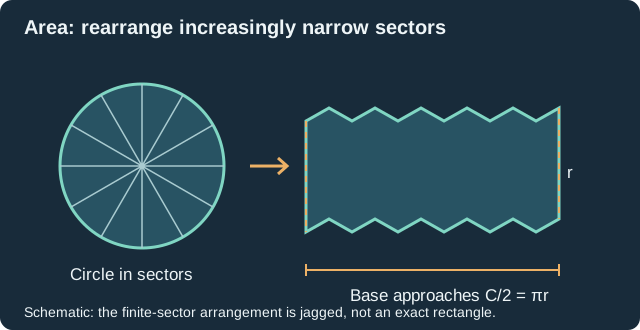
Area uses square units because it counts two-dimensional coverage. For \(r=4\) units, \(A=\pi(4)^2=16\pi\) square units, about \(50.27\) square units. Compare \(8\pi\) units of circumference with \(16\pi\) square units of area: the numbers are related, but the measurements cannot be added or substituted for one another.
Work from the measurement actually given
Given a radius. A circular garden has radius 6 m. The border length is
\[C=2\pi(6)=12\pi\text{ m}\approx37.70\text{ m}.\]
The covered region is
\[A=\pi(6)^2=36\pi\text{ m}^2\approx113.10\text{ m}^2.\]
Do not square \(2\pi r\) to get area; use the radius in the area formula. Rounding only at the end keeps the calculations consistent.
Given a diameter. A circular tabletop is 10 cm across through its center. This 10 cm is \(d\), so \(r=10/2=5\) cm. Then
\[C=\pi(10)=10\pi\text{ cm},\qquad A=\pi(5)^2=25\pi\text{ cm}^2.\]
Using \(10^2\) in the area formula would make the area four times too large. The diameter formula is convenient for circumference, but the standard area formula needs the radius.
Given a circumference. If \(C=18\pi\) cm, rearrange \(C=2\pi r\) before substituting:
\[r=\frac{C}{2\pi}=\frac{18\pi}{2\pi}=9\text{ cm},\qquad A=\pi(9)^2=81\pi\text{ cm}^2.\]
The \(\pi\) factors cancel because they multiply both numerator and denominator. If an approximate circumference were given instead, the recovered radius and area would also be approximate.
How radius changes affect the results
Suppose the original radius is \(r\), and a new circle has radius \(kr\), where \(k>0\). Substitute \(kr\) into each formula:
\[C_{\text{new}}=2\pi(kr)=kC_{\text{old}},\qquad A_{\text{new}}=\pi(kr)^2=k^2A_{\text{old}}.\]
Doubling the radius makes the circumference twice as long but makes the area four times as large. Tripling it makes the circumference three times as long and the area nine times as large. This difference is not an exception; circumference depends on one length, while area depends on a length squared.
| Radius | Circumference | Area |
|---|---|---|
| \(r\) | \(2\pi r\) | \(\pi r^2\) |
| \(2r\) | \(4\pi r\) | \(4\pi r^2\) |
| \(3r\) | \(6\pi r\) | \(9\pi r^2\) |
The table compares multipliers, not interchangeable units. If \(r\) is in centimetres, the middle column is in centimetres and the last is in square centimetres.
A partial circle needs one more decision
For a semicircle, half of the full circular region has area \(A_{\text{semi}}=\tfrac12\pi r^2\). The curved edge is half a circumference, \(\pi r\). But the perimeter of the semicircular region also includes its straight diameter \(2r\):
\[P_{\text{semi}}=\pi r+2r.\]
For \(r=3\) cm, the area is \(\tfrac92\pi\text{ cm}^2\), while its full boundary length is \(3\pi+6\) cm. If a question asks only for the curved edge, give \(3\pi\) cm instead. Read “arc,” “circumference,” and “perimeter” carefully; they need not refer to the same collection of edges.
Before accepting an answer
Mark whether the given segment is a radius or a diameter, and decide whether the question asks for boundary length or covered area. Keep \(\pi\) for an exact result or write \(\approx\) when using a decimal. Check the unit: \(C\) is a length and \(A\) is a squared length. Finally, compare with the graph or situation. A radius cannot be negative, and a diameter must be twice its radius.
Further reading
The standard circle relationships and topic scope were checked against OpenStax Prealgebra 2e, §9.5 and the openly available exploration of circle area and circumference from Illustrative Mathematics. This lesson's prose, examples, and diagrams were independently created; source text, exercises, and artwork were not reproduced.