Prealgebra · Unit 4 · Topic 4.1
Decimal Place Value and Comparing Decimals
Read decimal place values, explain placeholder and trailing zeros, compare and order decimals, and locate values on a number line with worked examples.
What do decimal digits mean, and how do you compare decimals?
A decimal digit's value depends on its position. Immediately to the right of the decimal point are tenths, then hundredths, then thousandths. Each place is one tenth of the place immediately to its left.
To compare nonnegative decimals, align their decimal points and compare matching places from left to right. The first unequal pair of digits determines the order. You may append zeros after the final decimal digit without changing the value.
For example, \(0.5=0.50\), so \(0.5>0.47\): five tenths is more than four tenths and seven hundredths. Counting the digits after the point is not a valid comparison method.
This lesson develops place-value names, expanded forms, zeros, number-line positions, and comparisons. The main examples use terminating decimals, whose written digits stop.
Place value extends below one
One whole can be divided into ten equal tenths. Each tenth can be divided into ten hundredths, and each hundredth into ten thousandths.
| Place | Value of one unit in this place | Decimal form |
|---|---|---|
| Tens | \(10\) | \(10\) |
| Ones | \(1\) | \(1\) |
| Tenths | \(\frac1{10}\) | \(0.1\) |
| Hundredths | \(\frac1{100}\) | \(0.01\) |
| Thousandths | \(\frac1{1000}\) | \(0.001\) |
| Ten-thousandths | \(\frac1{10000}\) | \(0.0001\) |
For a digit \(k\) in the \(n\)-th position after the decimal point, its contribution is \(\frac{k}{10^n}\), where \(n\) is a positive integer. For instance, a 6 in the third position contributes \(\frac6{1000}=0.006\).
The decimal point separates the ones place from the tenths place; there is no separate “decimal ones” place between them. Notice the distinction between tens and tenths, or hundreds and hundredths.
Worked example: read a place-value chart
Problem: Identify the value of every digit in \(23.406\).
| Tens | Ones | Decimal point | Tenths | Hundredths | Thousandths |
|---|---|---|---|---|---|
| 2 | 3 | . | 4 | 0 | 6 |
The 2 contributes 20, the 3 contributes 3, the 4 contributes \(0.4\), the 0 contributes zero hundredths, and the 6 contributes \(0.006\):
\[23.406=20+3+\frac4{10}+\frac0{100}+\frac6{1000}=20+3+0.4+0.006.\]
The decimal part is 406 thousandths. You can read the number as “twenty-three and four hundred six thousandths,” or say “twenty-three point four zero six” when reading its digits. Both readings identify the same value.
Write a decimal from words or fractions
Problem: Write “four and seven hundredths” as a decimal.
Seven hundredths is \(\frac7{100}=0.07\). Include a zero in the tenths position:
\[4+\frac7{100}=4.07.\]
Writing \(4.7\) instead gives four and seven tenths, a different value.
Problem: Write thirty-two thousandths.
Thousandths require three places after the point: \(\frac{32}{1000}=0.032\). The digits mean zero tenths, three hundredths, and two thousandths. Writing \(0.32\) would mean 32 hundredths, ten times the intended value.
Zeros can have different roles
A placeholder zero holds a position so later digits retain their intended values. In \(5.008\), the two zeros locate the 8 in the thousandths place. Removing them gives \(5.8\), which is not equal to \(5.008\).
A trailing zero after the final decimal digit does not change a terminating decimal's numerical value:
\[0.6=\frac6{10}=\frac{60}{100}=0.60=\frac{600}{1000}=0.600.\]
Thus \(7=7.0=7.00\). However, attaching a zero to a whole number without a decimal point changes its value: \(70\ne7\). In \(0.050\), the final zero may be removed to obtain \(0.05\), but the zero in the tenths place cannot be removed.
In measurement contexts, written trailing zeros may also communicate reporting precision. Equal numerical values such as 2.4 and 2.40 do not, by themselves, tell you that two measurements were made with the same precision. Here we are comparing numerical values.
A reliable comparison method
For nonnegative terminating decimals:
- Compare the whole-number parts first.
- If those are equal, align the decimal points so matching place values are in the same columns.
- Append trailing zeros if helpful; never insert a zero between existing digits.
- Compare tenths, then hundredths, then thousandths, continuing until the first unequal pair.
- Use \(<\), \(>\), or \(=\) to state the result. If every aligned digit matches, the values are equal.
The first differing place settles the comparison because its unit is larger than the total change that the remaining finite decimal digits can supply in the opposite direction.
Worked example
Problem: Compare \(0.47\) and \(0.405\).
Append a trailing zero to the first number: \(0.47=0.470\).
| Number | Ones | Tenths | Hundredths | Thousandths |
|---|---|---|---|---|
| \(0.470\) | 0 | 4 | 7 | 0 |
| \(0.405\) | 0 | 4 | 0 | 5 |
The ones and tenths match. At the hundredths place, 7 exceeds 0, so
\[0.47>0.405.\]
You do not need to compare the final digits once the hundredths differ. As an independent check, the values are 470 thousandths and 405 thousandths, and \(470>405\).
See decimals on an enlarged number line
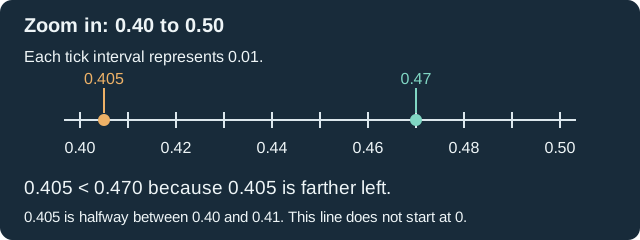
Both numbers lie between \(0.4\) and \(0.5\). The point \(0.405\) is \(0.005\) beyond \(0.4\); \(0.47\) is \(0.07\) beyond it. Therefore \(0.405\) appears farther left. The difference is \(0.470-0.405=0.065\).
Worked example: more digits does not mean greater
Problem: Compare \(0.8\) and \(0.79\).
Write \(0.8=0.80\). The whole parts match, but the tenths differ: 8 is greater than 7. Therefore \(0.8>0.79\). Equivalently, 80 hundredths exceeds 79 hundredths.
Do not compare 8 with 79 as if the decimal parts were unrelated whole numbers. Their original units are tenths and hundredths.
Worked example: compare the whole parts first
Problem: Compare \(6.02\) and \(5.999\).
Six whole units already exceeds a number below six. The whole parts 6 and 5 differ, so \(6.02>5.999\), regardless of the extra decimal digits in the second number. If desired, compare \(6.020\) and \(5.999\) in aligned columns.
Worked example: order several values
Problem: Put \(2.09,\ 2.9,\ 2.099,\ 2.090\) in increasing order.
Write them with three decimal places:
\[2.090,\quad2.900,\quad2.099,\quad2.090.\]
The two values \(2.09\) and \(2.090\) are equal. They both precede \(2.099\), because their thousandths digit is 0 rather than 9. The tenths digit of \(2.9\) is 9, so it is greater than all the values with 0 tenths:
\[2.09=2.090<2.099<2.9.\]
Worked example: compare negative decimals
Problem: Compare \(-0.62\) and \(-0.607\).
Their positive distances from zero are \(0.620\) and \(0.607\), and \(0.620>0.607\). For negative numbers, the greater distance from zero places the number farther left:
\[-0.62<-0.607.\]
Any negative value is below zero; any positive value is above zero. Do not apply the positive-digit comparison rule to negative values without accounting for the sign.
Worked example: compare measurements in matching units
Problem: A blue strip is \(0.85\) metre long and a green strip is \(0.805\) metre long. Which is longer?
Both measurements already use metres. Compare \(0.850\) with \(0.805\): the tenths match, but 5 hundredths exceeds 0 hundredths. The blue strip is longer by \(0.045\) metre, or 4.5 centimetres.
If one measurement were given in centimetres, first convert to the same unit. For example, \(0.85\) metre equals 85 centimetres; comparing the bare numbers 0.85 and 85 would ignore their units.
Comparing is not the same as rounding
Comparison asks which exact value is greater; rounding replaces a value with an approximation at a chosen place. For example, \(0.431<0.434\), even though both round to \(0.43\) to the nearest hundredth.
Do not round before comparing unless the question specifically requests a comparison of rounded values. Keeping the original digits prevents distinct values from becoming indistinguishable.
Common mistakes
- Counting decimal digits: \(0.9>0.125\), although the smaller value has more written digits.
- Confusing tenths with hundredths: \(0.5\) is five tenths, while \(0.05\) is five hundredths.
- Ignoring placeholder zeros: \(3.007\ne3.7\). The 7 occupies different places.
- Treating equal forms as different values: \(1.20=1.2\). A trailing decimal zero adds no value.
- Aligning final digits instead of decimal points: The tenths must be compared with tenths, not with the last digit of another number.
- Forgetting the sign: \(-0.8<-0.3\), because \(-0.8\) is farther left.
- Comparing incompatible units or rounded substitutes: Match units and preserve exact values before deciding the order.
Check your understanding
Try these before reading the explanations. These self-checks do not modify the separate Quizzes or Practice tabs.
- In \(18.307\), identify the value contributed by the digits 3 and 7.
- Write \(6.042\) in expanded form.
- Write “five and nine hundredths” as a decimal.
- Write seventy-three thousandths as a decimal.
- Insert \(<\), \(>\), or \(=\): \(0.6\ \square\ 0.58\).
- Compare \(0.052\) and \(0.05\).
- Compare \(4.700\) and \(4.7\).
- Order \(0.304,\ 0.34,\ 0.034,\ 0.300\) from least to greatest.
- Compare \(-1.08\) and \(-1.8\).
- Are \(0.090\) and \(0.009\) equal? Explain the 9's place in each.
- A red ribbon is 72 centimetres long; a yellow ribbon is \(0.705\) metre long. Which is longer?
- Find a decimal strictly between \(0.41\) and \(0.42\).
Answers and explanations
- The 3 contributes \(0.3\), or three tenths; the 7 contributes \(0.007\), or seven thousandths.
- \(6+\frac0{10}+\frac4{100}+\frac2{1000}\), or \(6+0.04+0.002\).
- \(5.09\). The tenths position needs a placeholder zero.
- \(0.073=\frac{73}{1000}\).
- \(0.6>0.58\), since \(0.60>0.58\).
- \(0.052>0.05\), since \(0.05=0.050\) and 2 thousandths exceeds 0 thousandths.
- \(4.700=4.7\). The two final zeros do not change the value.
- \(0.034<0.300<0.304<0.34\). Write the final number as \(0.340\) to compare matching places.
- \(-1.08>-1.8\): \(-1.08\) is closer to zero and farther right.
- No. In \(0.090=0.09\), the 9 contributes nine hundredths; in \(0.009\), it contributes nine thousandths. The first is ten times the second.
- The red ribbon is longer: 72 centimetres equals \(0.720\) metre, which exceeds \(0.705\) metre.
- One possible answer is \(0.415\): \(0.410<0.415<0.420\). There are many other valid answers.
Key takeaway
A decimal's digits count units of different sizes. Moving one place right makes the unit ten times smaller. Placeholder zeros keep later digits in their intended places; trailing decimal zeros preserve numerical value. Compare nonnegative values from the whole part toward smaller places, using the first unequal digit. For negative numbers, account for their reversed order relative to their positive distances from zero. Match measurement units and avoid rounding away useful differences.
Related lessons
- Place Value and Whole Numbers: the base-ten pattern before the decimal point
- Fractions and Equivalent Forms: tenths and hundredths as fractional units
- The Number Line and Absolute Value: position and negative-number order
- Decimal Operations: calculate with aligned place values
- Fraction–Decimal Conversion: connect equivalent representations
- Measurement Conversions: compare compatible units
Sources and authorship
The public textbook resources below were consulted to check topic scope and mathematical methods. This lesson's explanations, example settings, self-checks, tables, and number-line diagram were independently created; textbook prose, exercise sets, and artwork are not reproduced. Public access does not automatically permit unrestricted reuse: consult each source's stated license before reproducing its material.