Prealgebra · Unit 7 · Topic 7.5
Building Equations from Word Problems
Build one-variable equations from word problems using labeled quantities, units, and stated relationships; solve cost, number, geometry, and rate examples and check answers in context.
How do you build an equation from a word problem?
Define the unknown quantity, express the other quantities in terms of it, and write an equality for the relationship stated in the problem. Then solve the equation and check the answer against the original situation, including its units and restrictions.
An equation is a mathematical model: its two sides represent equal quantities. It is not just a collection of the numbers mentioned in a story. For example, a fixed fee plus a variable charge equals a total bill; adding the distance directly to the fee would mix incompatible units.
This lesson develops one-variable linear models. The numerical examples, check questions, and diagram below are independently created, not reproduced textbook exercises or artwork.
Separate the question, the data, and the relationship
Before calculating, identify three things:
- Question: What quantity must the final answer describe?
- Data: Which quantities are known, with what units?
- Relationship: How are the quantities connected—by a total, difference, rate, fraction, or formula?
Let \(n\) mean “the number of notebooks,” not “notebooks” or “the unknown.” A variable represents a numerical quantity. State whether it must be a whole number, nonnegative, or positive. A distance can be fractional, but a count of whole notebooks cannot.
You may choose a different unknown from the one requested, provided you can recover the requested quantity at the end. One variable can represent several related quantities: if one length is 3 cm longer than another, use \(w\) and \(w+3\), not two unrelated unknowns.
A modeling routine you can reuse
- Read the complete problem and restate the question.
- Define a variable with its units and allowed values.
- Label the other quantities using numbers or expressions.
- Write the relationship in words before writing symbols.
- Solve by performing valid operations on both sides.
- Substitute into the original relationship and check the context.
- Answer the actual question in a sentence with units.
An estimate can help catch an unreasonable answer, but it does not replace substitution. Algebra proves a solution to the equation; the contextual check tests whether that equation and answer represent the story.
Translate relationships, not isolated keywords
| Stated relationship | Expression or equation | Meaning |
|---|---|---|
| Seven more than a number | \(x+7\) | Add 7 to the number |
| Seven less than a number | \(x-7\) | Subtract 7 from the number |
| Seven minus a number | \(7-x\) | Subtract the number from 7 |
| Twice the sum of a number and 7 | \(2(x+7)\) | Double the entire sum |
| Seven more than twice a number | \(2x+7\) | Double first, then add 7 |
| A number is one quarter of 28 | \(x=28/4\) | The number is the part |
| One quarter of a number is 28 | \(x/4=28\) | The unknown is the whole |
An expression such as \(2x+7\) names a quantity; an equation such as \(2x+7=31\) states that it equals another quantity. Do not insert an equals sign without an equality relationship.
“More” does not always mean the next solving step is addition. If \(x+7=31\), subtracting 7 finds x. Likewise, “at most” calls for an inequality, not an equality.
Worked example: a fixed fee and a distance charge
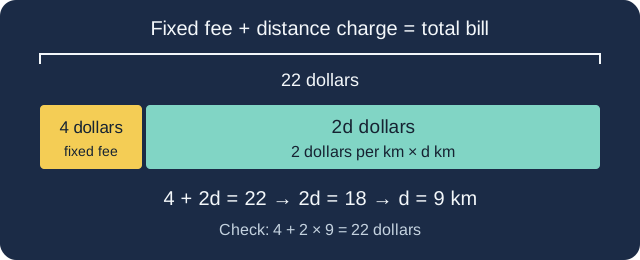
A ride costs a fixed 4 dollars plus 2 dollars per kilometer. The bill is 22 dollars, with no other charges. How far was the ride?
Let \(d\) be the distance in kilometers, with \(d\ge0\).
| Quantity | Model |
|---|---|
| Fixed fee | 4 dollars |
| Distance charge | \(2d\) dollars |
| Total bill | 22 dollars |
The relationship is fixed fee + distance charge = total bill:
\[ 4+2d=22 \]
Subtract 4 from both sides to get \(2d=18\). Divide both sides by 2 to get \(d=9\).
Check and answer: \(4+2(9)=22\), and 9 is nonnegative. The ride was 9 km. The units work because dollars per kilometer multiplied by kilometers gives dollars.
Worked example: two quantities with a stated difference
Two students collected 47 cards altogether. Mina collected 9 more cards than Leo. How many did each collect?
Let \(x\) be Leo's number of cards. Mina's number is \(x+9\). Both counts must be nonnegative integers.
The total gives:
\[ x+(x+9)=47 \]
Combine terms: \(2x+9=47\). Subtract 9: \(2x=38\). Divide by 2: \(x=19\). Mina's count is \(19+9=28\).
Check and answer: \(19+28=47\) and \(28-19=9\). Leo collected 19 cards and Mina collected 28 cards. Giving only 19 would not answer the question about both students.
Worked example: consecutive whole numbers
Three consecutive whole numbers have a sum of 72. Find them.
Let \(n\) be the smallest number. The next two are \(n+1\) and \(n+2\), since consecutive whole numbers differ by 1.
\[ n+(n+1)+(n+2)=72 \]
Thus \(3n+3=72\), \(3n=69\), and \(n=23\).
Check and answer: The numbers are 23, 24, and 25. They are consecutive whole numbers and \(23+24+25=72\). For consecutive even integers the offsets would be 2 and 4 instead; “consecutive” must be interpreted for the specified type of number.
Worked example: a fraction of an unknown whole
A container is \(3/5\) full and holds 18 liters of water. What is its full capacity?
Let \(c\) be the positive capacity in liters. The relationship is fraction filled × full capacity = water present:
\[ \frac{3}{5}c=18 \]
Multiply both sides by \(5/3\), the reciprocal of the nonzero coefficient, to get \(c=30\).
Check and answer: \((3/5)(30)=18\). The capacity is 30 liters, greater than the current water volume. Multiplying 18 by \(3/5\) would find a fraction of the water present, not the unknown full capacity.
Worked example: a discount applies to the original price
A backpack costs 48 dollars after a 20% discount, with no tax or other fees. What was its original price?
Let \(p\) be the original price in dollars. A 20% discount leaves 80% of the original price:
\[ p-0.20p=48,\qquad 0.80p=48 \]
Divide by 0.80: \(p=60\).
Check and answer: The discount is \(0.20(60)=12\) dollars, and \(60-12=48\). The original price was 60 dollars. Adding 20% of the sale price to 48 would use the wrong percentage base.
Worked example: a rectangle's perimeter
A rectangle has perimeter 38 cm. Its length is 3 cm greater than its width. Find both dimensions.
Let \(w\) be the positive width in centimeters. Then the length is \(w+3\). A rectangle has two widths and two lengths, so:
\[ 2w+2(w+3)=38 \]
Distribute and combine: \(4w+6=38\). Then \(4w=32\), so \(w=8\). The length is \(8+3=11\).
Check and answer: The width is 8 cm and the length is 11 cm. Both are positive; their difference is 3 cm, and \(2(8)+2(11)=38\) cm. Area would be measured in square centimeters, not the centimeters used for perimeter.
Worked example: distance at a constant rate
A cyclist travels 27 km at a constant speed of 12 km per hour, without stops. How long does the trip take?
Let \(t\) be the time in hours. For constant speed, distance = speed × time:
\[ 12t=27,\qquad t=\frac{27}{12}=2.25 \]
The fractional hour is \(0.25(60)=15\) minutes.
Check and answer: \(12(2.25)=27\). The trip takes 2 hours 15 minutes. The decimal .25 represents one quarter of an hour, not 25 minutes. A constant-speed model would not describe the total time if unaccounted stops were included.
What if the answer does not fit the context?
Suppose a 5-dollar fee plus 4 dollars per whole ticket must total exactly 23 dollars. Defining n as the ticket count gives:
\[ 5+4n=23,\qquad n=4.5 \]
The equation has a real solution, but the stated whole-ticket situation has no allowed solution. Do not round to 4 or 5: their totals are 21 and 25 dollars, not 23 dollars.
If the question instead asks how many tickets can be bought for at most 23 dollars, use \(5+4n\le23\). Then \(n\le4.5\), and the maximum nonnegative whole-number count is 4 tickets. Equality and a spending limit answer different questions.
Missing information can also prevent a unique answer. “Some identical tickets cost 24 dollars” does not determine the count unless a price per ticket or another relationship is supplied. Do not invent a missing value.
Common mistakes and how to avoid them
- Undefined variables: Write what the variable counts or measures, including units.
- Keyword guessing: Describe the relationship between complete quantities before choosing an operation.
- Reversed subtraction: “Five less than x” means \(x-5\), not \(5-x\).
- Lost grouping: Three times the whole sum \(x+2\) means \(3(x+2)\), not \(3x+2\).
- Mixed units: Convert minutes to hours before multiplying by a rate in kilometers per hour.
- Wrong percentage base: A discount is a fraction of the original price unless stated otherwise.
- Ignoring constraints: Negative lengths and fractional whole-object counts are not valid contextual answers.
- Rounding an exact count: If a count fails the original equality, rounding does not repair the model.
- Incomplete answers: Recover every requested quantity and check every stated relationship.
Check your understanding
For each problem, define a variable, write an equation, solve it, and check the result in the story. Assume there are no unmentioned fees or taxes.
- Six more than three times a number is 45. Find the number.
- A 7-dollar fee and 5 dollars per notebook total 32 dollars. How many notebooks were bought?
- Two ribbon lengths total 34 cm. The longer is 8 cm longer than the shorter. Find both lengths.
- Two consecutive whole numbers total 57. Find them.
- Two fifths of a container's capacity is 14 liters. Find its full capacity.
- A jacket costs 63 dollars after a 10% discount. Find its original price.
- A rectangle has perimeter 52 cm and length 4 cm greater than width. Find both dimensions.
- A walker travels 10 km at a constant 4 km per hour without stops. Find the travel time in hours and minutes.
- A 6-dollar fee plus 3 dollars per whole ticket totals exactly 23 dollars. Is there an allowed ticket count?
- Twice the sum of a number and 4 is 26. Find the number.
- A 9-dollar setup charge plus 2 dollars per printed poster must cost at most 30 dollars. Find the maximum whole-number poster count.
- Three consecutive even whole numbers total 90. Find them.
Answers and checks
- Let x be the number. \(3x+6=45\) gives \(3x=39\), so x = 13. Check: \(3(13)+6=45\).
- Let n be the nonnegative integer count. \(7+5n=32\) gives \(5n=25\), so 5 notebooks. Check: \(7+5(5)=32\).
- Let s be the shorter length in cm. \(s+(s+8)=34\) gives \(2s=26\), so 13 cm and 21 cm. Check: \(13+21=34\) and \(21-13=8\).
- Let n be the smaller whole number. \(n+(n+1)=57\) gives \(2n=56\), so 28 and 29. They differ by 1 and sum to 57.
- Let c be the capacity in liters. \((2/5)c=14\) gives c = 35 liters. Check: \((2/5)(35)=14\).
- Let p be the original price in dollars. \(0.90p=63\) gives p = 70 dollars. Check: the discount is 7 dollars, leaving 63 dollars.
- Let w be the width in cm. \(2w+2(w+4)=52\) gives \(4w=44\), so width 11 cm, length 15 cm. Check: \(22+30=52\) and \(15-11=4\).
- Let t be the time in hours. \(4t=10\) gives 2.5 hours, or 2 hours 30 minutes. Check: \(4(2.5)=10\); half an hour is 30 minutes.
- Let n be the whole-ticket count. \(6+3n=23\) gives \(n=17/3\), not an integer. No allowed count: 5 tickets cost 21 dollars; 6 cost 24 dollars.
- Let x be the number. \(2(x+4)=26\) gives \(x+4=13\), so x = 9. Check: \(2(9+4)=26\).
- Let n be the nonnegative integer count. \(9+2n\le30\) gives \(n\le10.5\). At most 10 posters: 10 cost 29 dollars, while 11 cost 31 dollars.
- Let n be the smallest even whole number. \(n+(n+2)+(n+4)=90\) gives \(3n=84\). The numbers are 28, 30, and 32; each is even, consecutive even numbers differ by 2, and their sum is 90.
Summary: build, solve, and interpret
A useful equation comes from a defined unknown and a stated relationship, not from guessing operations. Label related quantities, keep units consistent, and use grouping to preserve meaning. After solving, check the original data and restrictions, then answer with the requested quantities and units. A mathematical solution is not automatically a valid real-world answer.
Related lessons
Sources and independent authorship
The following publicly readable OpenStax sections were consulted for topic coverage. This lesson's prose, numerical examples, questions, solutions, and SVG diagram were independently written; source exercises and illustrations are not reproduced. Public access does not mean unrestricted reuse: consult the publisher's current license and terms before copying or adapting its material.