Prealgebra · Unit 4 · Topic 4.2
Calculating with Decimals
Add, subtract, multiply, and divide decimals using place value, equivalent quotients, and estimation; follow worked examples and check answers with inverse operations.
How do you calculate with decimals?
For addition and subtraction, align decimal points so matching place values line up. For multiplication, use the combined decimal places of the factors to place the product's decimal point. For division, multiply both numbers by the same power of ten to make the divisor a whole number.
These are different procedures for different operations. A decimal is a number expressed with base-ten place values, not a whole number with a decorative point. Understanding those places helps you check whether a result is ten or a hundred times too large.
You will learn all four operations, carrying and regrouping, quotient zeros, signed results, and when a decimal answer is exact or approximate. Division always requires a nonzero divisor.
Match the method to the operation
| Operation | Main idea | Check |
|---|---|---|
| Addition | Combine counts of equal-sized units | Subtract an addend from the sum |
| Subtraction | Remove or compare counts of equal-sized units | Add the subtracted amount back |
| Multiplication | Scale an amount; combine the factors' decimal places | Estimate size or divide by a nonzero factor |
| Division | Count groups or share equally; preserve an equivalent quotient | Multiply the quotient by the original divisor |
Trailing decimal zeros do not change numerical value: \(3.6=3.600\). Adding such zeros can make columns easier to read. Inserting zeros between existing digits, however, generally changes the number.
Worked example: addition with carrying
Problem: Compute \(8.47+3.6\).
Write \(3.6=3.60\) and align the decimal points:
\[\begin{array}{r}8.47\\+\,3.60\\\hline12.07\end{array}\]
- Hundredths: \(7+0=7\).
- Tenths: \(4+6=10\) tenths. Write 0 tenths and carry one whole.
- Ones: \(8+3+1=12\).
The result is \(12.07\). An exact place-value check is \(\frac{847}{100}+\frac{360}{100}=\frac{1207}{100}\). An estimate, \(8.5+3.6\approx12.1\), is close to the answer.
Do not line up only the last digits: that would combine hundredths with tenths.
Worked example: subtraction across zeros
Problem: Compute \(12-7.865\).
Write the whole number as \(12.000\). To subtract 5 thousandths, exchange one whole for 10 tenths, then one tenth for 10 hundredths, then one hundredth for 10 thousandths:
\[12.000=11+0.9+0.09+0.010.\]
The regrouped counts are 11 ones, 9 tenths, 9 hundredths, and 10 thousandths. Subtract matching places:
- Thousandths: \(10-5=5\).
- Hundredths: \(9-6=3\).
- Tenths: \(9-8=1\).
- Ones: \(11-7=4\).
Thus \(12-7.865=4.135\). Check: \(7.865+4.135=12.000\). Regrouping changes the representation, not the starting value.
Why decimal multiplication counts places
If \(x=\frac{A}{10^m}\) and \(y=\frac{B}{10^n}\), then
\[xy=\frac{AB}{10^{m+n}}.\]
Here \(A,B\) are the integer numerators obtained from the written terminating decimals, and \(m,n\) are their numbers of decimal places. The formula explains why the total number of decimal places is added.
Example: \(0.6\times0.4=\frac6{10}\times\frac4{10}=\frac{24}{100}=0.24\).
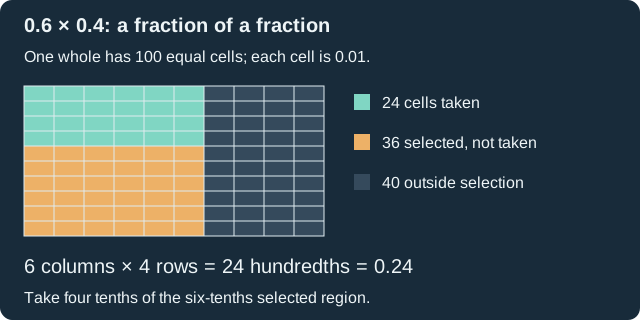
Unlike addition, multiplication does not keep the original denominator: tenths multiplied by tenths produces hundredths. The product is smaller than either factor because both positive factors are below 1.
Worked example: multiplication and decimal placement
Problem: Compute \(2.4\times0.35\).
First calculate the integer product:
\[24\times35=24\times30+24\times5=720+120=840.\]
The original factors have one and two decimal places, so use three places in the product: \(0.840=0.84\). Equivalently,
\[\frac{24}{10}\times\frac{35}{100}=\frac{840}{1000}=0.84.\]
The trailing zero may be removed after the decimal point is correctly placed. The answer should be less than 2.4 because the multiplier 0.35 is positive and below 1.
Worked example: small products need placeholder zeros
Problem: Compute \(0.08\times0.06\).
The integer product is \(8\times6=48\). The two factors each have two decimal places, so write the product with four places:
\[0.08\times0.06=0.0048.\]
The denominator explanation is \(\frac8{100}\times\frac6{100}=\frac{48}{10000}\). Writing \(0.48\) would make the answer 100 times too large. Small numbers may require zeros between the decimal point and the first nonzero digit.
Why scaling both numbers preserves division
For any numbers \(a,b\), with \(b\ne0\), and a nonzero scale factor \(k\),
\[\frac ab=\frac{ka}{kb}.\]
Multiplying numerator and denominator by the same factor preserves the quotient. In decimal division, choose \(k=10^n\), where \(n\) is enough to make the divisor an integer. Move the decimal point in both numbers by that many places to the right.
Changing only the divisor changes the quotient. For example, \(3.6\div0.24\) is not the same as \(3.6\div24\).
Worked example
Problem: Compute \(3.6\div0.24\).
The divisor has two decimal places. Multiply both numbers by 100:
\[3.6\div0.24=\frac{3.6\times100}{0.24\times100}=\frac{360}{24}=15.\]
For the integer division, \(24\times10=240\), leaving 120; \(24\times5=120\). Therefore \(360\div24=15\).
Check: \(15\times0.24=3.60\). A rough estimate, \(3.6\div0.2=18\), supports a result near 15 rather than 0.15 or 150. Dividing a positive number by a positive number below 1 can increase its numerical value.
Worked example: decimal quotient after scaling
Problem: Compute \(0.756\div0.18\).
Only two places are needed to turn the divisor into 18:
\[0.756\div0.18=75.6\div18.\]
The transformed dividend does not have to be a whole number. Eighteen fits into 75 four times, leaving \(75-72=3\). Bring the 6 tenths into the calculation: the remaining \(3.6\) is 36 tenths, which gives 2 tenths in the quotient. Thus the answer is \(4.2\).
Check: \(4.2\times0.18=0.756\). Using an additional common scale factor would also work, but scaling only one number would not.
Worked example: do not skip a zero in the quotient
Problem: Compute \(4.08\div4\).
Four ones divided by 4 gives one whole. Zero tenths divided by 4 gives zero tenths. Eight hundredths divided by 4 gives two hundredths:
\[4.08\div4=1.02.\]
The zero in the tenths place is necessary. Writing 1.2 would put the 2 in the wrong place. Check: \(1.02\times4=4.08\).
When dividing by a whole number in a vertical calculation, the quotient's decimal point goes directly above the dividend's decimal point.
Powers of ten: explain the shift
Multiplying by 10 makes each digit contribute ten times its original value; dividing by 10 makes each contribution one tenth as large. More generally, use one place per factor of 10:
| Calculation | Result |
|---|---|
| \(0.307\times10\) | \(3.07\) |
| \(0.307\times100\) | \(30.7\) |
| \(30.7\div100\) | \(0.307\) |
“Move the decimal” is shorthand for this change in value, not a rule for randomly relocating a point.
Signed decimals and zero
The integer sign rules still apply. For example, \((-0.4)\times0.75=-0.30=-0.3\), while \((-1.2)\div(-0.3)=4\).
For subtraction, preserve the original order: \(1.2-2.75=-(2.75-1.20)=-1.55\). Check: \(-1.55+2.75=1.20\).
Zero times any defined decimal equals zero; zero divided by a nonzero decimal equals zero. Division by zero, including \(0\div0\), is undefined.
Exact answers, repeating decimals, and rounding
Not every quotient of terminating decimals is a terminating decimal. For example, \(2\div3=0.666\ldots=0.\overline6\): after each division step, the same remainder returns and another 6 is produced.
The fraction \(\frac23\) and repeating notation \(0.\overline6\) are exact. To the nearest hundredth, \(\frac23\approx0.67\), not \(\frac23=0.67\). Calculate one extra digit beyond the requested place before rounding; here the third decimal digit is 6, so 0.66 rounds upward to 0.67.
Keep full values during a multi-step calculation, then round at the end if requested. A final zero may be useful when reporting money to two decimal places, even though \(3.50=3.5\) numerically.
Worked example: a multi-step measurement problem
Problem: A 6.5-metre roll of ribbon supplies three pieces of length 0.85 metre. How much ribbon remains, assuming no cutting loss?
Multiply first to find the length used, then subtract:
\[6.5-3\times0.85=6.5-2.55=3.95.\]
The remaining length is 3.95 metres. Check: \(3.95+2.55=6.50\) metres. Estimating each piece as about 0.9 metre gives about \(6.5-2.7=3.8\) metres left, consistent with the exact answer.
Multiplication and division have equal priority and are evaluated left to right; addition and subtraction follow, also left to right, unless parentheses specify another grouping.
Common mistakes
- Aligning the last digits for a sum or difference: Align decimal points so like place values share columns.
- Applying the addition rule to a product: \(0.6\times0.4=0.24\), not 2.4. Multiplication combines the decimal places of both factors.
- Changing only one number in division: Scale the dividend and divisor by the same nonzero factor.
- Dropping a necessary quotient zero: \(4.08\div4=1.02\), not 1.2.
- Assuming division always makes smaller: A positive divisor below 1 produces a quotient larger than the positive dividend.
- Treating an approximation as exact: Use \(\approx\) for rounded results, and do not round intermediate steps unnecessarily.
- Ignoring units or signs: Convert incompatible measurement units first, and check the sign before accepting an answer.
Check your understanding
Try these before reading the explanations. These self-checks do not change the separate Quizzes or Practice tabs.
- Compute \(4.86+2.7\).
- Compute \(9-3.478\).
- Compute \(2.35\times0.4\).
- Compute \(0.07\times0.08\).
- Compute \(5.4\div0.18\).
- Compute \(0.936\div0.24\).
- Compute \(6.06\div3\). Explain the zero in the quotient.
- Compute \(0.045\times100\) and \(4.5\div1000\).
- Compute \(-1.25\times0.8\) and \(-0.72\div(-0.09)\).
- Give \(5\div6\) to the nearest hundredth, using the correct equality or approximation symbol.
- A 7.2-metre rope loses four pieces of length 0.65 metre. How much remains, assuming no cutting loss?
- A student changes \(1.8\div0.12\) to \(1.8\div12\). Correct the transformation and find the quotient.
Answers and explanations
- \(4.86+2.70=7.56\). Align hundredths and tenths.
- \(9.000-3.478=5.522\). Check: \(5.522+3.478=9\).
- \(235\times4=940\); three decimal places give \(0.940=0.94\).
- \(7\times8=56\); four decimal places give \(0.0056\).
- \(540\div18=30\). Check: \(30\times0.18=5.4\).
- \(93.6\div24=3.9\). Check: \(3.9\times0.24=0.936\).
- \(2.02\). The tenths contribution is zero; the 2 after it is hundredths.
- \(4.5\) and \(0.0045\), respectively.
- \(-1\) and 8. Different signs give a negative product; matching negative signs give a positive quotient.
- \(\frac56\approx0.83\). The exact decimal is \(0.8333\ldots\); the third decimal digit is 3, so the hundredths stay unchanged.
- \(7.2-4\times0.65=7.2-2.6=4.6\) metres.
- Scale both numbers by 100: \(180\div12=15\). Scaling only the divisor makes the quotient 100 times smaller.
Key takeaway
Decimal calculations are place-value calculations. Match columns for sums and differences, account for both factors' decimal places in products, and preserve equivalent quotients when scaling for division. Keep necessary zeros and signs, distinguish exact answers from approximations, and use estimation plus inverse operations to catch decimal-point errors.
Related lessons
- Decimal Place Value and Comparing Decimals: interpret the units behind each digit
- Addition and Subtraction: carrying and regrouping
- Multiplying and Dividing Fractions: explain the decimal rules with fractions
- Fraction–Decimal Conversion: exact and repeating representations
- Exponents and Order of Operations: multi-step expressions
- Measurement Conversions: make units compatible
Sources and authorship
Public textbook resources were consulted for topic coverage and mathematical checks. The explanations, example settings, self-checks, table, and grid diagram here were independently created for this lesson; textbook prose, exercise sets, and artwork are not reproduced. Public access does not mean unrestricted reuse: check each source's current license before reproducing its material.