Prealgebra · Unit 3 · Topic 3.6
Mixed Numbers and Fraction Applications
Convert mixed numbers and improper fractions, regroup for subtraction, calculate with all four operations, and apply fractions to recipes, lengths, and areas.
What is a mixed number, and how do you use it?
A mixed number combines a whole-number part and a proper-fraction part. For example, \(2\frac23\) means \(2+\frac23\), not \(2\times\frac23\). It represents two complete wholes and two thirds of another whole.
To calculate with mixed numbers, you can convert them to improper fractions and use the ordinary fraction rules. For addition and subtraction, a second method is to work with whole and fractional parts separately, regrouping when necessary. For multiplication and division, conversion to improper fractions is usually the clearest route.
This lesson connects those methods to recipes, measurement, sharing, and area. Identify the reference whole and units before choosing an operation.
Convert a mixed number to an improper fraction
For nonnegative integers \(w,n\) and a positive integer \(d\), with \(0\le n<d\),
\[w\frac nd=w+\frac nd=\frac{wd+n}{d}.\]
Here \(w\) is the whole-number part, \(n\) is the numerator of the fractional part, and \(d\) is its denominator. Each whole contains \(d\) pieces of size \(\frac1d\), so \(w\) wholes contain \(wd\) such pieces. Add the \(n\) remaining pieces.
Example: \(2\frac23=\frac{2\times3+2}{3}=\frac83\). Two wholes contribute six thirds, and the fractional part contributes two more thirds. The denominator stays 3 because the piece size remains one third.
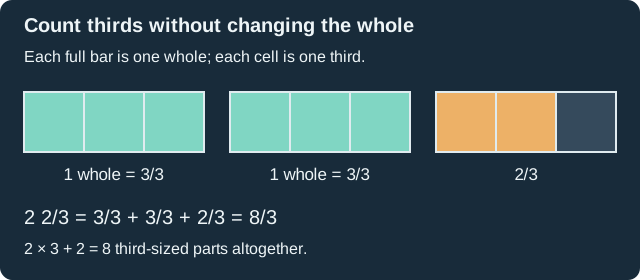
Multiplying only the whole part by the numerator would not count all the pieces. Writing \(\frac{2+2}{3}\) would also omit the six thirds represented by the two wholes.
Convert an improper fraction to a mixed number
An improper fraction has a numerator at least as large as its positive denominator when describing nonnegative quantities. It is a valid number, not an error.
Divide the numerator by the denominator to find complete wholes and the remainder. If \(N=qd+r\), with \(0\le r<d\), then
\[\frac Nd=q+\frac rd.\]
Here \(q\) is the whole-number quotient and \(r\) the remainder. The denominator \(d\) remains unchanged; simplify the remaining fraction if possible.
Example: Convert \(\frac{29}{6}\). Since \(29=4\times6+5\), the value is \(4\frac56\). Check by converting back: \(4\times6+5=29\).
If the remainder is zero, write a whole number: \(\frac{24}{6}=4\). If the numerator is smaller than the denominator, the value is already a proper fraction: \(\frac56\) does not need a visible zero whole-number part.
Choose an operation from the situation
| Situation | What the operation finds | Example setup |
|---|---|---|
| Combine two lengths | Total amount | \(1\frac12+2\frac14\) |
| Remove part of an amount | Amount remaining | \(3\frac14-1\frac34\) |
| Scale a recipe or take a fraction of an amount | Scaled amount | \(3\times2\frac14\) |
| Share equally among a known number of people | Amount per person | \(2\frac12\div5\) |
| Count groups of a known size | Number of groups | \(2\frac12\div\frac34\) |
Read the whole situation rather than relying on one keyword. Keep compatible units: lengths in metres can be combined after any necessary conversion, while a length plus an area is not a meaningful total.
Worked example
Problem: A recipe needs \(2\frac14\) cups of flour per batch. How much flour is needed for three batches?
Assume the same recipe is used for each batch. Convert the mixed number and multiply:
\[2\frac14=\frac94,\qquad 3\times\frac94=\frac{27}{4}=6\frac34.\]
Three batches need \(6\frac34\) cups. The denominator remains 4 during conversion; the whole part contributes eight quarters and the fractional part one more.
Check: Three batches of 2 cups need 6 cups, and three extra quarter-cups make \(\frac34\) cup. Their sum is \(6\frac34\) cups. The result should be between 6 and 9 cups because each batch needs between 2 and 3 cups.
Worked example: add and carry a complete whole
Problem: A walker travels \(1\frac56\) kilometres in the morning and \(2\frac34\) kilometres later. Find the total distance.
Use denominator 12 for the fractional parts:
\[1\frac56+2\frac34=3+\frac{10}{12}+\frac9{12}=3+\frac{19}{12}.\]
Nineteen twelfths is one whole plus seven twelfths, so the total is \(4\frac7{12}\) kilometres. Carrying the extra whole is necessary because the fractional parts sum to more than 1.
Alternative: Convert first: \(\frac{11}{6}+\frac{11}{4}=\frac{22}{12}+\frac{33}{12}=\frac{55}{12}=4\frac7{12}\). Both methods give the same total.
Worked example: regroup before subtracting
Problem: Cut \(1\frac34\) metres from a \(3\frac14\)-metre ribbon. How much remains, assuming no material is lost?
The starting fractional part \(\frac14\) is smaller than \(\frac34\). Move one whole into the fractional part without changing the value:
\[3\frac14=2+\left(1+\frac14\right)=2+\frac54.\]
Now subtract:
\[\left(2+\frac54\right)-\left(1+\frac34\right)=1+\frac24=1\frac12.\]
The remaining ribbon is \(1\frac12\) metres. Regrouping reduces the whole part from 3 to 2 and increases the fractional numerator by 4, because one whole equals four quarters.
Improper-fraction check: \(\frac{13}{4}-\frac74=\frac64=\frac32=1\frac12\). Adding back \(1\frac34\) metres gives the original \(3\frac14\) metres.
Worked example: unlike denominators and regrouping
Problem: Find \(4\frac15-1\frac34\).
First use twentieths: \(\frac15=\frac4{20}\) and \(\frac34=\frac{15}{20}\). Then regroup:
\[4+\frac4{20}=3+\frac{24}{20}.\]
Subtract corresponding parts:
\[\left(3+\frac{24}{20}\right)-\left(1+\frac{15}{20}\right)=2+\frac9{20}=2\frac9{20}.\]
A direct improper-fraction calculation also works: \(\frac{21}{5}-\frac74=\frac{84}{20}-\frac{35}{20}=\frac{49}{20}=2\frac9{20}\). Do not subtract the smaller numerator from the larger one regardless of order; that changes the problem.
Worked example: multiply to find an area
Problem: A rectangular board is \(1\frac12\) metres long and \(2\frac23\) metres wide. Find its area.
Area of a rectangle is length times width. Convert both dimensions:
\[A=\frac32\times\frac83=4.\]
The area is 4 square metres, because metres multiplied by metres gives square metres. Simplifying 3 with 3 and 8 with 2 before multiplication keeps the arithmetic small.
Multiplying just the whole parts and just the fractional parts would omit cross terms. For instance, \((1+\frac12)(2+\frac23)\) contains four products, not just \(1\times2\) and \(\frac12\times\frac23\). Converting first avoids that error.
Worked example: equal sharing
Problem: Share \(2\frac12\) litres of juice equally among 5 people.
\[2\frac12\div5=\frac52\div\frac51=\frac52\times\frac15=\frac12.\]
Each person receives \(\frac12\) litre. Check: five half-litres total \(\frac52=2\frac12\) litres. Invert the divisor 5, not the dividend \(\frac52\).
Worked example: partial groups versus complete items
Problem: A \(2\frac12\)-metre strip is cut into pieces of length \(\frac34\) metre. How many complete pieces can be made, with no cutting loss?
\[2\frac12\div\frac34=\frac52\times\frac43=\frac{10}{3}=3\frac13.\]
The quotient describes three and one third of a piece-sized group. Only three complete pieces can be cut. Their total length is \(3\times\frac34=\frac94=2\frac14\) metres, leaving
\[\frac52-\frac94=\frac{10}{4}-\frac94=\frac14\text{ metre}.\]
The fractional group \(\frac13\) is one third of a \(\frac34\)-metre piece: \(\frac13\times\frac34=\frac14\) metre. Do not confuse the fractional group count with a leftover length.
Worked example: two operations in a recipe
Problem: One batch requires \(1\frac34\) cups of flour. You have \(5\frac12\) cups. How much remains after making two batches?
Multiply before subtracting:
\[5\frac12-2\times1\frac34=\frac{11}{2}-2\times\frac74=\frac{11}{2}-\frac72=2.\]
Two cups remain. Check the interpretation: two batches use \(3\frac12\) cups; adding the 2 cups left recovers \(5\frac12\) cups. Keep the units and operation order visible.
Negative mixed numbers and zero
A leading minus sign applies to the entire mixed-number value:
\[-2\frac13=-\left(2+\frac13\right)=-\frac73.\]
It does not mean \(-2+\frac13=-\frac53\). Parentheses make the intended meaning explicit. For example, \(-1\frac12\times\frac23=-\frac32\times\frac23=-1\).
Subtraction can produce a negative answer: \(1\frac14-2\frac12=\frac54-\frac{10}{4}=-\frac54=-1\frac14\). In a physical cutting problem, a negative remainder instead signals that there is not enough material for the requested cut.
All fraction denominators must be nonzero, and division also requires a nonzero divisor. Zero divided by a nonzero mixed number is zero; division by zero is undefined.
Common mistakes
- Reading adjacent parts as multiplication: \(2\frac14\) means \(2+\frac14\). Use a multiplication sign when you mean a product.
- Changing the denominator during conversion: \(3\frac25=\frac{17}{5}\), not \(\frac{17}{15}\). The unit remains one fifth.
- Forgetting to carry or regroup: Fractional parts can add to an extra whole, or require a whole to be converted into fractional units before subtraction.
- Multiplying whole parts and fraction parts separately: Convert to improper fractions, or distribute over every term.
- Inverting both values in division: Convert both mixed numbers first, then take only the divisor's reciprocal.
- Rounding too early: Keep exact fractions during the calculation. Round only if the situation asks for an approximation.
- Leaving out units or context: A quotient may count groups, while the remainder may measure length. State which one your answer represents.
Check your understanding
Try these before reading the explanations. These lesson self-checks do not modify the separate Quizzes or Practice tabs.
- Convert \(3\frac25\) to an improper fraction.
- Convert \(\frac{37}{8}\) to a mixed number.
- Convert \(\frac{18}{6}\). Why is no fractional part needed?
- Compute \(2\frac23+1\frac56\).
- Compute \(5\frac14-2\frac34\), showing regrouping.
- Compute \(3\frac16-1\frac34\).
- Compute \(1\frac35\times2\frac14\).
- Compute \(3\frac12\div1\frac34\).
- A recipe uses \(1\frac23\) cups per batch. How many cups are needed for three batches?
- How many complete \(\frac23\)-metre pieces fit into \(3\frac14\) metres of ribbon, with no cutting loss? Find the leftover length.
- Share \(4\frac12\) litres equally among 6 bottles. How much goes into each bottle?
- Rewrite \(-3\frac14\) as an improper fraction. Is it the same as \(-3+\frac14\)?
Answers and explanations
- \(\frac{3\times5+2}{5}=\frac{17}{5}\).
- \(4\frac58\), because \(37=4\times8+5\).
- \(3\). Division leaves remainder 0.
- \(3+\frac46+\frac56=3+\frac96=4\frac12\).
- \(5\frac14=4+\frac54\), so the difference is \(2+\frac24=2\frac12\).
- \(\frac{19}{6}-\frac74=\frac{38}{12}-\frac{21}{12}=\frac{17}{12}=1\frac5{12}\).
- \(\frac85\times\frac94=\frac{18}{5}=3\frac35\).
- \(\frac72\times\frac47=2\). Check: twice \(1\frac34\) is \(3\frac12\).
- \(3\times\frac53=5\) cups.
- \(\frac{13}{4}\div\frac23=\frac{39}{8}=4\frac78\) piece-sized groups. Four complete pieces use \(\frac83\) metres; \(\frac{13}{4}-\frac83=\frac7{12}\) metre remains.
- \(\frac92\div6=\frac92\times\frac16=\frac34\) litre per bottle.
- \(-3\frac14=-(3+\frac14)=-\frac{13}{4}\). In contrast, \(-3+\frac14=-\frac{11}{4}\), so they are different.
Key takeaway
A mixed number names a whole part plus a fractional part of the same unit. Count all fractional pieces to convert it to an improper fraction; divide to recover whole units and a remainder. Use common denominators for sums and differences, convert before products and quotients, and regroup when subtracting fractional parts. In applications, choose the operation from the situation and distinguish complete items, partial groups, and physical remainders.
Related lessons
- Fractions and Equivalent Forms: equal parts and improper fractions
- Adding and Subtracting Fractions: common denominators and simplification
- Multiplying and Dividing Fractions: reciprocals and group-size models
- Exponents and Order of Operations: multi-step calculations
- Measurement Conversions: use compatible units before calculating
Sources and authorship
Public textbook resources were consulted to check topic coverage and mathematical methods. The explanations, application settings, self-checks, and diagram here were independently created for this lesson; textbook prose, exercise sets, and artwork are not reproduced. Open access does not mean unrestricted reuse: consult each source's current license before reproducing its material.
- OpenStax Prealgebra 2e, 4.3: Multiply and Divide Mixed Numbers and Complex Fractions
- OpenStax Prealgebra 2e, 4.6: Add and Subtract Mixed Numbers
- OpenStax Prealgebra 2e: preface and reuse conditions
- Siyavula Grade 9 Mathematics: Fractions and mixed-number conversions
- Siyavula: open-textbook access and licensing