Prealgebra · Unit 2 · Topic 2.3
Subtracting Integers
Subtract integers by adding opposites, explain the rule with number lines and zero pairs, distinguish signed change from distance, and verify each result.
How do you subtract an integer?
Subtracting an integer means adding its opposite. For integers \(a\) and \(b\),
\[a-b=a+(-b).\]
Here \(a\) is the starting number and \(b\) is the number being subtracted. Keep \(a\) unchanged, replace subtraction with addition, and replace \(b\) with its opposite. Then apply integer-addition rules. The opposite of a positive number is negative; the opposite of a negative number is positive; the opposite of zero is zero.
This rule does not say that subtraction always makes a number smaller or that subtracting a negative always gives a positive answer. Subtracting a positive moves left, subtracting a negative moves right, and the starting position still matters.
Why does adding the opposite work?
Subtraction asks for a missing addend: the difference \(d=a-b\) is the number satisfying \(d+b=a\). If you choose \(d=a+(-b)\), then
\[d+b=[a+(-b)]+b=a+[(-b)+b]=a+0=a.\]
The opposite pair cancels, returning the original number. This explains both the rule and a useful check: difference + number subtracted = starting number.
For example, \(9-4=5\) checks because \(5+4=9\). The same inverse relationship works for negative numbers, not only familiar whole-number subtractions.
Read the signs by their roles
In \(-3-(-5)\), the first minus sign belongs to the starting number −3. The middle minus sign is the subtraction operation. The final minus sign belongs to the number −5 being subtracted.
Rewriting gives \(-3+(+5)\). Only the operation and the second number change. The starting −3 does not become +3. Parentheses keep these different roles visible.
See subtraction on a number line
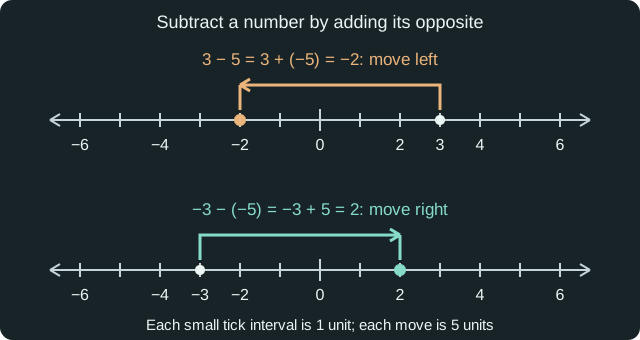
Always begin at the first number. The opposite of the number being subtracted gives the direction and length of the move. In the top drawing the result is negative; in the lower drawing it is positive. A change in direction does not by itself determine the final sign.
Worked example
Problem: Compute \(-4-(-11)\).
- Keep the starting value −4.
- Replace subtracting −11 with adding its opposite, +11.
- Calculate \(-4+11=7\): four units reach zero and seven more reach +7.
Thus \(-4-(-11)=7\). Check by adding back the subtracted number: \(7+(-11)=-4\). Adding +11 for the check would be incorrect, because the original number subtracted was −11.
Worked example: subtracting a positive integer
Problem: Find \(-6-4\).
Rewrite as \(-6+(-4)\). Both addends are negative, so their magnitudes add and the result keeps the negative sign:
\[-6-4=-6+(-4)=-10.\]
On a number line, start at −6 and move four units left. Check: \(-10+4=-6\). The difference is not −2: positive 4 is being removed, not added to −6.
Worked example: subtracting a negative can leave a negative result
Problem: Find \(-9-(-4)\).
The opposite of −4 is +4, so \(-9-(-4)=-9+4=-5\). The move is rightward, but four units are not enough to reach zero from −9.
The result −5 is greater than −9, even though it is still negative. Check: \(-5+(-4)=-9\). Avoid the shortcut “two negatives make a positive answer”; it confuses the rewritten operation with the sign of the final result.
Zero pairs give a second explanation
Problem: Model \(2-(-3)\) by removing signed counters.
Represent the starting 2 with two +1 counters. To remove three −1 counters, first introduce three zero pairs, each made from +1 and −1. Each pair totals zero, so the represented value remains 2.
| Stage | Number of +1 counters | Number of −1 counters | Represented value |
|---|---|---|---|
| Start | 2 | 0 | 2 |
| Add three zero pairs | 5 | 3 | 5 + (−3) = 2 |
| Remove three negative counters | 5 | 0 | 5 |
The result is \(2-(-3)=5\). Removing a negative contribution increases the represented value. Adding zero pairs changed the available counters, not the starting total; removing the negative counters is the actual subtraction step.
A rewrite table, not a separate rule for every case
| Original expression | Add the opposite | Result |
|---|---|---|
| \(8-3\) | \(8+(-3)\) | 5 |
| \(3-8\) | \(3+(-8)\) | −5 |
| \(8-(-3)\) | \(8+3\) | 11 |
| \(-8-3\) | \(-8+(-3)\) | −11 |
| \(-8-(-3)\) | \(-8+3\) | −5 |
| \(-3-(-8)\) | \(-3+8\) | 5 |
All rows follow the same identity \(a-b=a+(-b)\). Once rewritten, use the addition rule appropriate to the signs and magnitudes of the addends.
Zero and subtraction order
For any integer \(a\), \(a-0=a\), \(0-a=-a\), and \(a-a=0\). In particular, \(0-(-7)=7\), while \(-7-0=-7\).
Subtraction is not commutative: \(8-3=5\), but \(3-8=-5\). Reversing two subtracted values produces opposite differences. Subtraction is not associative either: \((10-6)-2=2\), but \(10-(6-2)=6\).
If only addition and subtraction remain and there are no grouping symbols, calculate from left to right. Alternatively, rewrite every subtraction as addition of an opposite before regrouping; keep each resulting signed addend intact.
Worked example: a chain and a grouped subtraction
Problem A: Evaluate \(8-(-3)-6\).
Left to right gives \(11-6=5\). Rewriting also works: \(8+3+(-6)=5\). Do not combine the last two numbers as a group unless the expression actually groups them.
Problem B: Evaluate \(6-[-3+5]\).
First simplify the bracket: \(-3+5=2\). Then \(6-2=4\). The subtraction applies to the whole bracketed value. Changing only the first term's sign and leaving the other term unchanged would not preserve that value.
Worked example: signed change versus distance
Problem: The temperature changes from +4°C to −3°C. Find the signed change and the size of the change.
For a final value \(f\) and initial value \(i\), the signed change is \(f-i\). Here,
\[\text{change}=-3-4=-7\text{°C}.\]
The negative sign indicates a decrease. The size of the change is \(|-7|=7\) Celsius degrees. Check the final temperature by adding the change to the initial value: \(4+(-7)=-3\).
Signed change and distance answer different questions. In general, the distance between positions \(a\) and \(b\) is \(|a-b|\), not necessarily \(a-b\). Coordinates must use the same reference and units.
Worked example: interpret a negative starting amount
Problem: A simplified account balance is −18 dollars. A 7-dollar charge is applied, then a 10-dollar deposit is added. What is the final balance? Assume no other fees or transactions.
The charge subtracts +7 dollars; the deposit adds +10 dollars:
\[-18-7+10=-25+10=-15.\]
The final balance is −15 dollars. The combined change is \(-7+10=3\) dollars, and \(-18+3=-15\) gives a second check. A negative initial balance is not a reason to turn a charge into a positive change.
Check your understanding
Try these before reading the explanations. These lesson self-checks do not change the separate Quizzes and Practice tabs.
- Rewrite and evaluate \(5-12\).
- Rewrite and evaluate \(5-(-12)\).
- Find \(-7-6\) and check by addition.
- Find \(-7-(-6)\). Explain why the result is still negative.
- Evaluate \(0-(-9)\), \(-9-0\), and \(-9-(-9)\).
- Evaluate \(9-(-4)-8\).
- Evaluate \(-5-[2+(-9)]\).
- An elevation changes from −8 metres to +3 metres. Find the signed change and vertical separation.
- A student claims \(-10-(-3)=13\). Identify the sign that was changed incorrectly.
- Find the integer that makes \(x-(-5)=2\) true, and check it.
Solutions and reasoning
- \(5+(-12)=\mathbf{-7}\). Five units right of zero followed by twelve units left ends at −7.
- \(5+12=\mathbf{17}\). Subtracting a negative adds a positive.
- −13. \(-7+(-6)=-13\); check \(-13+6=-7\).
- −1. \(-7+6=-1\). Moving six units right from −7 does not reach zero.
- 9, −9, and 0, respectively. Take the opposite when subtracting from zero; subtracting zero changes nothing; equal values subtract to zero.
- 5. \(9+4-8=13-8=5\).
- 2. The bracket gives −7, so \(-5-(-7)=-5+7=2\).
- Signed change +11 metres, since \(3-(-8)=11\); vertical separation 11 metres. The positive change indicates an increase in elevation.
- The starting −10 was incorrectly changed to +10. Keep it unchanged: \(-10+3=\mathbf{-7}\).
- −3. The equation is \(x+5=2\), so \(x=-3\). Check: \(-3-(-5)=-3+5=2\).
Common mistakes
- Changing both numbers' signs: Only take the opposite of the number being subtracted.
- Treating every subtraction as a leftward move: Subtracting a negative moves right.
- Assuming subtracting a negative gives a positive result: The result still depends on the starting position.
- Using an absolute value instead of a signed difference: A distance is nonnegative, but a difference can be negative.
- Checking with the wrong addend: Add back the original subtracted number, including its sign.
- Ignoring grouping: Evaluate an entire bracket before subtracting its value.
- Regrouping subtraction as if it were addition: Rewrite to signed addition first, or preserve the original grouping and left-to-right order.
- Using initial minus final for a change: Signed change is final minus initial.
Key takeaway
Subtracting an integer is adding its opposite: \(a-b=a+(-b)\). Keep the starting number unchanged, interpret the second number's sign, and apply integer addition. Check a difference by adding back the number subtracted. Distinguish signed differences and changes from nonnegative distances, and preserve grouping and subtraction order.
Continue learning
- Adding Integers: apply the addition rules after rewriting subtraction.
- The Number Line and Absolute Value: distinguish positions, opposites, and distances.
- Exponents and Order of Operations: preserve grouping in longer expressions.
- Integer Products: distinguish subtraction rules from multiplication and division sign rules.
Sources and further reading
Public textbook materials were consulted for topic coverage and teaching models. The explanations, numerical examples, tables, self-checks, and SVG diagram above were independently created. No textbook prose, exercises, or artwork are reproduced or closely paraphrased.
- OpenStax Prealgebra 2e: Subtract Integers — integer-subtraction coverage.
- OpenStax Prealgebra 2e: preface and reuse conditions — consult current restrictions before reproducing textbook material.
- Siyavula: Calculations with Integers — related signed-number calculation coverage.
- Siyavula: Integers and textbook license notice — attribution terms for textbook content; external media can have different terms.