Prealgebra · Unit 10 · Topic 10.5
Polynomials and Factoring a Common Factor
Combine like polynomial terms, factor out a greatest common factor, verify by distribution, and see why expanded and factored forms have the same graph.
What can be combined?
In \(3x^2+2x-1\), the pieces \(3x^2\), \(2x\), and \(-1\) are terms. A polynomial in \(x\) is a sum of terms whose powers of \(x\) are nonnegative whole numbers. The numbers multiplying those powers are coefficients; a nonzero constant such as \(-1\) is treated as a degree-zero term. The highest exponent with a nonzero coefficient is the polynomial's degree, so this example has degree 2. By contrast, \(x^{-1}=1/x\) is not a polynomial term.
Only like terms have the same variable part, including its exponent. To add \(3x^2+2x-1\) and \(x^2-5x+4\), first collect the \(x^2\) terms, then the \(x\) terms, then the constants:
\[ \begin{aligned} (3x^2+2x-1)+(x^2-5x+4) &=(3x^2+x^2)+(2x-5x)+(-1+4)\\ &=4x^2-3x+3. \end{aligned} \]
The powers stay unchanged: \(3x^2+x^2=4x^2\), not \(4x^4\). Adding coefficients counts how many copies of \(x^2\) we have; multiplying powers is a different operation. Likewise \(x^2\) and \(x\) are not like terms, even though both contain the letter \(x\).
Reverse distribution to expose a common factor
Distribution turns a product into a sum: \(6(x+3)=6x+18\). Factoring a common factor runs that equality backward. Both terms of \(6x+18\) are divisible by 6, so divide each term by 6 to find what remains inside parentheses:
\[ 6x+18 =6\left(\frac{6x}{6}+\frac{18}{6}\right) =6(x+3). \]
Expand to check: \(6(x+3)=6x+18\). If only the first term had been divided, the check would fail. The greatest common factor (GCF) of these two terms is 6: \(x\) is not common because the constant 18 has no \(x\).
Now take a polynomial whose terms share both a number and a variable:
\[ f(x)=2x^2+6x. \]
The coefficient GCF of 2 and 6 is 2. The terms contain \(x^2\) and \(x\), so one factor of \(x\) is common to both; two are not, because \(6x\) has only one. The GCF is therefore \(2x\). Rewrite each term as a product containing that factor:
\[ \begin{aligned} 2x^2+6x &=(2x)(x)+(2x)(3)\\ &=2x(x+3). \end{aligned} \]
The two original terms contained the same factor, so the distributive property lets us collect it outside the parentheses. No division by \(x\) is needed, and \(x=0\) remains a valid input. Expand the result to verify the identity for every real \(x\):
\[ 2x(x+3)=2x\cdot x+2x\cdot3=2x^2+6x. \]
One function, two useful forms
The expanded form \(2x^2+6x\) makes the degree and coefficients easy to see. The factored form \(2x(x+3)\) makes it easy to see when the value equals zero. If we ask specifically for solutions of \(f(x)=0\), a product is zero when at least one factor is zero:
\[ 2x(x+3)=0 \quad\Longrightarrow\quad x=0\ \text{or}\ x+3=0 \quad\Longrightarrow\quad x=0\ \text{or}\ x=-3. \]
These are the graph's two \(x\)-intercepts, \((0,0)\) and \((-3,0)\). Simply factoring the expression \(2x^2+6x\) is not the same task as solving the equation \(2x^2+6x=0\). The equals-zero condition is what permits the zero-product reasoning.
| \(x\) | \(2x^2+6x\) | \(2x(x+3)\) |
|---|---|---|
| \(-4\) | \(8\) | \(8\) |
| \(-3\) | \(0\) | \(0\) |
| \(-2\) | \(-4\) | \(-4\) |
| \(-1\) | \(-4\) | \(-4\) |
| \(0\) | \(0\) | \(0\) |
| \(1\) | \(8\) | \(8\) |
The table checks several inputs. The distributive calculation above explains something stronger: the two forms agree for every real input, not just the six shown. Consequently they have one graph, drawn below, rather than two different curves. On this coordinate graph both axes count in unit steps.
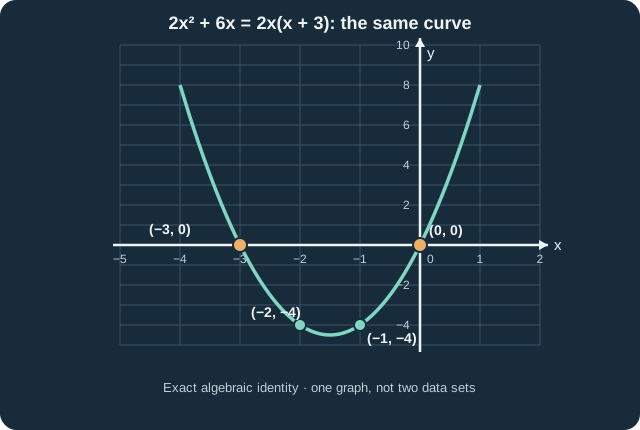
The curve goes below the \(x\)-axis between its zeros. For example, at \(x=-2\), the factored form gives \(2(-2)(-2+3)=-4\), matching the table and the plotted point. This sign check matters: \(x\) can be negative, and the factor \(x+3\) can have a different sign depending on the input.
When a common factor has a negative coefficient, it can be convenient to take out that negative sign too. For example,
\[ -3x^2+9x=-3x(x-3), \]
because \(-3x\cdot x=-3x^2\) and \(-3x\cdot(-3)=9x\). Expansion is a quick way to catch a sign error. Regardless of which equivalent factored form we choose, the polynomial's value and graph do not change.
Further reading
The definitions of terms, degree, and combining like terms were checked against OpenStax Prealgebra 2e §10.1; the GCF and reverse-distribution method against §10.6. The wording, examples, table, and graph here were independently created; textbook prose, exercises, and artwork were not reproduced.