Prealgebra · Unit 6 · Topic 6.3
Commutative, Associative, and Identity Properties
Distinguish changing order, changing grouping, and leaving values unchanged; use real-number properties to simplify calculations and test why subtraction and division need different treatment.
What do the three properties allow you to change?
For real-number addition and multiplication, the commutative property changes order, the associative property changes grouping, and an identity leaves a value unchanged. These are different reasons an expression can be rewritten without changing its value.
For example, \(6+4=4+6\) changes order; \((6+4)+2=6+(4+2)\) changes grouping; \(6+0=6\) adds an identity. These rules apply to exact real-number arithmetic, including integers, fractions, and decimals, not just positive whole numbers.
All numerical examples and the diagram below were independently created for this lesson. The symbols \(a,b,c\) in the formulas represent arbitrary real numbers.
Definitions and formulas at a glance
| Property | Addition | Multiplication | What changes? |
|---|---|---|---|
| Commutative | \(a+b=b+a\) | \(ab=ba\) | Order of the two inputs |
| Associative | \((a+b)+c=a+(b+c)\) | \((ab)c=a(bc)\) | Grouping, while input order stays the same |
| Identity | \(a+0=0+a=a\) | \(a\cdot1=1\cdot a=a\) | Adding 0 or multiplying by 1 leaves the value unchanged |
The additive identity is 0; the multiplicative identity is 1. Neither identity rule means you can replace an arbitrary number with 0 or 1. It describes a specific operation using that number.
Commutative means change the order
Addition example: \((-8)+13=13+(-8)=5\). The negative sign remains attached to \(-8\) when it moves.
Multiplication example: \((-3)\cdot7=7\cdot(-3)=-21\). Switching the factors does not change the product.
For a variable expression, \(4x=x\cdot4\) and \(x+9=9+x\). Addition and multiplication each have a commutative rule; this does not permit moving symbols across different operations without checking the structure.
Associative means change the grouping
For addition, \((2+3)+4=5+4=9\), while \(2+(3+4)=2+7=9\). The numbers stay in the order 2, 3, 4, but the pair evaluated first changes.
For multiplication, \((2\cdot5)\cdot7=10\cdot7=70\), while \(2\cdot(5\cdot7)=2\cdot35=70\). This permits a convenient choice of grouping for a product.
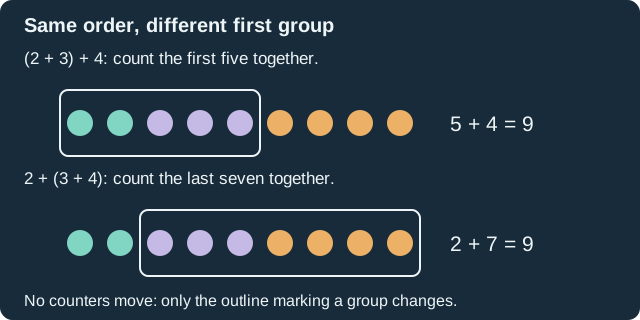
Parentheses normally specify grouping. The associative rule lets you remove or move them within an unbroken sum or product without changing the value; it does not make all parentheses optional in mixed expressions.
Worked example: identify order versus grouping
Consider \((x+5)+8\).
- Rewriting it as \(x+(5+8)\) uses associativity: the order x, 5, 8 is unchanged.
- Rewriting it as \((5+x)+8\) uses commutativity inside the first group: x and 5 switch order.
- Rewriting it as \((x+8)+5\) uses both properties when justified by regrouping and switching terms.
Name the change being made, not just the property that sounds familiar.
Worked example: make a product easier
Problem: Calculate \(25\cdot7\cdot4\) without a long multiplication.
Treat the original product as \(25\cdot(7\cdot4)\). Switch 7 and 4 by commutativity, then regroup by associativity:
\[25\cdot(7\cdot4)=25\cdot(4\cdot7)=(25\cdot4)\cdot7=100\cdot7=700.\]
The factor order changes, so this is not associativity alone. Check with the original order: \(25\cdot7=175\) and \(175\cdot4=700\).
Worked example: a convenient sum with signed terms
Problem: Calculate \(18+(-7)+2\).
Switch the complete terms \(-7\) and 2, then group 18 and 2:
\[18+(-7)+2=18+2+(-7)=(18+2)+(-7)=20-7=13.\]
The sign belongs to its term. Rewriting this as \(18+7+2\) would change the value instead of using a property.
For decimals, \(0.35+0.8+0.65=(0.35+0.65)+0.8=1+0.8=1.8\). The reordering and regrouping make a whole first.
Identity means leave the value unchanged
Addition: \(-12+0=-12\), \(\frac35+0=\frac35\), and \(x+0=x\).
Multiplication: \((-12)\cdot1=-12\), \(\frac35\cdot1=\frac35\), and \(1x=x\). The coefficient of a term written simply as \(x\) is therefore 1.
Identity is not the same as making a result zero. Multiplication by zero satisfies \(a\cdot0=0\), the zero property of multiplication, not the multiplicative identity property. Adding 1 usually changes a value; multiplying by 0 usually changes it.
Worked example: \(1(3x+2)+0=3x+2\). Multiplying the whole expression by 1 and adding 0 leave it unchanged. By contrast, \(0(3x+2)=0\).
Identity versus inverse: a useful distinction
An identity leaves a value unchanged; an inverse combines with it to produce an identity. For example, \(9+0=9\) is an identity example, but \(9+(-9)=0\) is an additive-inverse example.
For a nonzero real number \(a\), its reciprocal \(1/a\) satisfies \(a(1/a)=1\). The number zero has no reciprocal because division by zero is undefined. For instance, \(\frac38\cdot\frac83=1\); this uses reciprocals, not multiplication by the identity 1 as an input.
Why subtraction and division are not commutative
Subtraction: \(10-3=7\), but \(3-10=-7\). Division: \(12/3=4\), but \(3/12=1/4\). Switching the inputs changes these results.
Special coincidences such as \(5-5=5-5\) do not establish a property for all real numbers. A single counterexample disproves a proposed universal rule.
Why subtraction and division are not associative
Keep the numbers in the same order and change only the grouping:
\[(14-5)-2=9-2=7,\qquad14-(5-2)=14-3=11,\] \[(24/6)/2=4/2=2,\qquad24/(6/2)=24/3=8.\]
These unequal results show that regrouping subtraction or division is not generally valid. Without parentheses, evaluate consecutive subtraction or division from left to right.
Although \(a-0=a\) and \(a/1=a\), reversing these gives \(0-a=-a\) and \(1/a\), not generally \(a\). Thus 0 and 1 do not provide the same two-sided identity behavior for subtraction and division as they do for addition and multiplication.
Rewrite subtraction or division before rearranging
For real numbers, \(a-b=a+(-b)\). This lets you use addition properties while carrying each sign with its term:
\[15-6+5=15+(-6)+5=(15+5)+(-6)=14.\]
Similarly, division by a nonzero number is multiplication by its reciprocal:
\[18/3\cdot2=18\cdot\frac13\cdot2=(18\cdot2)\cdot\frac13=12.\]
Do not rewrite the original as \(18/(3\cdot2)\), which gives 3. Moving a factor into a denominator is not merely switching factors.
Keep mixed operations intact
Compare \(2+3\cdot4=14\) with \((2+3)\cdot4=20\). The associative properties do not authorize this regrouping because the expression mixes addition and multiplication.
The equality \(3(x+2)=3x+6\) uses the distributive property, not the associative property. Use the rule that matches the structure you are changing.
Common mistakes
- Calling an order change associative: Associativity changes grouping without changing input order.
- Rearranging subtraction or division directly: Rewrite as signed addition or reciprocal multiplication first, preserving the structure.
- Moving a number but dropping its sign: The entire signed term must move.
- Confusing the two identities: Add 0; multiply by 1.
- Calling multiplication by zero an identity: It produces zero rather than preserving every input.
- Ignoring mixed operations: Parentheses cannot be moved freely across different operations.
- Proving a universal claim with one example: A demonstration illustrates the rule; the stated real-number property is what justifies general use.
Check your understanding
These independently written self-checks do not change the separate Quizzes or Practice tabs.
- Name the property in \(7+(-4)=(-4)+7\).
- Name the property in \((a\cdot3)\cdot5=a\cdot(3\cdot5)\).
- Fill the blanks: \(x+\square=x\) and \(x\cdot\square=x\), for every real x.
- Calculate \(4\cdot13\cdot25\) using a convenient pair. Name the properties used.
- Calculate \(27+(-9)+3\) using a convenient pair.
- Calculate \(\frac25+\frac7{10}+\frac35\) by making a whole first.
- Simplify \(1(2x-5)+0\).
- Is \(0(2x-5)=0\) an example of multiplicative identity? Explain.
- Compare \(9-2\) with \(2-9\). What rule fails?
- Compare \((20-6)-4\) with \(20-(6-4)\). What rule fails?
- Calculate \(30/5\cdot2\). Explain why it differs from \(30/(5\cdot2)\).
- Rewrite and evaluate \(16-7+4\) as a sum of signed terms, grouping the convenient pair.
Answers and explanations
- Commutative property of addition: the inputs switch order.
- Associative property of multiplication: only the grouping changes.
- 0 and 1, the additive and multiplicative identities respectively.
- \((4\cdot25)\cdot13=100\cdot13=1300\), using commutativity and associativity.
- \((27+3)+(-9)=30-9=21\), using commutativity and associativity.
- \((\frac25+\frac35)+\frac7{10}=1+\frac7{10}=\frac{17}{10}=1.7\).
- \(2x-5\), by the identity properties of multiplication and addition.
- No. This is the zero property of multiplication; multiplying by 1 is the identity operation.
- 7 and \(-7\). Subtraction is not commutative.
- 10 and 18. Subtraction is not associative.
- \((30/5)\cdot2=12\); \(30/(5\cdot2)=3\). The added parentheses change the divisor.
- \(16+(-7)+4=(16+4)+(-7)=20-7=13\). The negative sign stays with 7.
Key takeaway
For real-number addition and multiplication, changing order uses commutativity and changing grouping uses associativity. Adding zero or multiplying by one uses an identity. These rules justify efficient calculations and equivalent expressions, but subtraction, division, and mixed operations require careful rewriting rather than arbitrary rearrangement.
Related lessons
- Variables and Algebraic Expressions: read signs, coefficients, and grouping
- Exponents and Order of Operations: preserve mixed-operation order
- Subtracting Integers: rewrite subtraction as signed addition
- Multiplying and Dividing Fractions: use reciprocals correctly
- Combining Like Terms and Classifying Numbers: rearrange compatible terms
- The Distributive Property: distinguish distribution from regrouping
Sources and authorship
The publicly accessible educational resources below were consulted for topic coverage and mathematical checks. This lesson's explanations, numerical examples, tables, self-checks, and diagram were independently created; source prose, exercises, and artwork are not reproduced. Public access does not imply unrestricted reuse: check each resource's current license before reproducing material.